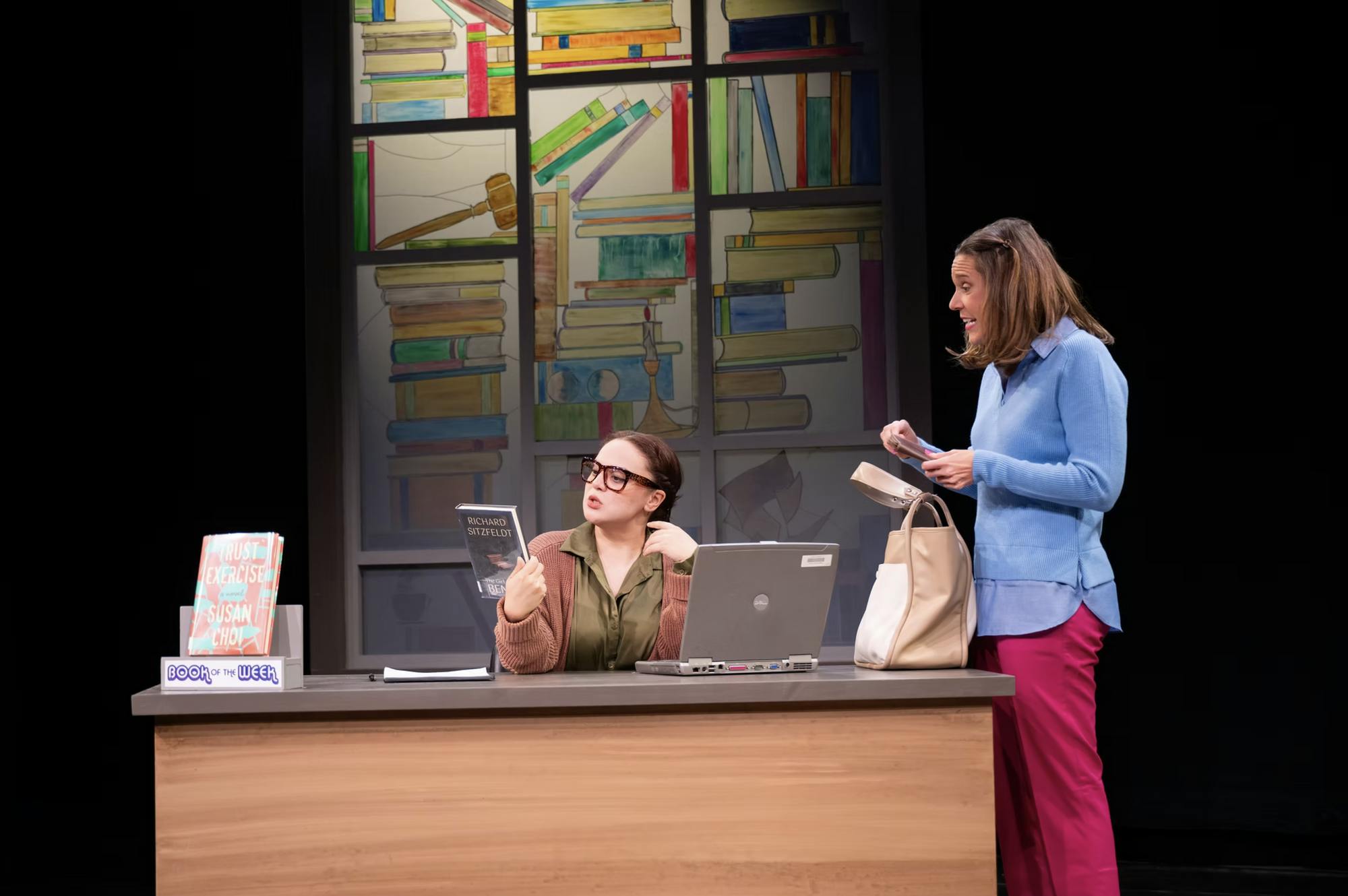
On a slow, brisk Sunday afternoon, my girlfriend and I had the pleasure of being the youngest attendees to the new play Bad Books, running at the Kitchen Theater Company until Sept. 21. The play, written by Sharyn Rothstein, follows a concerned mother meeting with the town librarian over a book recommended to her son that she deemed to be obscene. The play continues over a series of consequences from the original interaction, following the impact that the craze over censorship has on their lives and communities. The Kitchen, a small blackbox theater that could feel limiting, sets a meaningful and deliberate intimate tone for the production. It’s a two actor production, with a simple set and costuming, that creates an unassuming aesthetic that places the story anywhere in the country.
The mother played by Catherine Dubord and the librarian played by Spinks, allow their ideological conflict to go past typical lines of liberalism and conservatism. The conflict at the core of this story is what it means to be a caregiver in a child's life; where and when a parent or an educator can step into a child’s life, and where they must step back. The play largely follows the role of the mother, weighting the consequences of her pushback against the library more than that of the librarian. Dubord does an excellent job displaying her struggle to hold down her values whilst her community disentangles before her, yet the unbalance of the two stories feels like a deviation from the original idea of the show. There are multiple, heavily serious topics that delve from the mother’s arc, such as her past life as an author and the uncertain future of her son, that feel like unrealistic progressions from the main conflict, incredibly serious situations build up too large of an exacerbation from the beginning of the play. The two actors speak in a manner that is almost Shakespearean, an incredibly presentory way of speaking that requires the entire development of the show to justify. At the beginning of the show, it feels almost too theatrical, making the audience hyper-aware of the play. It reads almost like a speech and debate tournament at first, a reciting of argument points rather than a seamless conversation. This style of speaking is unraveled as the library grows into a public spectacle and the two women’s lives start to unravel. This represents a development away from the women reciting their belief systems, into an expression of their direct experience.
Director Emily Jackson is intent with the direction of this show directly outlining the argument of both women, allowing for their opinions to be realistically implied to the real world. Whilst the argument of censoring books certainly works against the mother’s original motivation, the play would serve more with both women feeling the burn of pushback against their ideals. What uplifts this play the most is the moments when the lines are blurred.To establish a clear winner and loser of the conflict is to disregard a balance of value that feels key to the show’s main idea. Nevertheless, Dubord and Spinks bring a quickness and energy that keeps the audience hanging on every word. Spinks, who plays three characters throughout the show, establishes a clear and unique personality and physicality for each one, highlighting the difference of opinion that any person could have on this conflict. Dubord’s portrayal of the mother has the perfect amount of heart and misguided care that she has on her family, she displays a dedication to be believed and taken seriously that she does not back down from. Bad Books serves as a worthy and meaningful introduction to the conflict of book censorship, finding the heart of the conflict in a manner that refuses to be fearmongered. It tackles the conflict at its surface, and hits it where it matters.
Caroline Murphy is a sophomore in the College of Arts and Sciences. She can be reached at cqm8@cornell.edu.