


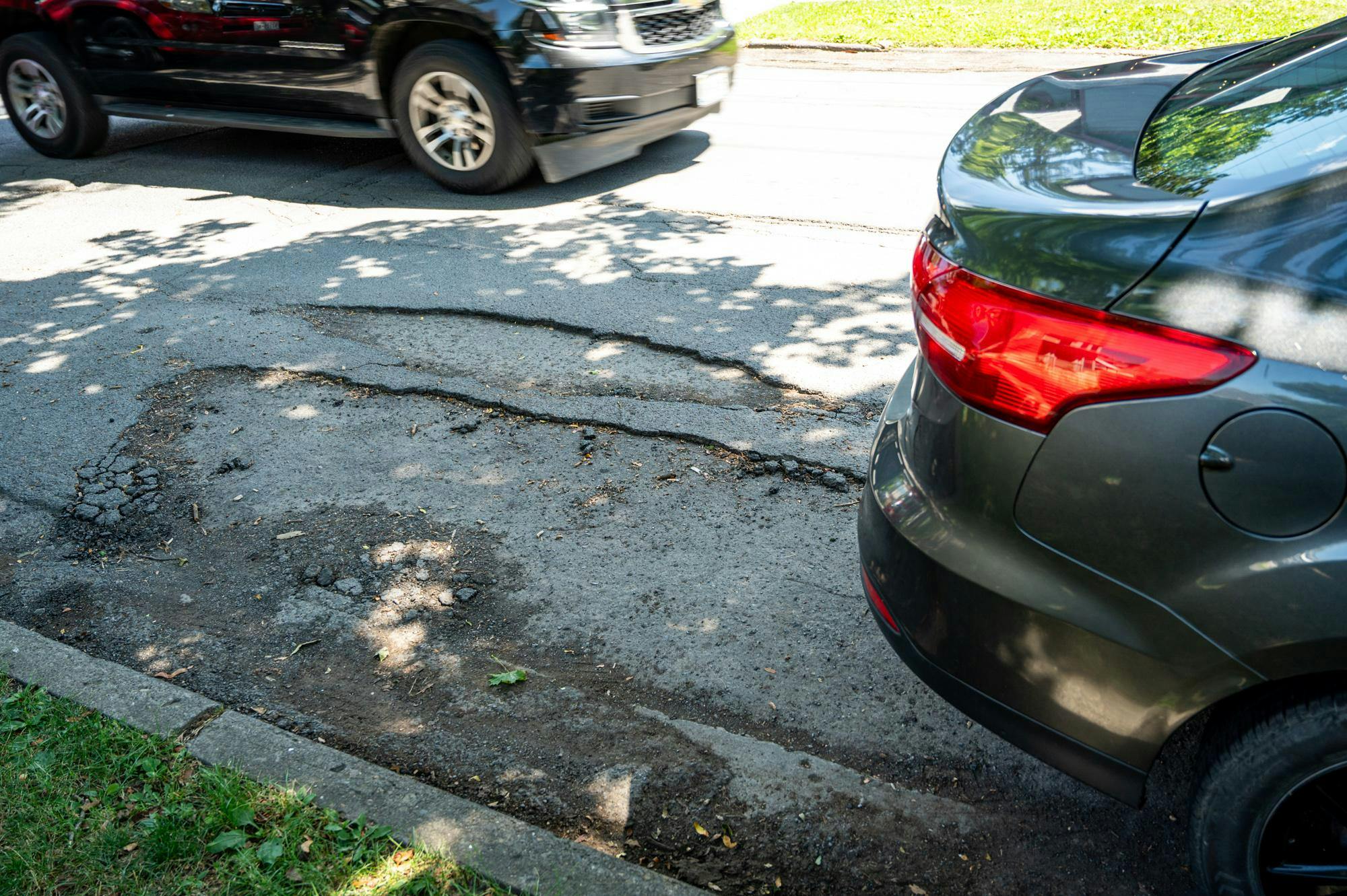
Potholes, one of Ithaca’s most contested issues, have become a notable part of the city’s landscape. However, while city roads are riddled with cracks, pits and ruptures, the City of Ithaca doesn’t need to pay for damage caused by these road imperfections — including for injuries or vehicle damage — according to its charter.
Potholes are the product of uneven and cracked roads. They occur when water seeps into cracks in the road and expands when temperatures drop. When vehicles drive over these cracks filled with frozen water, the area pops, creating a pothole. Potholes can cause injuries or damage when they create an uneven surface for riders and vehicles.
Preventative road fixes, such as crack sealing and surface treatments, can be short-term fixes. Major rehabilitation to roads and complete reconstruction have longer-term benefits, but can be more costly.
Denise Katzman, an Ithaca resident of seven years, filed an insurance claim in June after hitting a pothole with her bike. Katzman travels by bike as her primary mode of transport around the city, she told The Sun in an interview.
Katzman was biking when she hit a pothole on North Plain and West Buffalo Street in March. The pothole caused her bike's back tire to split open, with the inner tube completely destroyed. But after filing an insurance claim, Katzman was not granted any money.
According to information obtained by The Sun from the City of Ithaca, Katzman was one of 49 individuals who submitted claims for potholes or road imperfections that caused damage or injury in Ithaca since 2021 based on Travelers General Liability loss runs. Only two individuals ended up receiving money for their claim.
Katzman noted that, under a rarely known section of the Ithaca City Charter, individuals can only win these claims if they can prove the city had formal written notice, delivered by mail or in person, of the pothole at least 24 hours before the incident.
§ C-107 of the Ithaca City Charter: “Liability for damage or injury occurring on City property,” states that the city is not liable for damage or injury that is a consequence of city-owned property, such as any street, highway, sidewalk or crosswalk. This includes damages due to city-owned property or structures being out of repair, unsafe or “obstructed by snow, ice or otherwise or in any way or manner, including but not limited to protruding pipes, metal plates or covers or other objects,” as written in the charter.
This exemption applies unless written notice of the “defective, unsafe, dangerous, obstructed or concealed conditions” is given to the City of Ithaca by delivery to the office of the City Clerk at least 24 hours prior to the damage or injury.
The Ithaca-Tompkins County Transportation Council, which is in charge of facilitating county-wide transportation planning, does not own or control infrastructure like roads or bridges. Instead, the ITCTC collaborates with state, county and municipal staff to help them secure federal funding for projects they identify as necessary.
According to Fernando de Aragón, staff director of ITCTC, federal funds are limited and their use is highly regulated. According to de Aragón, the federal funds are usually programmed with larger projects that need the extra financing assistance.
“Federal funds are not targeted to address pothole prevention specifically,” de Aragón wrote. “That comes along with adequate construction and maintenance of pavement.”
Only projects using federal funds are included in the Ithaca-Tompkins County Transportation Improvement Program, while state and local funds can also be used by local governments for other projects. The TIP is a five-year program of federally funded surface transportation projects, which is updated every two to three years.
The new TIP takes effect Oct. 1, 2025 to Sept. 31, 2030. The program includes 18 highway projects, 14 of which are continuations of the current TIP, while four were identified through the ITCTC’s project proposal, evaluation and selection process. The projects total $56,674,743.
None of those millions of dollars goes directly towards repairing potholes, which remain an ongoing issue to Ithaca residents.
Now, while she still rides her bike to commute, if Katzman sees something that is too difficult to traverse around, she will “stop and get off [her bike], because riding on the streets is more than enough of a challenge.”
“I have been in Ithaca seven years,” Katzman said. “My bike is my primary form of transportation. I’ve been traversing all of this. It’s not just potholes — it’s sinkholes, craters, streets that are splitting down the middle.”

Cereese Qusba is a member of the Class of 2027 in the College of Arts and Sciences. She was a news editor for the 143rd Editorial Board and is a senior editor for the 144th Editorial Board. She can be reached at cqusba@cornellsun.com.


