


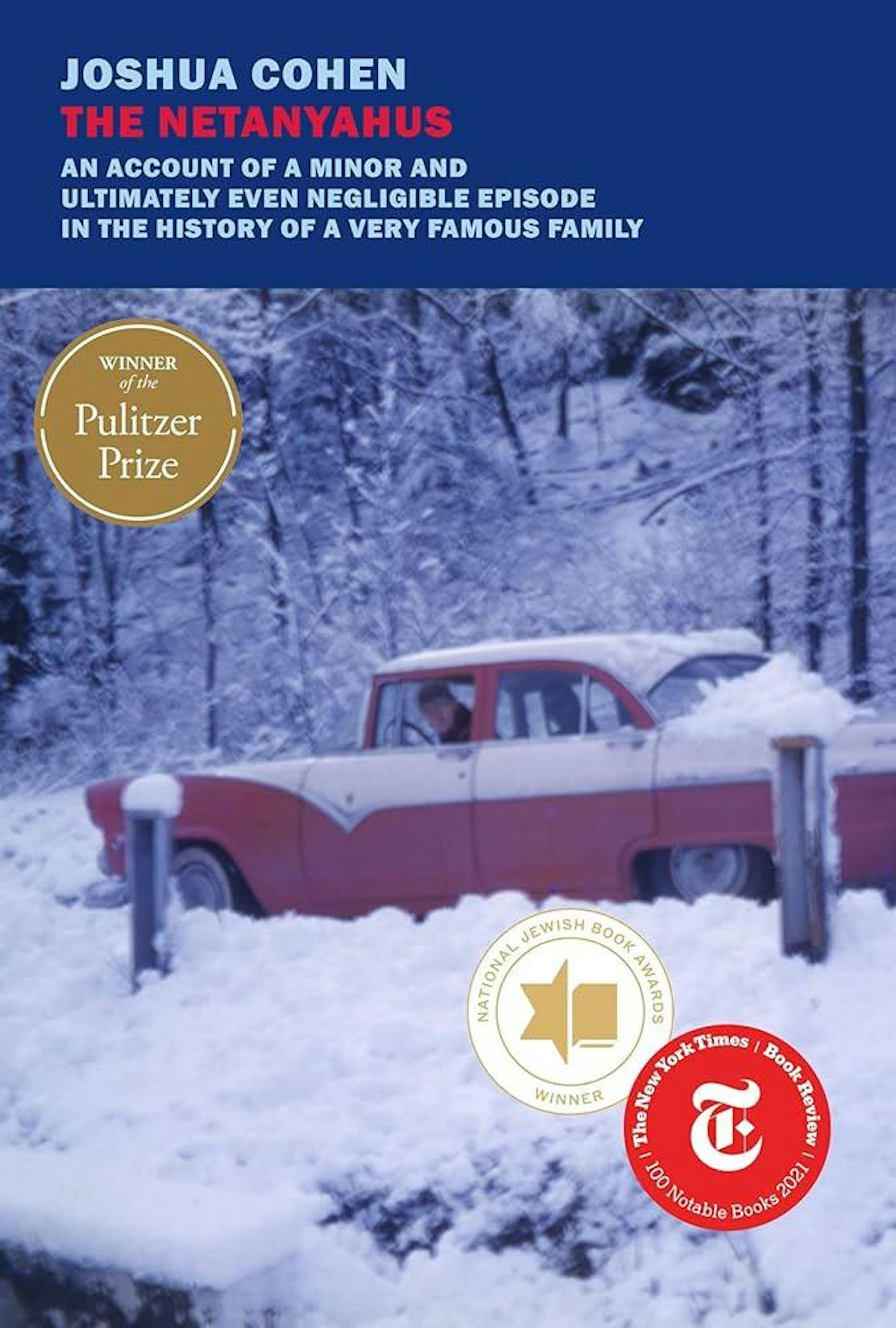
From 1971 to 1975, a man by the name of Benzion taught at Cornell University, serving as Chair of the Department of Near Eastern Studies. His second-born son, Benjamin, would go on to become Israel’s prime minister. He is also the subject of a Pulitzer Prize-winning novel.
In 2021, a man by the name of Joshua published a novel about a professor at an upstate New York university. A Cornell University student, Dina, would go on to interview him. He is also the recipient of the 2022 Pulitzer Prize in fiction.
Cohen’s novel The Netanyahus: An Account of a Minor and Ultimately Even Negligible Episode in the History of a Very Famous Family depicts a fictionalized episode of Benzion Netanyahu’s life. Based on Harold Bloom’s experience with the Netanyahu family, Cohen blends the real with the fictitious and the very real, telling both a comedic and serious tale complete with Jewish flair.
Instead of Cornell, Cohen sets his novel at Corbin College, still upstate New York, but nearing Pennsylvania. His main protagonist, Corbin history professor Ruben Blum, has been tasked with joining the hiring committee of a potential history professor, Benzion Netanyahu, who brings his whole family (his wife and three sons) in tow to Corbin with him to endure the hiring process.
I met Cohen in January of this year at an event celebrating Franz Kafka in New York City, where he read his Kafkaesque short story, “Return to the Museum.” With full intentions of writing this article, he was kind enough to grant me permission to contact him to discuss his novel. Below are some insights which Cohen gave me about his work, his writing process and the world in which we exist.
In telling this story about a microcosm of history, Cohen aimed to demonstrate how “the figures that come to, that take on a symbolic weight and that come to represent certain ideologies or certain strains of thought, that their shorthands, their metonymies… they're not as interesting as the forces behind them,” Cohen said. “The person himself is like a synecdoche of something. And so I was more interested in speaking about the world that created him [Benzion Netanyahu] as opposed to him himself, [who] like it or not, is a person who exists.”
For his campus novel “written at the intersection of history and gossip,” Cohen faced research challenges. He said that no one was interested in this niche part of history. A lot of the process, he explained, involved him bringing food to older people and talking to them about their experiences with people/ideas relevant to the book.
As a fiction writer, who says, “I always just write to make myself happy or to drive myself crazy, some admixture of happiness and craziness,” Cohen has been able to identify particular historical niches and explore those through his writing, and this novel is no exception.
“There are vast parts of everyone’s life I think that are unknowable and one of the pleasures is to find out where the gaps are in the historical record and invent into them,” Cohen explained. “In other words, first find the size of your ignorance, first find the size of the world’s ignorance and then that becomes the frame of your book and then you can create within this blank spot. I think a lot of my work is trying to find where those blind spots are, where those blanknesses are, where those lacuna are, and then make something that fits into them.”
The novel is filled to the brim with Jewish history, references and idioms. However, Cohen believes that stories often resonate across cultures.
“We live in a culture where everything is mainstreamed and defanged, where there's an attempt to always make something translated or translatable. And yet at the same time, there's a fetishization of authenticity, whatever that means, you know, that indefinable term,” Cohen said. “I think people can sense deeply on a very animal level when something feels genuine to someone's emotion and when someone's interest, however perceptibly ethnic or niche, actually represents the fullness of their human reality. And I think that there's an attraction to that.”
Benjamin Netanyahu, who makes a small yet prominent appearance in Cohen’s novel, has been a hot-topic in recent history due to his role as Israel’s prime minister during the ongoing 2023 Israel-Hamas War.
In the year following the start of the war, the highest recorded number of antisemitic hate crimes were committed in the US, according to the Federal Bureau of Investigation.
Despite this increase, Cohen believes that antisemitism, rather, has always been high. He recalls his father, who could not attend US law schools of his choice due to Jewish quotas at higher-education institutions. However, today, he believes we are in a period of time in which antisemitism has become permissible.
“There has always been profound antisemitism or Jewish hate in the world, and only really in specific periods does it become socially acceptable to and even socially expedient to express… Suddenly the floodgates come open,” Cohen said.
In this era, Cohen believes that language precision is crucial.
“There’s a real necessity to be sure about my language. And the language slips every day,” Cohen said.
Cohen, who often puts his likeness into his own work, says that the art of being a fiction writer is creating your own reality. The Netanyahus, which seamlessly blends Cohen’s imagination with real life, illustrates how language, when wielded responsibly, has the power to create intricate and nuanced stories.
“Realism is the ability to delude myself that my reality is reality,” Cohen said.
Dina Shlufman is a junior in the College of Arts and Sciences and can be reached at dfs225@cornell.edu.
Dina Shlufman is a member of the Class of 2027 in the College of Arts and Sciences. She is a senior writer and was an assistant news editor for the 142nd Editorial Board. She can be reached at dshlufman@cornellsun.com.


