

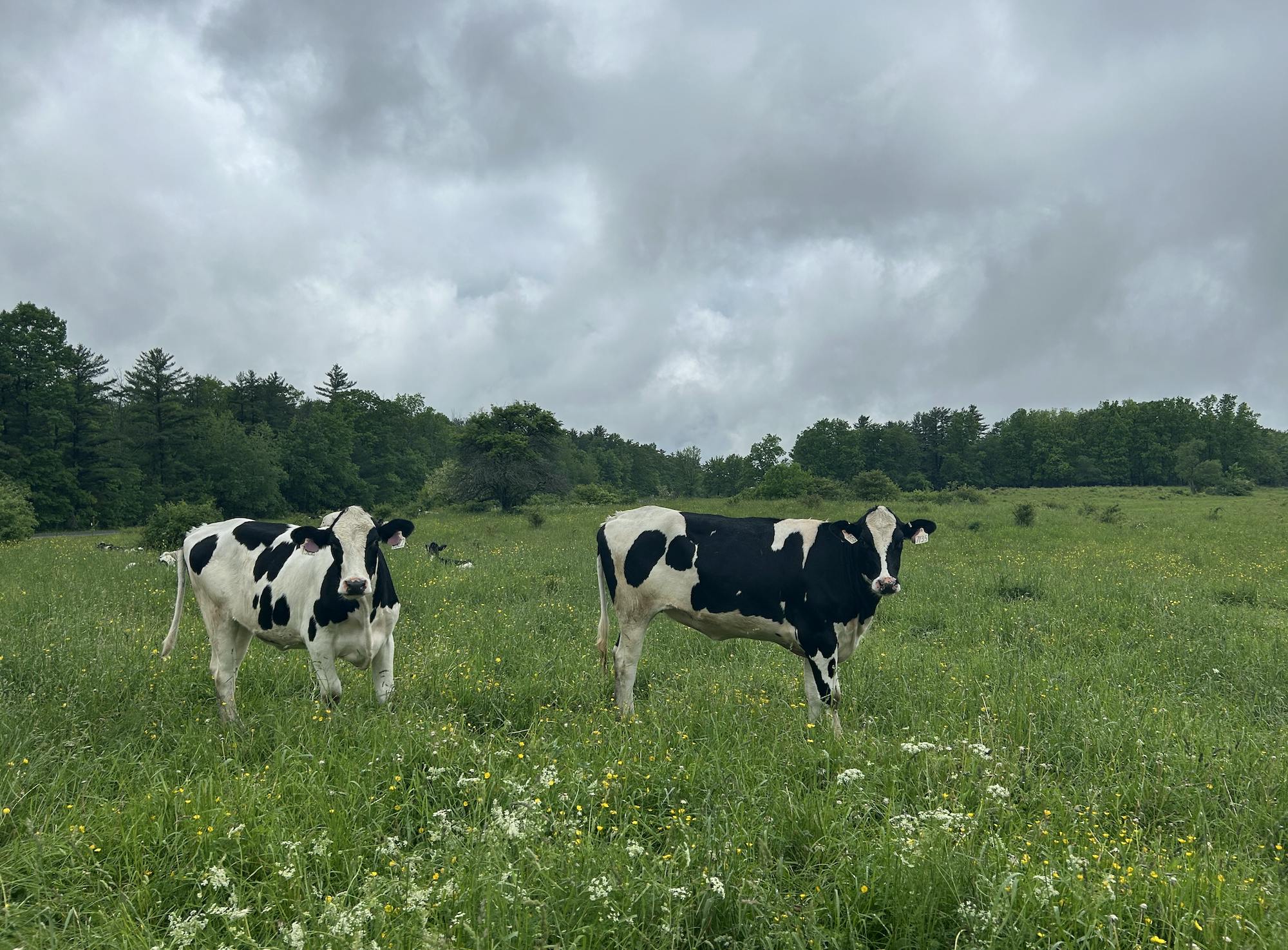
If you’ve ever come across a cow or two during a hike in the Finger Lakes National Forest, you may have asked yourself “Is this real life?” And though the blending of cows and outdoor recreation may seem mutually exclusive, they are anything but.
A Forest in Common(s)
Nestled between Cayuga and Seneca Lakes, the Finger Lakes National Forest is the only national forest in New York State and the second smallest in the country, covering about 16,200 acres. According to Jim Fravil, an Ovid beef farmer who has been grazing his cows in the Forest since 1980, through a 10-year allotment management partnership with the Hector Cooperative Grazing Association, farmers pay just over $100 per cow to let their herd roam in designated areas of the forest — totalling 4,800 acres — from May 15 through October 15.
In essence, the Finger Lakes National Forest is a commons held in public trust by the U.S. Forest Service. The HGA formed unofficially in 1943 but wasn’t incorporated as a cooperative until 1946. Now, 80 years later, we can look back, as a retrospective of sorts, to see how this experiment has worked as a tenure model adapted to promote both ecological and social wellbeing.
State trust land forms a significant portion of the landscape in the United States, especially in the West. In Nevada, Alaska, California and other states, this model of utilizing public lands for grazing is a popular method of increasing access to farmland for farmers and for providing conservation management through cows doing what they do best — munch away on flora.
Grazing as Stewardship
Sound land stewardship practices have many ecosystem services and can prevent erosion, restore the soil and sequester carbon, encourage the growth of native plant varieties and support widespread diversified land use. As secure access to farmland becomes an increasing concern for farmers nationwide, a cooperative approach to securing grazing land can be a remedy. All-in-all, this multifaceted low-hanging fruit approach has worked for all involved.
Fravil relishes the opportunity to feed and house his cattle on public lands and recalls its myriad benefits, many of them economic.
“Where else can you feed an adult cow for that price for five months? We couldn’t own enough land to raise the cattle herd as big as we were. We just couldn’t make it work,” Fravil said.
Farmers must meet a bottom line in order to continue farming and, according to Fravil, that hasn’t changed and it doesn’t look like it ever will.
“[The program] works for the Forest Service, for the HGA, and for the farmers. We get a cow fed, HGA takes care of a lot of the mowing and maintenance, and the USFR gets their land managed and native species, like the White-crowned Sparrow, remain protected,” Fravil said.
Changing Landscapes, Changing Herds
Participation in the program has dropped in recent years, as herd sizes and dairy businesses across New York have grown and been consolidated. Fravil attributes this to the “get big or get out” mindset that became prominent following major agricultural policy shifts in the mid-1970s, which encouraged farmers to expand operations to remain competitive. Today, with limited resources available and a continued reliance on generational wealth, supplemental income from a spouse or another job to shape access to land and other assets needed, it’s hard to be a farmer in New York. Fravil knows this well. With the rise of cattle prices, farmers feel increased pressure to take specialized care of their herds, which now means that many prefer to house them on their own land.

According to Fravil, the HGA doesn’t run a perfect program, but it works. There are limitations to employing good agricultural practices, like rotational grazing and more intentional water management, but for Fravil, the HGA program meets his needs. This sentiment is echoed by Brett Chedzoy, senior resource educator with Cornell Cooperative Extension, which, located in every county of New York, works to connect research and resources at the University with those in the farming community and to other small businesses.
For Chedzoy, supporting statewide forestry, agroforestry and grazing efforts means sharing practices he’s passionate about and uses on his own farm. Chedzoy has been supporting the work of the HGA as well as a larger push for agroforestry practices for over 30 years.
“As an extension forester, I’ve been studying the ways we can grow a quality future forest and the method used with the Finger Lakes National Forest not only functions as a way to browse off invasive woody shrubs but can also support good deer management,” Chedzoy said. The habitat we’re maintaining in our grasslands through grazing supports wildlife species that are of significant interest to us.”
Overall, the legacy of this experiment shows the multifaceted benefits of alternative farmland access, and mirrors today’s calls for land reform. New Deal-era efforts, like this one, were largely radical at the time, and still are to many today.
From Collapse to Commons
Around the turn of the 20th century, the U.S. government revised its approach to speculation and land management through a series of bills that resulted in the creation of the National Forests. The 1891 General Revision Act flipped 50 million acres of private land into public trusts, allowing the government to directly control saleable commodities as well as their capacity for extractive and consumptive activities like logging or using water for irrigation or power.
Around the 1930’s, farming across the United States took a turn, as depleted and overworked soil stopped supporting the agricultural production that farmers relied on to make a living. Parcels fell into rapid decline and the few farmers who stayed in the area now known as the Finger Lakes National Forest struggled to rehabilitate their tired fields. The federal government, primarily concerned with American GDP and agricultural productivity, decided to purchase this farmland as part of a large-scale effort to rehabilitate it, all in the name of competing with Europe’s small grain production.

The Interloken Trail is the longest trail located completely within the boundaries of the Finger Lakes National Forest.
The Bankhead-Jones Farm Tenant Act of 1937 was passed to address these problems and allowed for the creation of the Resettlement Administration, which worked to relocate farmers — and their entire families — to better lands and different jobs. Between 1938 and 1941, over 100 farms were purchased along this Seneca-Cayuga backbone and by turning the land into a national forest with the eventual coordination of the HGA, the government worked to demonstrate the ways in which grazing can support improved soil and food production concurrently. Political opposition to these efforts scaled back ambition, and over time, federal landholdings became focused more on conservation and grazing rather than redistribution, and food production and conservation work were kept separate.
Keeping in mind the millennia of violence of Haudenosaunee people, who utilized the land for hunting territory for over 10,000 years and were swiftly dispossessed through the 1830 federal Indian Removal Act, it’s important to understand that the many layers of land reform leading to communal usage have not always been done in the name of local development or wellbeing. And still, the HGA continues to consider the ways in which this legacy of colonialism and dispossession can be repaired.
The Case for a Cooperative Future
In many ways, the HGA can act as a model for land reform going forward, supporting both conservation and rural development. Strategic and sound livestock management changes the overall impact on the land. Ruminants, including cows and other grass-digesting animals, have co-evolved with grasslands, shaping and sustaining ecosystems over time. Grazing, species and land management can prevent ecological degradation, ultimately altering the plant species that can flourish over time as well as supporting nutrient cycling and carbon storage in the soil. Grasslands can also act as carbon sinks — or reservoirs that can absorb more carbon dioxide from the atmosphere than what’s released.
Overall, a hungry cow stimulates new grass growth, ultimately supporting enhanced biodiversity, and acts as a climate solution for our natural and working lands. In terms of social impact, the Finger Lakes National Forest offers an example of land reform efforts — by increasing access to land through management of the commons, prioritizing elements of flexibility and decentralized administrative management that continue to support small beef producers like Fravil.


