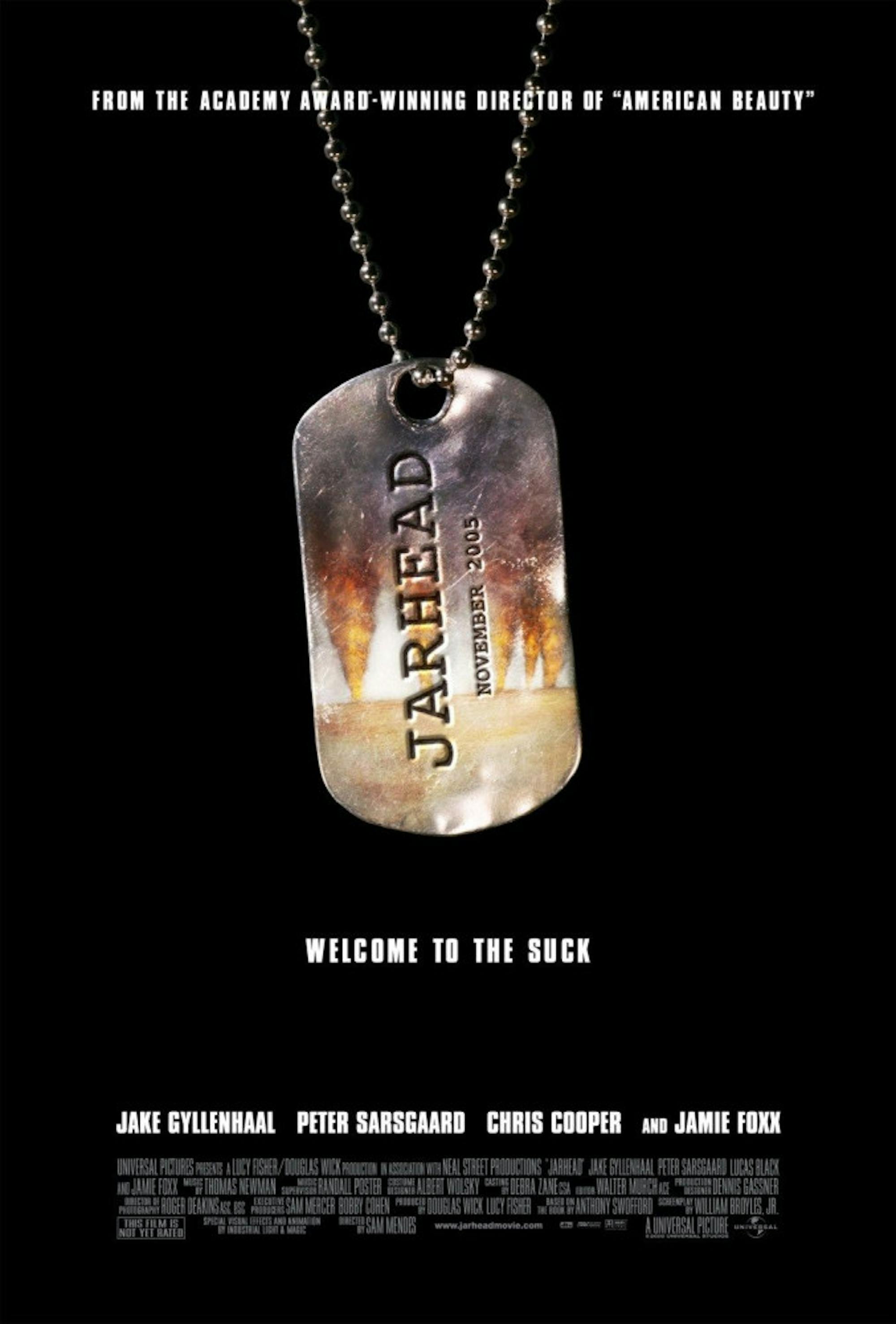
“A story.
A man fires a rifle for many years, and he goes to war.
And afterwards, he comes home.
And he sees that whatever else he might do with his life:
Build a house.
Love a woman.
Change his son's diaper.
He will always remain
…a jarhead.”
— Anthony “Swoff” Swofford, Jarhead (2005)
Smoke plumes billow from the distance, a dusky silhouette sinks into the ablaze, molten gold horizon. Opaque, viscous crude oil oozes from the sky, entrenching charred and decayed bodies, coating dog tags and stinging the eyes and skin of every Marine until they are virtually and irreparably unrecognizable — inside and out.
It must be made clear that Jarhead (2005) is no classic action movie about Operation Desert Storm, nor should it be taken as such. It is neither a glorification of war nor a thrilling spectacle of military prowess. Rather, it is an anti-war film disguised as a warmonger movie — a meditation on the existential ennui of soldiers, the dissonance between the call to arms and the inaction that often follows. It strips away the traditional Hollywood heroism that pervades films like Top Gun: Maverick (2022) and Black Hawk Down (2001), offering instead a vision of war that is dull, alienating and psychologically grating.
What fundamentally separates Jarhead from those films? It was not funded by the U.S. Department of Defense.
Hollywood has long been intertwined with the American military-industrial complex, an unspoken yet reciprocal relationship that ensures a steady stream of war films casting U.S. military operations in a favorable light. In 1953, President Dwight D. Eisenhower wrote, "The hand of government must be carefully concealed, and, in some cases, I should say, wholly eliminated" and that "a great deal of this particular type of thing would be done through arrangements with all sorts of privately operated enterprises in the field of entertainment, dramatics, music, and so on and so on." The result? A film industry that serves as an unofficial propaganda arm of the U.S. military, offering audiences a highly curated depiction of war — one filled with noble sacrifices, tactical brilliance and unwavering camaraderie.
Top Gun: Maverick, for instance, received extensive support from the monopolistic control that the U.S. Navy has over armaments, with access to real fighter jets, aircraft carriers and military advisors to ensure an optimal portrayal of American air superiority. Black Hawk Down, depicting the 1993 Battle of Mogadishu, was similarly crafted with Pentagon assistance, showcasing a high-intensity, action-packed narrative of American soldiers caught in the throes of combat. Both films are designed to be immersive and emotionally stirring, reinforcing the notion of war as an arena of heroism, self-sacrifice and moral certainty.
Jarhead, however, diverges from this formula entirely. It does not bask in the glory of combat because there is none.
The soldiers in the film do not engage in firefights, execute daring rescue missions or emerge as victors in climactic battles. Instead, they wait. They train, they haze each other, they burn time (and each other) in the desert, longing for action that never truly arrives. The film meticulously captures the restless anticipation, the paranoia and the sheer monotony that define a soldier’s life as much as combat itself does.
This authenticity stems from the film’s source material, Jarhead: A Marine’s Chronicle of the Gulf War and Other Battles, a memoir by Anthony Swofford, who served as a scout sniper during the First Gulf War. His account is deeply introspective, detailing the psychological toll of warfare, the loss of self and the way that military experience seeps into a soldier’s identity long after they leave the battlefield. This sentiment — of never truly leaving war behind — is what lingers most hauntingly in the film.
Members of the United States Marine Corps subreddit have described Jarhead as "scarily accurate." While individual experiences vary, the depiction of relentless boredom, harsh conditioning and acute mental fatigue resonates deeply with many veterans. The film does not adhere to the traditional war narrative because war itself does not adhere to a single story. Every war is different, yet every war is the same:
THIS IS MY RIFLE. REPEAT AFTER ME. SAY THE FUCKING WORDS.
THERE ARE MANY LIKE IT, BUT THIS ONE IS MINE.
WITHOUT MY RIFLE, I AM NOTHING.
This creed, drilled into every Marine in the film, encapsulates the paradox of military service — the weapon becomes an extension of the self, yet the self is simultaneously diminished in its presence. In Jarhead, the rifle is not fired in battle but remains an ever-present symbol of identity, duty and disillusionment.
Because no matter what else he may do with his life, a soldier will always remain… a jarhead.
Aima Raza is a sophomore in the School of Industrial and Labor Relations. She can be reached at ar2548@cornellsun.edu.
Aima Raza is a member of the Class of 2027 in the School of Industrial and Labor Relations. She is a staff writer for the Arts & Culture department and can be reached at araza@cornellsun.com.