Few can say they’ve woken up each day for 30 years to work the exact same job and enjoyed it.
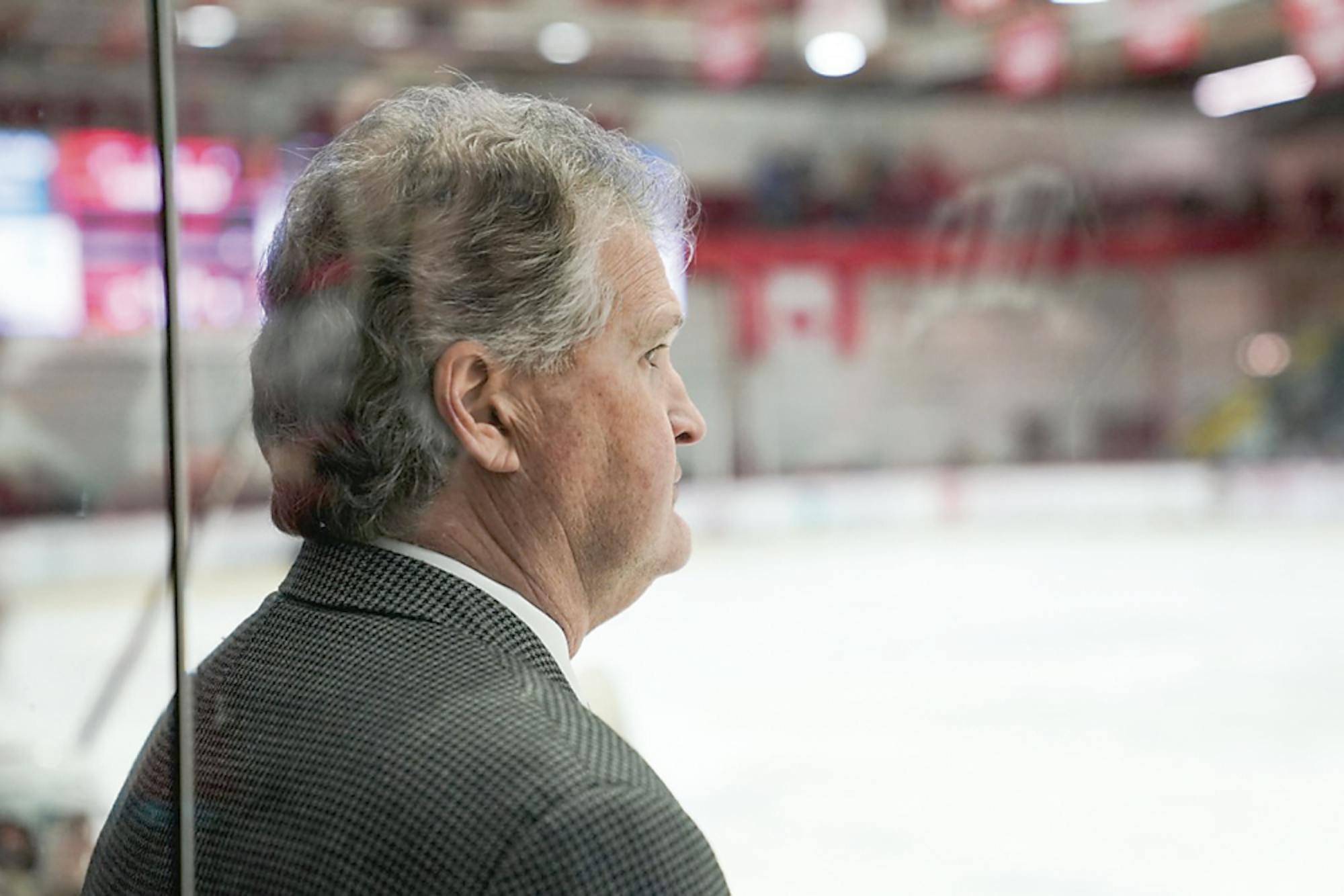
Head coach Mike Schafer ’86 can. And when he announced his predetermined retirement on June 13, despite spending nearly 40 years on East Hill as both a player and a coach, many were shocked by the announcement.
“I’m on the back nine here,” Schafer had said following Cornell’s ECAC Championship victory on Mar. 23, 2024.
What few know is how close Schafer was to hanging up his skates and whistle shortly after the 2023-2024 season. The departure of former associate head coach Ben Syer in April found Schafer at a crossroads.
“It’s been a wild ride since the end of last year, starting with Ben Syer getting the head coaching job at Princeton,” Schafer said. “At that time, [I was] thinking, ‘I’m ready to retire.’”
Yet the departure of his longtime coaching accomplice and fond friend challenged Schafer to adopt a new perspective that focused on the well-being of a program — his alma mater — that he had committed years and years of work and effort towards.
With the assistance of Athletics Director Nikki Moore, the program zeroed in on Casey Jones ’90 as Schafer’s successor, announcing in June — alongside his retirement — that Jones would be Schafer’s associate coach in 2024-2025 before replacing him at the helm for 2025-2026.
“The recruits, our players [and] our alumni all know who's going to be the head coach the following year,” Schafer said.
A relatively atypical way of announcing retirement, what Schafer is inevitably faced with is the idea of a “last dance” — familiarized by the popular 2020 Michael Jordan documentary, the term is coined as a way of commemorating one final push towards greatness.
With Cornell poised to make a run at a national title in returning almost its entire 2023-2024 squad, Schafer is tasked with juggling the narrative — and knowing — that each milestone he checks off this season will ultimately be his last.
In an almost stoic fashion, though, Schafer doesn’t plan on letting that stray him from his course. At least, not yet.
“It’s the same thing I tell my players — I’m not looking to the future. I’m not looking to those things,” Schafer said.
Retirement, on a lighter note, does lift the burden of the many pedantic things that coincide with running a Division-1 hockey program — from scheduling, recruiting, travel and so much more.
“Some of the things I've grown tired of, which is scheduling, recruiting, budgets and, you know, staff department meetings and trainings and that stuff is like — that's great. That's the last time I have to do that. That's been exciting,” Schafer said.
The ebbs and flows of the program have certainly taken a toll on the head coach, especially since the COVID-19 pandemic. The toll of the 2020-2021 season shutout is still being felt today, as Ivies continue to reconcile with the effects it left on recruiting especially. Many of Cornell’s seniors are currently spending their eighth and ninth semesters on East Hill in efforts to preserve eligibility after they missed their freshman year.
It’s undoubtedly been a struggle for the program to return to the national prestige it held when the 2019-2020 season was shut down. Schafer himself had a battle with COVID-19 in the 2021-2022 season which caused him to miss the latter part of the season which ended in an upset in the ECAC quarterfinals against Colgate.
“[As for] the recruiting aspect — I realized very quickly how much self-stress I was putting on myself, thinking about our recruits and how they're developing. … You know, are they going to make an impact? Are they going to carry our program forward?” Schafer said. “That's taken a huge amount of stress off.”
The storylines are endless, and the narrative nearly writes itself: the Red have an opportunity to contend for a national title with a legendary coach in his final season. Can Schafer finally reach his second Frozen Four of his tenure in a year where it matters most?
The way in which the media can frame his season is indubitably overwhelming, yet Schafer remains steadfast and committed to not dwelling on the headlines. Schafer has always been one to focus his players on their craft and ignore all the rankings, polls, individual awards and more. Perhaps it’s been the recipe for success for Cornell in becoming a national powerhouse.
“I just don't know where that journey is going to take us, but I'm not worried about it,” Schafer said. “There's an old saying: ‘If you want to see God laugh, tell him your plans.’ And for me, my plans are just to stay in the moment each day. And if I do that, and our team can do that, it always leads to success for us.”
Schafer has, of course, battled all kinds of adversity over the years. He quickly elevated the program to national prominence, winning five ECAC titles in 15 years before enduring a 14-year wait for the next one that came in 2024. He has tolerated a global pandemic and the heartbreak that came with watching the No. 1 team in the nation get robbed of an opportunity to contend for a national title.
Still, there are things to be learned, even after three decades.
“You never stop learning,” Schafer said. “I learn stuff from other coaches in our department about recruiting. I learn stuff from fundraising from our fundraisers. I learn stuff from Casey [Jones]. I learn stuff from Sean Flanagan. I learn stuff from Corey [Leivermann]. I learn stuff from watching NHL, hockey. If you stop learning in this business, you're in trouble.”
The year will be another one full of new lessons, both in life and in hockey. Schafer, although the style of play of his teams has remained relatively unchanged as years have passed, his style of coaching has adapted.
“I'm excited to hear different guys’ ideas and approach something differently. Do something different. … [It’s been] 30 years. I'm a way different coach than I was 30, 15, 10 and five years ago — much different,” Schafer said. “You keep evolving and keep getting better, and that's [what] we're still doing.”
So as the team prepares for puck drop on its 2024-2025 season, with Schafer leading the way alongside his new-look coaching staff, few things will look different when you look on the ice. Off it, though, as the program turns a new leaf in less than seven months’ time, blocking out the noise will be a challenge.
“It's a challenge for them, and it'll be a challenge for me,” Schafer said. “It's kind of looking forward to that challenge.”
Jane McNally is a senior editor on the 143rd editorial board and was the sports editor on the 142nd editorial board. She is a member of the Class of 2026 in the College of Agriculture and Life Sciences. You can follow her on X @JaneMcNally_ and reach her at jmcnally@cornellsun.com.