



It doesn’t matter that junior forward Jonathan Castagna is one of the best faceoff men in the NCAA.
It doesn’t matter that his 63.9% win rate is the best among all college hockey players with at least 300 faceoff wins — 338 and counting, good for 12th most in the NCAA. Or that he is one of four players in all of college hockey who have won more than 300 draws with a success rate over 60%.
At the end of the day, when the stat sheet gets back to him after every game, Castagna eyes his percentage. But not to compare to the other top centers in the NCAA, or to make sure he’s still dotting leaderboards across the country.
Instead, he’s seeing how he compares to junior forward Ryan Walsh.
“They compete,” said associate head coach Sean Flanagan, who works specifically with Cornell’s centers. “They compete in the classroom, on the ice, and they love seeing that every week. They all do.”
As Walsh and Castagna settle in for film every week with Flanagan, they’re pushing each other. They look at who’s ahead of the others and how that helped the team's percentage. It’s wired in them to compete. It is a large reason why Cornell’s 54.7% faceoff winning percentage ranks third in the entire NCAA, and why both are nominees for the Hobey Baker Award.
“We’re just reaping the benefits,” said head coach Casey Jones ’90. “We’re reaping the benefits of two juniors being really, really good.”
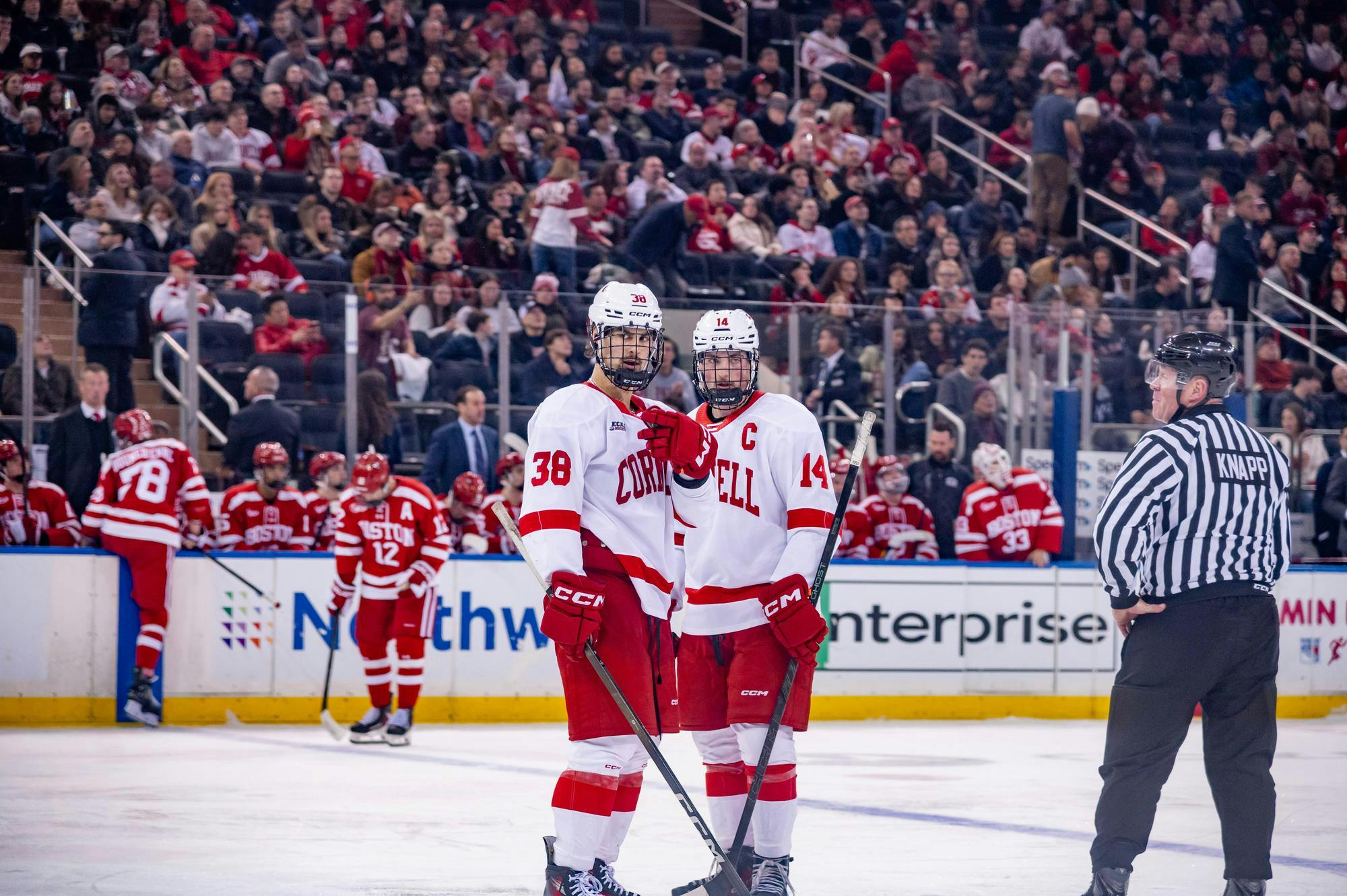
The percentages alone are impressive. Castagna’s name has headlined leaderboards around college hockey, but Walsh trails not far behind — his 257 wins tie him for 28th-most in the NCAA, and he is operating at a steady 55.4% clip at the dot.
But then you consider Cornell’s 23.5% conversion rate on the power play and 80.5% penalty-killing percentage, and Walsh and Castagna’s prowess becomes that much more invaluable to team success.
Winning the faceoff impacts everything that comes after it.
“You start special teams a lot of times in a position that gets you the puck,” Jones said. “On the power play in the offensive zone, on the penalty kill exiting the zone. It gives you possession, which is a huge advantage.”
…
GETTING low. Bending your knees.
“We call it owning the dot,” Flanagan concluded. “Those are the three biggest things.”
Flanagan is in the midst of his 10th season on Cornell’s coaching staff and his first as associate head coach. Since he arrived in Ithaca, he’s been in charge of Cornell’s man advantage and works daily with centers on draws. Flanagan bounced between center and wing as a collegiate player at St. Lawrence, and noted that, when he began coaching, honing in on faceoffs and the power play came “naturally” to him.
The results have come naturally too — in each of the last four seasons, Cornell has ranked in the top 10 nationally in faceoff win percentage. As a team, the Red hasn’t dipped below a 50% clip since Flanagan was hired in the 2016 offseason.
Being successful at the faceoff dot at the NCAA level takes practice. Lots of it, Flanagan said. For Castagna and Walsh, both with three years of taking draws under their belts, the experience itself plays a large role in their success.
“If you look back, [Castagna] and Walsh — they were good as younger guys, but they've obviously gotten better and better each year when they get used to it,” Flanagan said. “The experience is just something you need. You don't get it without going through it.”
Walsh and Castagna have certainly gone through it. For Walsh, now captaining the Red, he was relied upon heavily at the dot last season, taking a team-leading 749 draws and winning 55.9% of them. Castagna’s percentage, on the other hand, has climbed nearly 10% in just two seasons, concluding his freshman season at 54.6% before rising to 58.7% as a sophomore and now into the 60% range as a junior.
Castagna and Walsh are wildly successful in their own ways. Either could be a top-line center at most NCAA programs. But the way Cornell utilizes them — as a 1-2 punch at the center position — is even more notable. When one isn’t going — which is a rarity for both of them — the other can pick up the slack.
Freshman forward Aiden Long has gotten the privilege to play on the wings of both players. Most recently, Long has found prime real estate on Castagna’s left wing while freshman forward Caton Ryan took the right side, but Long skated alongside Walsh in various iterations of line combinations earlier in the year.
“I've played with other skilled centermen, but sometimes those skilled players kind of cheat the game in other ways,” Long said. “And I think [Castagna] and Walsh definitely don't do that.”
It’s helpful to Long — who has largely kept to the wing throughout his young playing career — to know that he’ll probably be getting the puck shortly after a faceoff is taken.
“[Castagna]’s always snapping the puck back,” Long said. “I think as wingers, we know that he's going to win most of our draws. We still got to kind of get in there and try to help him as best we can, but it's definitely nice to know that most of the time, you know he’s going to win them.”
Especially with the puck in the offensive zone.
…
PART of what makes Castagna and Walsh so effective is their handedness. Walsh is a righty, while Castagna is a lefty, giving the staff multiple options to pit up against opponents’ top centers. Castagna is the lead man on offensive zone faceoffs to kickstart the Red’s power play — in fact, of Cornell’s 20 power-play goals, a Castagna faceoff win has preceded 12 of those.
An even more impressive statistic? Seven of Cornell’s goals on the power play have come within 30 seconds of it starting. Three have come within 10 seconds of the first offensive-zone draw.
“We put them in a lot of situations that give us possession,” Jones said. “So that's kudos to [Walsh] and [Castagna] for the most part [for the power play’s success], with how good they are at winning draws.”
Take this past Saturday against Princeton. Castagna, heading the top power-play unit, goes to the dot against Luc Pelletier, a fellow lefty. Castagna has the advantage, though — he’s taking the faceoff from the left circle, which is his strong side.
“From a faceoff perspective, it's a lot easier to win a faceoff on your backhand,” Jones said. “I don't know why, but it is. It puts you in a position of power.”
Castagna has the power — he wins the draw on his backhand, sending it straight between his legs and up to the point where freshman defenseman Xavier Veilleux settles it. He leaves it for junior defenseman Hoyt Stanley, who then delivers a pass to Walsh — who looks to sail a centering pass, but the one-time slap feed winds up deflecting off a Princeton skater and into the back of the net. Power-play goal for Walsh, all within the span of six seconds.
But Flanagan can also choose to start on the right faceoff dot. In that case, they’ll slide Walsh in to take the draw — when he’s not potting the power-play goals, Walsh has won four faceoffs leading up to man-advantage successes.
That’s what Cornell opted to do against Clarkson back on Dec. 5. Walsh won the draw up to Castagna, who delivered the puck up to Veilleux, then to Stanley, and back down for Walsh. A couple of nice feeds from sophomore forward Charlie Major and big rebounds off the goaltender lead to Castagna’s eventual burying of the puck. Another power-play goal, this time for Castagna, coming just 16 seconds after Walsh’s faceoff win.
“A power play will start on one dot because their center is a certain [handedness],” Jones said. “But we have two guys who’ll go on the backhand and put us in a good situation for possession. It gives you a little bit of an advantage. You don't always have that.”
Last year, Cornell’s power play converted on only 14.7% of its chances, which was even helped by a couple of strong postseason performances in the end. Still with two games to play in the 2025-2026 regular season, this year’s Red has already surpassed last year’s power-play goal totals (16).
“It gives you that luxury, having those two guys — veterans — who have been around, and it’s good in critical times in games,” Jones said. “And they're mature. They take pride in it. They watch video on it according to [the] weekend.
“They don't just show up and do it. They put the work in.”
…
SO what's the real secret behind Cornell’s faceoff prowess, anyway?
Though his track record might suggest otherwise, Flanagan insists that there is no special formula or secret touch that contributes to the Red’s dominance at the dot.
“We can coach them and show them anything that we can,” Flanagan said, “but it comes down to them doing the work like [us coaches] do.”
It comes down to the moments in the film room, breaking down the screen frame by frame, seeing where they can be lower or where they can “own the dot” better. It comes down to all the centers — not just Walsh and Castagna, but freshman forward Gio DiGiulian and Major and junior forward Tyler Catalano — implementing those little changes in practice.
It comes down to putting equal emphasis on faceoffs as on shooting and scoring.
“I think those two guys are some of the best at that,” Flanagan said. “They're sponges, and they want to get better at it.”
Castagna and Walsh are very different players. Castagna will beat you with speed and tenacity — a “terror” on the ice, Flanagan said — while Walsh’s creativity, finesse and sometimes brooding physicality burn his opponents.
What they both have, though, is a will to learn. That’s been the constant in 10 years of faceoff success for Cornell — players that come in wanting to improve, not ones that think they’re already good enough.
“That’s why guys have success here, because it's a work-based program,” Flanagan said. “You could show the same things to different people, and they might not have the same success. That's where I'll still go back to those guys — they care, they invest in it, and they work at their craft.”
That’s because development at Cornell — whether it’s a goaltender, a center, a defenseman or anyone else — is a four-year commitment. Flanagan and Jones, when recruiting, are not looking for the “best” possible player, as per the classic “Miracle” mantra — they are looking for the right ones.
Four years of lifting, film, skating and experience — that’s what enables kids from Salisbury School and St. Andrew’s College to develop into two of the top centers in the NCAA.
“We want kids who want to get better here, [that] want to listen [and] that want to learn. [Walsh and Castagna] are those guys, and we have a lot more in the room,” Flanagan said. “Obviously, these guys are at a different level right now in terms of what they're doing and some of the stats and the faceoffs. But that's just the program. Whatever we do, we want to do it better.”
Jane McNally is a senior editor on the 143rd editorial board and was the sports editor on the 142nd editorial board. She is a member of the Class of 2026 in the College of Agriculture and Life Sciences. You can follow her on X @JaneMcNally_ and reach her at jmcnally@cornellsun.com.


