Let’s set the stage: it’s early September. The year is 2023. I’m entering my senior year of high school in a week and I have a plan: I am going to start my college apps early (I did not), I am going to decorate my room (again, unsuccessful), and I am going to figure out what I want to do for the rest of my life (unfortunately, another failure — this one, however, led to some important self realizations). In a way, I could not have chosen a better time to watch Dead Poets Society: it was fall, a transitional period into my last year at boarding school and the first time I’d ever have to meaningfully grapple with the question of what comes next.
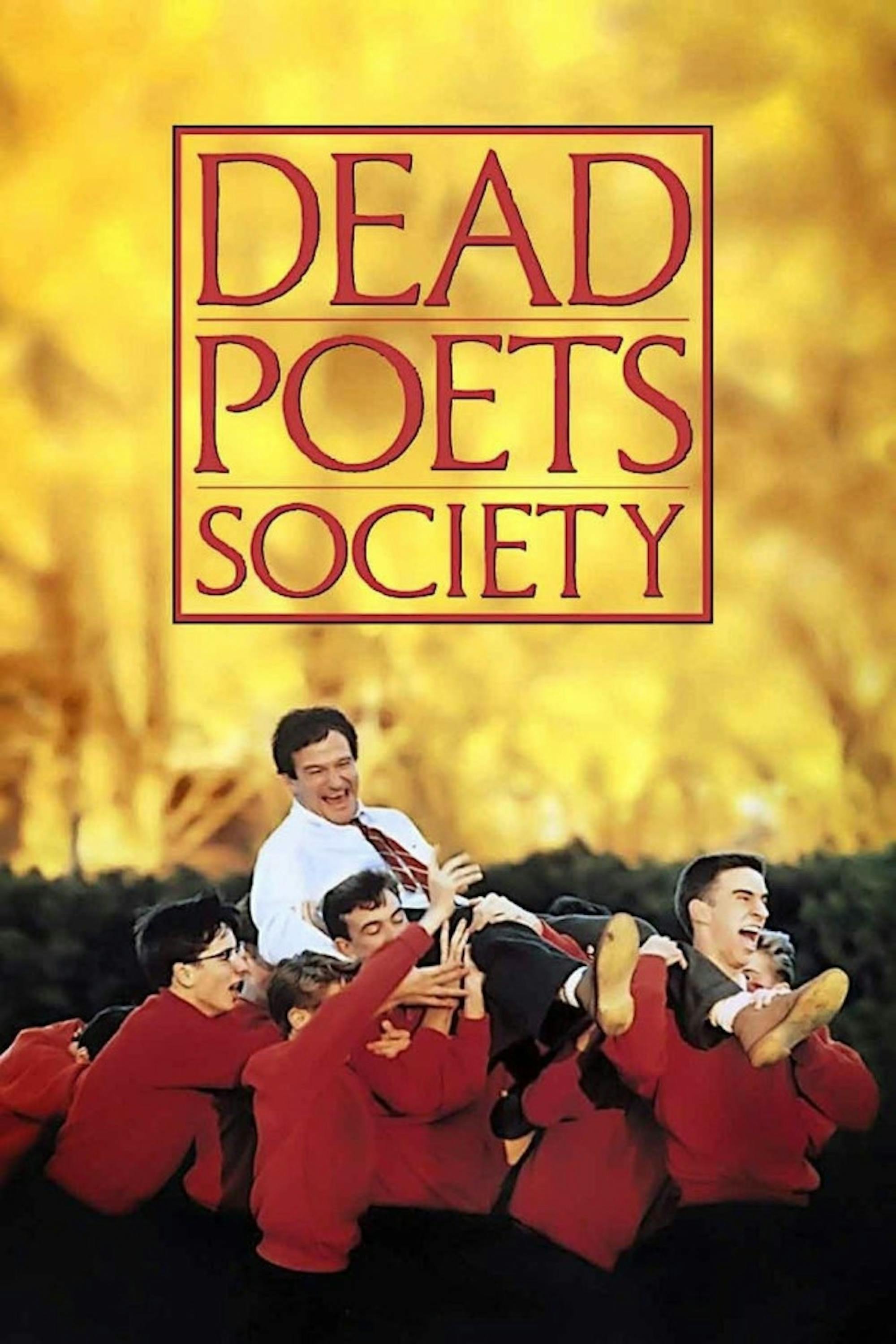
It’s now 2024 and fall started a week and a half ago. As chlorophyll production begins to slow down and the air begins to adopt a chill, there is no better time to revisit Peter Weir’s 1989 film Dead Poets Society.
Upon first glance, it’s obvious why Dead Poets Society is widely considered a quintessential fall movie. Filmed at a Delaware boarding school, the movie’s natural setting is quaint and idyllic, and the film itself is color graded to highlight the rich golden hues of fall. However, it is not only the setting that makes the film so reminiscent of autumn but also its themes.
At its core, Dead Poets Society is a movie about change. Set in 1959 at a prestigious New England boarding school, the movie begins with a move-in day chapel convocation, not unlike one that I would have attended at my episcopalian high school. Immediately, we catch a glimpse of what the school stands for as the movie pans to four uniformed boys holding up the school’s four pillars: Tradition, Honor, Discipline, Excellence. The head of the school launches into a speech about the great academic reputation of the institution, we catch a glimpse of the naive, nervous faces of the teenagers, and it becomes clear where the story is headed.
The movie revolves around three characters: bold and enthusiastic Neil Perry (Robert Sean Leonard), quiet Todd Anderson (Ethan Hawke) and their unconventional English teacher, John Keating (Robin Williams). Born to wealthy and overbearing families, Neil and Todd are bound by their parents’ expectations and, thus, they have no concept of who they are outside of who people tell them they can be.
Mr. Keating opens the boys’ eyes to a world outside of their authoritarian boarding school, inspiring them to think unconventionally and to strive for individuality. As we watch the seasons transition from fall to winter in charming, panoramic shots, we watch the boys transition into men. They become more confident in their actions, more assured in their language. They grow into themselves. The real conflict, then — a clash between idealism and realism — is introduced as the boys struggle to find themselves through the clasp of the school’s authority. The movie ends on a melancholic note, but also a hopeful one. Romanticism is as much a struggle with your environment as it is with yourself, but, ultimately, the choice to indulge is up to you.
Dead Poets Society can be summarized in one repeated refrain: “Carpe Diem.” Seize the day. It’s a warning as much as it is a call-to-action. Within it is an implied “because” statement. Because you don’t know how much time you have left, because you’ll never get your years back. Because you are young. Because you have room for mistakes.
It’s a lesson that I’m glad to have learned when I did.
It’s early October. The year is 2024. You are young once. College, like fall, is a transitional period as much as it should be a transformative one. Go outside, make memories, approach new people, try new things. Hear the leaves crunch under your feet. Indulge in a Novick’s pumpkin chai, perhaps. Study hard and try to find a zeal for what you do. Everything you have ever done — everything you ever will do — is concentrated in this moment, so take a breath, feel the world and make your life extraordinary.
Yaelin Hough is a freshman in the College of Arts & Sciences. She can be reached at yh2299@cornell.edu.