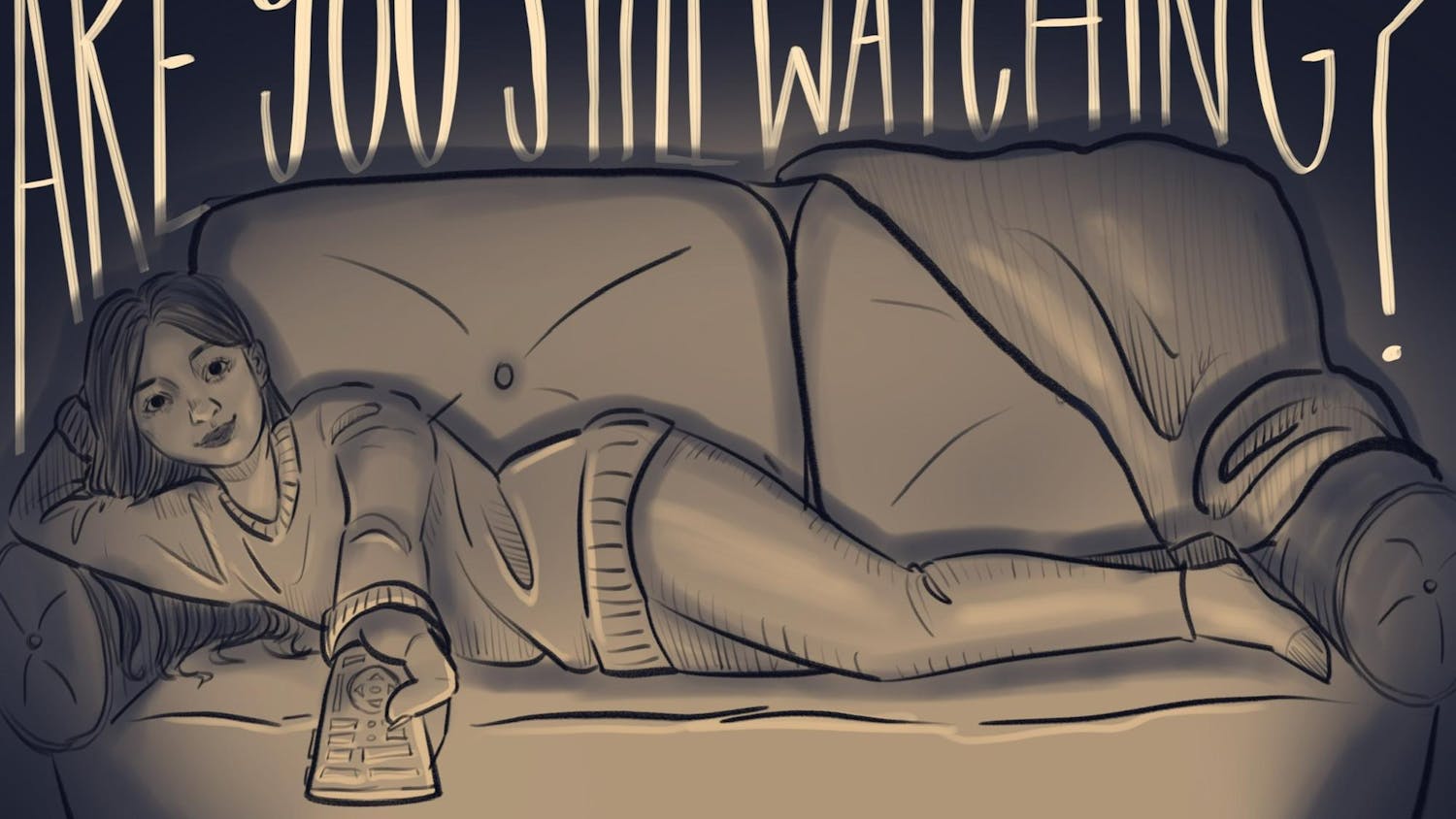
Fleabag premiered on the BBC 10 years ago, and never since have we met a more hairbrained, neurotic, tragically horny woman. Following an unnamed woman (Fleabag) in London as she navigates tragedy, sexuality, unorthodox family dynamics and love, the limited series shattered hearts and bended conceptions of young womanhood with wit and charm. However, in her quest for a healthier and more meaningful relationship to sex, herself and her family, she inadvertently embodies many of the trials and tribulations of gay romantic identities.
The show is definitively about womanhood; however, it doesn’t detract from Fleabag’s power to identify the unnamed lead’s appeal to gay audiences, nor is it a reductive typification of gay audiences to point out that resonance.
You can start with the mechanics Phoebe Waller-Bridge builds her story with, most notably Fleabag’s signature breaking of the fourth wall. There is expansive online literature about this, and it opens up much of the relatability gay audiences can feel to her. However, her appeal extends far beyond the brilliance of her cheeky looks, mutterings and monologues to the audience.
Sex is a dominant item on her mind; her hypersexuality is an item of recurring anxiety throughout Season 1. In episode two, she sits on the toilet and explains to the audience that she’s “not obsessed with sex, [she] just can’t stop thinking about it. The performance of it; the awkwardness of it; the drama of it.” Sex is less an activity of pleasure and intimacy than it is a form of entertainment or dissociation.
More so, she turns to sex as a defense mechanism against her profound loneliness, a cope that only self-multiplies. Her body is her only thing of value; sex is the most tangible connection she feels she can make with others. She says this in the Season 1 finale, breaking down to another character: “I know that my body as it is now really is the only thing I have left, and when that gets old and unfuckable, I may as well just kill it.” In her abject loneliness, she lashes out at herself by having sex to fill her void.
The misconstruction of sex as an outlet for detaching oneself from loneliness or rejection is resonant with gay audiences; a lack of meaningful romantic connection beyond sex frames encounters as the end-all-be-all of intimacy, power and being desired. In the words of Fleabag while getting a mammogram: “At the end of the day, it’s nice to be touched.” Her treatment of sex throughout the first season aligns with the relationship to sex many gay men have forged.
She cites her mother’s dying as a rupturing moment for her family (as one might expect that to be). Her relationship with her sister, Claire, is strained. Their father buys them tickets to feminist lectures to substitute for their lack of a female role model — these being the only times they spend together. In the first episode, the two attend a lecture called “Women Speak: Opening Women’s Mouths Since 1998.” The speaker poses the question: “Would you trade five years of your life for the so-called perfect body?” She and her sister are the only ones in the audience to raise their hands. Later, in a drunken, 2 a.m. rant to her father, she calls herself a “morally bankrupt woman who can’t even call herself a feminist.”
Living up to the exterior constructs of what “feminism” entails is a tall order; there’s an incredible amount of pressure to be a feminist purely by virtue of being a woman. The agenda of feminism presents like a mold to configure one’s shape to; reality is more malleable. This is alike to the pressure to conform to arbitrary definitions of queer identities: out, proud, flamboyant and totally progressive. Queer looks a thousand different ways, and they don’t always add up to “queer liberation.”
Season 2, filmed and released three years after the first, features Fleabag falling in love in the build up to her father and her horrible stepmother-to-be’s wedding. The opening line to the season is, bluntly, “this is a love story.” At a dinner party with her family, Fleabag strikes up a rapport with the priest (played by Andrew Scott) officiating the wedding; a friendship builds between the two. She realizes she’s falling in love with him, and that impression builds as he becomes the only character who senses the moments she breaks the fourth wall. “Where do you go?” he interrupts her quips to the viewer.
She was never shy in her attraction to him, despite his celibacy. In the early goings, he tells her that he can only be her friend — until the fourth episode, when they make out in the heat of an intimate confessional at the church. In a bit of divine irony, a painting of Jesus falls off the wall as they kiss. The penultimate fifth episode sees the culmination of their dynamic: having sex. In the end, he chooses God over Fleabag, leaving her heartbroken but resilient.
Her attraction to the priest can be understood as a desire for what she can’t have. There’s a symmetrical logic to her pining for the priest to the time-old concept of “turning the straight man” in the gay community. Falling in love with a straight guy is so easy — a common confusion gay men experience is the difference between a platonic and romantic relationship. Her love for the priest is much the same; he showed her kindness, a depth in vulnerability, and continued to be close to her despite knowing she was in love with him. Her confusion is tragically understandable, if too understandable for many gay people.
In Fleabag’s broadest strokes, gay audiences can see much of themselves and their treks to self acceptance and sexual maturity in her journey toward the same. You could analyze Fleabag’s queer relatability across a thousand pages, despite her being a straight woman. Identifying intersectionality across different groups’ like experiences doesn’t typify one or detract from the other; besides, being tragically horny transcends Fleabag, gay audiences, and sexual liberty writ large.
Alexander Walters is a member of the Class of 2028 in the College of Arts and Sciences. He is a staff writer for the Arts & Culture department and can be reached at apw65@cornell.edu.