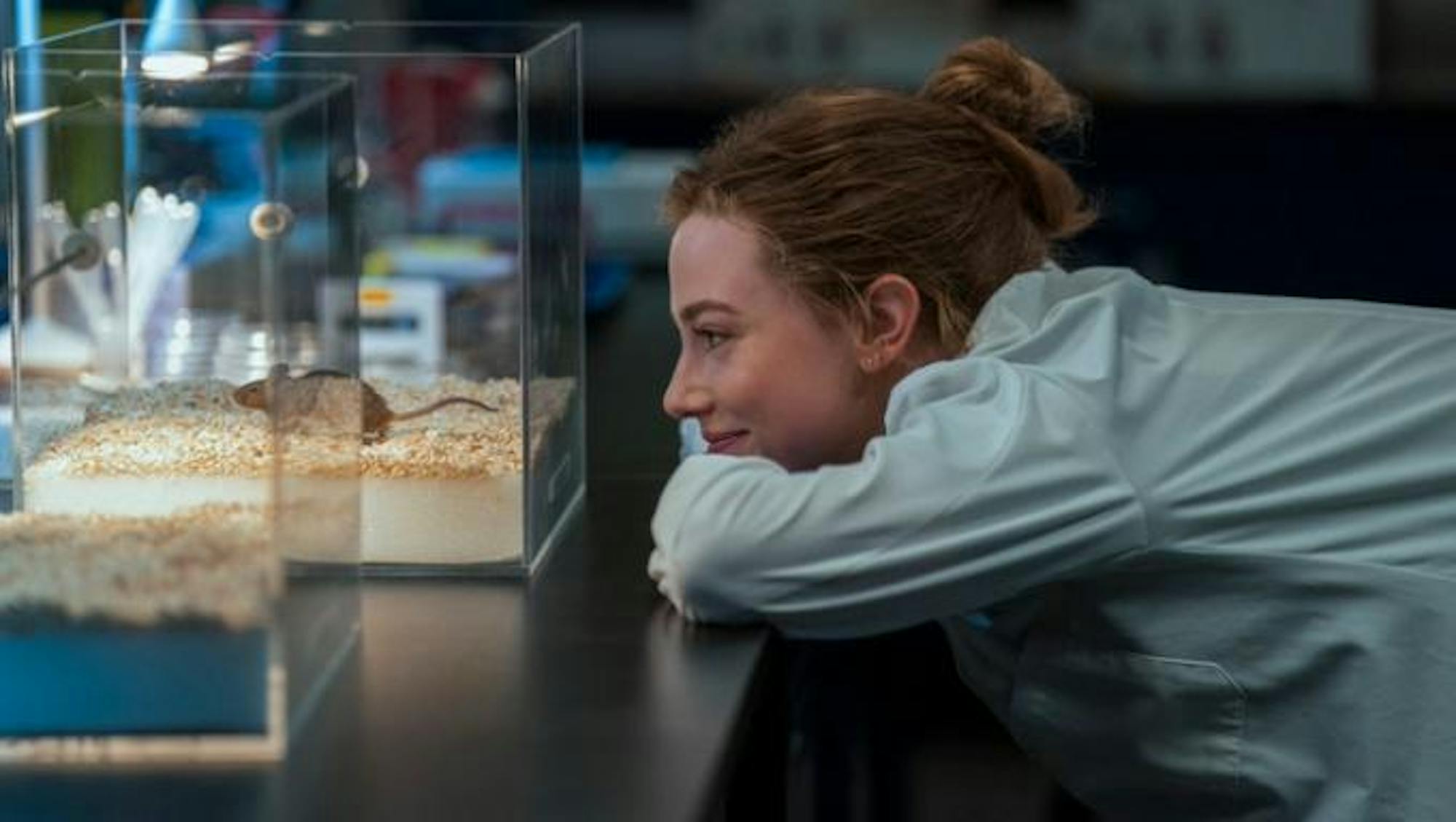
When my friends and I sat down to watch The Love Hypothesis, as a romance reader and a cheesy romcom fan, I was excited. I love the fake-dating trope. I love banter and tension. I just love love! What I didn't love was The Love Hypothesis. Based on the Ali Hazelwood book, The Love Hypothesis follows a fake-dating scheme at Stanford Medical School between graduate student Olive Smith and advising professor Dr. Adam Carlsen. They get together to convince Olive's best friend, Ahn, that she can date Olive's old crush without any issue. At the same time, they are showing Adam's colleagues that he has ties to Stanford in order to secure his research funding and not present a flight risk. It is known that the film is also based on a Reylo fanfiction. Contrary to popular opinion, I believe fanfic adaptations can be done well. The Love Hypothesis was not that. From the questionable messaging to the cliché plot and lack of chemistry, the movie was poorly executed.
Right off the bat, I found the handling of sexual assault too cavalier. In the first encounter where Olive kisses Adam, he talks about filing a Title IX report against her, claiming her act was non-consensual. It is essentially a coercive threat to convince her to talk to him; and then they get into a fake relationship? It struck me as a strange near-joke to gloss over, especially considering the sexual harassment that Olivia faces later in the film from Adam's friend, Dr. Tom Benton. Tom offers to fund Olive's research in exchange for sex, threatening to end her career if she does not comply. Subsequently, Olivia does not file any sort of complaint against Tom, which might serve as a powerful commentary on women facing threats when they speak up about sexual harassment. Olive does tell Ahn though, which then might speak to the power of womanhood. Except then Ahn tells Adam, who comes to Olive's rescue by being a "big strong man," when he punches Tom in the face in the middle of a class. Romantic? Maybe. Empowering and realistic messaging? Not so much.
Additionally, I thought the choice continued a gross precedent of sexualizing women in STEM. The lab inaccuracies started as comedic, with characters bringing Mountain Dew and snacks into the labs. When protagonist Olive Smith walked into the lab in her mini skirt, my friend studying biology actually laughed out loud. Anyone who has passed even a basic high school chemistry course can tell you to wear pants in a laboratory. Yet not only is the choice inaccurate, it's also inappropriate in a movie that claims to critique the sexual harassment of women in the workplace. There is no reason for Olive to wear a skirt in a lab except to show off the actress' legs. Let's take a little more costume consideration, please!
Ironically, the film touches on the challenges that women in STEM face, when Olive overhears a group of gossipers in the bathroom suggesting that she has only earned the right to speak at a prestigious science conference because of her relationship with Adam. Although Adam reassures her, there is no further resolution and we later find out that she actually got the opportunity to speak because of Tom's intent to sexually harass her. That's not a great message for young women! As much as The Love Hypothesis was trying to 'tackle the issues' that women in STEM face, it contradicted itself more than it contributed anything meaningful to the discussion space.
Even if I’d managed to get past these misgivings, I still found the plot rushed and the characters two-dimensional. Adam came off as rude, condescending and robotic, to a degree that made him genuinely unlikeable. When I later found out that, in the book, he spends years pining after Olive before she kisses him, I was shocked. The movie simply left out that important little detail. As aforementioned, I am a fake-dating fan, but I was never sold on Olive and Adam's affection for one another. It felt like their romantic scenes came out of left field, whether that was the deep conversation about Olive's mom's battle with pancreatic cancer or the sudden hotel sex scene. Plus, Olive's overdramatic roommate, Malcolm, felt like a complete stereotype. The quintessential gay best friend, his fight with Olive and moment of realization that STEM just "wasn't the right fit" felt like a randomly tossed in cliché. Overall, I think the directors did not have enough time to flesh out the characters and develop the kind of slow-burn relationship that Adam and Olive deserved. Finally, the dialogue just made me cringe. The poet in me loves a good extended metaphor, so theoretically starting and ending with bonds should have been cute. Yet I thought the repeated science-love metaphors felt so unnatural and unbelievable that they took me out of the movie.
I've been critical, but the film wasn't all bad. In my opinion, the best part of the film was the relationship between Olive and her best friend, Ahn. That supportive girlhood bond jumped out at me from the rest of the movie, and for that I commend the author and directors. Honestly, I thought they had more chemistry than Olive and Adam. I also liked the ending wherein Olive got her research funding from a female professor at Stanford University and was able to continue her groundbreaking work using her connections and skill. There we finally saw the feminist energy that the film was trying to capture.
Cute friendships and happy endings aside, The Love Hypothesis still wasn't a hit with me. I thought the film had a lot of potential, but it ultimately fell flat. Between the mild sexism, the lacking chemistry and the unrealistic dialogue and lab safety, I can't say this one makes my recommended rom-coms list.
Emily Federovitch is a member of the Class of 2029 in the College of Arts and Sciences. She is a staff writer for the Arts & Culture department and can be reached at eaf258@cornell.edu.