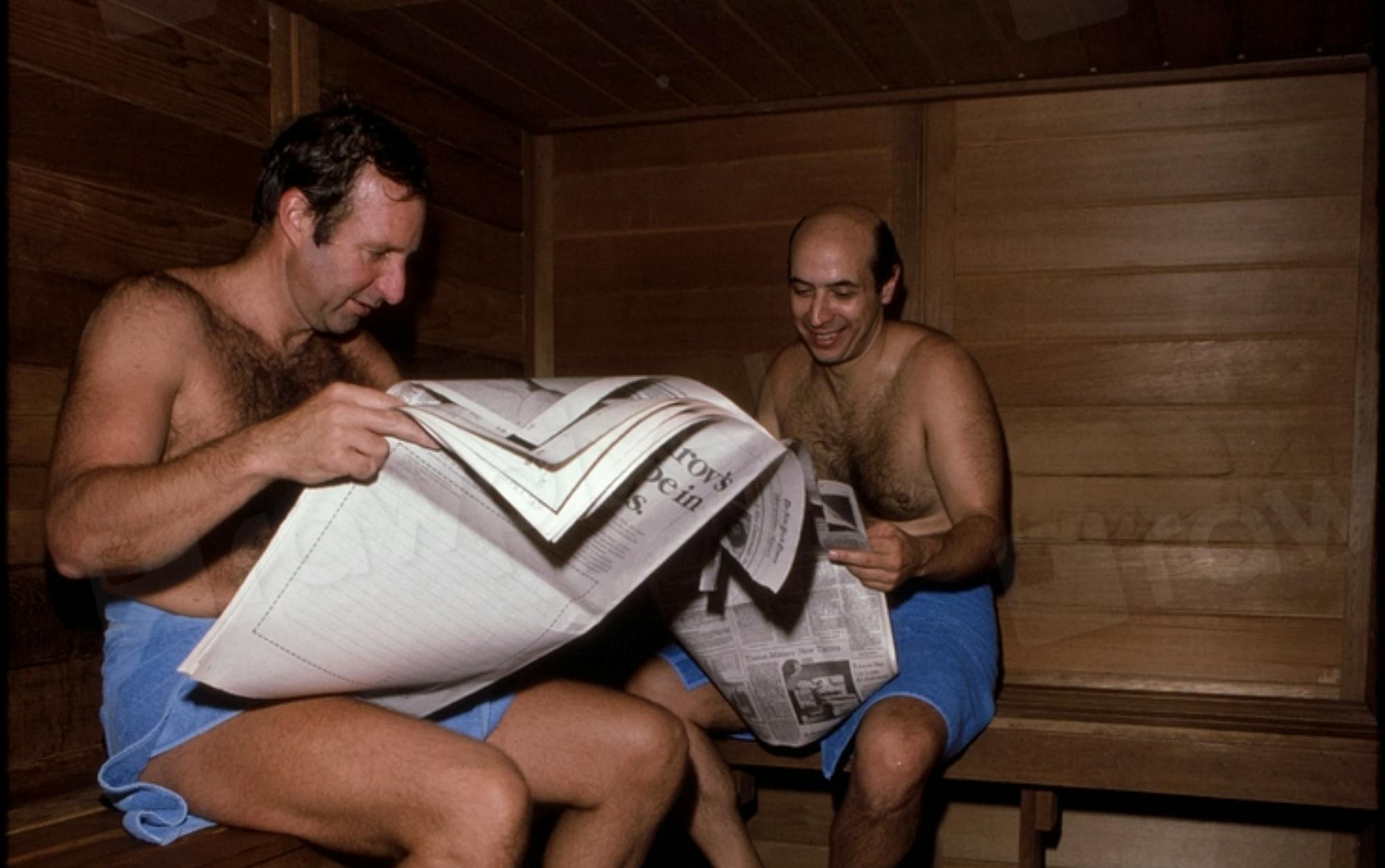
The Cut put a picture to your deepest, darkest (one might say steamiest) bathhouse fantasies in its most recent Men’s Style Issue. Aptly named “The Boys in the Baths,” it profiles the Russian & Turkish Baths on E. 10th Street in New York’s East Village via high-definition photos of highly attractive men. Operating since 1892, The Russian & Turkish Baths self-brands as a “health club,” and has played sweat-inducing host to New York’s stars for decades. Despite the feature’s (somewhat flinching) narrative of saunas as sites of recuperation, the photos do nothing to deter from their popular impressions of raunchiness.
Now, don’t get me wrong: I find the photo shoot awesome. Troye Sivan, Isaac Cole Powell and Sam Nivola dumping buckets of cold water over their heads? The awesomeness of such an image encourages readers to scroll past the article and straight down to the photos — as, admittedly, I did. But that very urge encapsulates the broader joke of the sexualization of bathhouses and saunas.
I went to the Russian & Turkish Baths myself back in July with a couple of friends visiting from out of town — that’s to say, we deemed it a worthy enough “New York” experience to carve three hours out of their 48 in the city to sweat. The crowd wasn’t too different from the photo shoot’s, albeit with fewer verified Instagram users. We more so went for ‘the meme’ of it, and the “Absolutely No Sex” signs only made the joke funnier.
However, the raunchy undertones of saunas are a rather recent advent. Only for the last hundred or so years of a thousands-of-years-long history have saunas carried this stigma. The first saunas came along in Finland over 2,000 years ago, and were built underground. It was later that the characteristic wooden logs were introduced to aboveground buildings. They were a place of spirituality and folk healing, and even today talk of nudity or sex in a sauna is taboo.
Saunas and bathhouses, though colloquially lumped together, actually have separate histories. Whereas saunas were ritualized sites, bathhouses were public utilities in times before toilets were built into homes. They can be traced back to the Indus Valley 2,500 years ago and were co-opted by the Romans around 300 B.C.E. It was in Roman times that bathhouses began to assume their sexual undertones — because people were having sex there.
The history of cruising starts in Roman bathhouses, called thermæ; in Seneca the Younger’s dialogue “On the Happy Life,” he references the “shady nooks” of bathhouses where men were known to find other male lovers. Modern excavations of the baths have revealed the depth of sexual imagination in Roman culture, particularly in the erotic frescoes that tiled the walls and columns. The prevalence of bathhouse culture lingered in Europe over time, and was brought across the Atlantic in the late 19th and early 20th centuries.
Bathhouses often offered sauna treatments and rooms, but originally served a public hygiene need rather than an exclusively folk-ritual one. Especially in crowded urban centers like New York, where immigrants often lived in tenements lacking in plumbing, bathrooms and general cleanliness, the tradition of bathhouse culture was brought with them. Upon their arrival, the misconception of bathhouses and saunas as one and the same stemmed from their proximity to one another, and they more or less became synonymous. Thus is the root of their association with voyeurism and sexuality.
That association has been enhanced by popular media. In Challengers (2024), a movie about a love triangle between tennis players, two of the lovers involved, Art Donaldson and Patrick Zweig, compete to passive-aggressively assert their masculinity over one another in a highly stylized, bordering-on-homoerotic conversation in a sauna wearing nothing but towels. Funnily enough, Art is played by Mike Faist, who shares The Cut’s feature cover photo with Christopher Abbott.
The logical next step here would be to criticize this conflation of saunas and bathhouses as sexual environments as an American tendency to associate nudity exclusively with sex. There’s also something to be said for critiquing the fact that an element of another culture was brought to America just to be twisted into something taboo. But what fun is that?
If we treat hypersexualization as an element of American culture, as arguments like these do, then meeting with saunas and bathhouses brought by Europeans created the raunchy impression many of us have today. What separates that impression from other “Melting Pot” creations?
Airbnb ran a commercial campaign during the FIFA World Cup this past summer called “The World Is Meant to Meet” which highlighted the iconic, artistic products of interactions between cultures. One example they cited was the creation of punk music after Jamaican immigrants brought their sound systems to the U.K. in the mid-20th century. Would you call that a gross perversion of Jamaican cultural elements? Or, in the reverse, of the tradition of British rock music laid by the Beatles? Probably not.
The argument can also be made that saunas and bathhouses as sexual environments have become an element of gay culture. The feature alludes to as much in identifying the Baths’ men’s-only hours as “gay meetups,” and referencing the prevalence of the AIDS crisis, as much a presence in the history of New York’s bathhouses as in its gay community. Many of the models are gay, including Troye Sivan and Brandon Flynn. As previously mentioned, cruising began in bathhouses as far back as Ancient Rome.
It’s impossible to conceive of “gay culture” without it in some way being contoured by sex. It’s the element that deviates from the norm — the heteronorm. I suppose the question becomes: What came first, the sexualization of saunas and bathhouses, or the homosexualization of saunas and bathhouses?
Regardless, “The Boys in the Baths” is emblematic of the erotic intrigue saunas and bathhouses lord over many of us, and knows exactly what its target audience is. And it is awesome.
Alexander Walters is a member of the Class of 2028 in the College of Arts and Sciences. He is a staff writer for the Arts & Culture department and can be reached at apw65@cornell.edu.