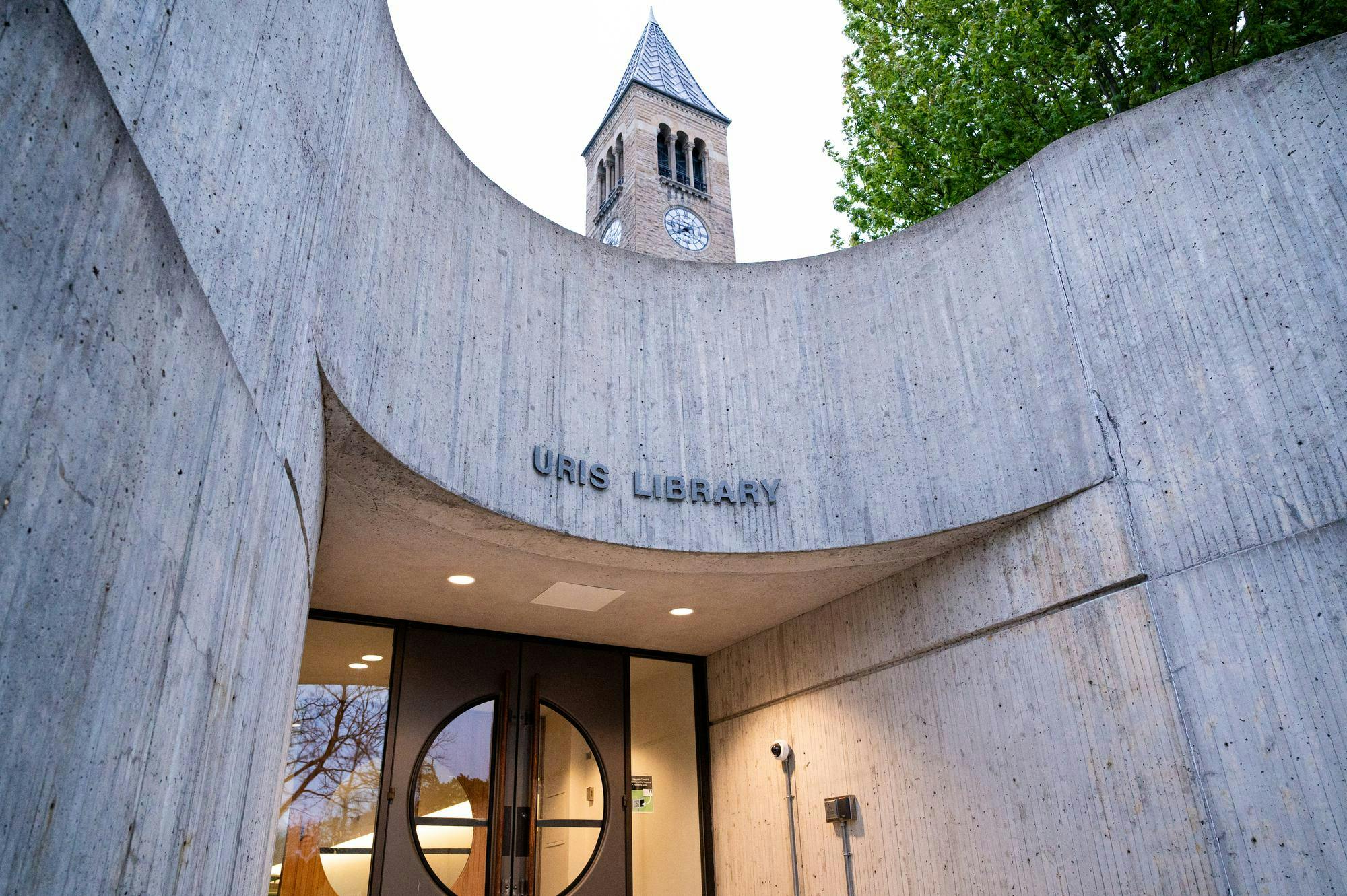
As a freshman, I’ve been searching since August for undiscovered spots on campus, including niche study spaces. On Oct. 30, I found one. First floor of Uris Library — the main area, not the Harry Potter part — around the corner where the two handicap-accessible bathrooms are located and to the right exists the Uris Library stacks, which, while maybe not as impressive as those in Olin Library, house shelves and shelves of the written word. On the windowed side of these shelves sits a row of study carrels. My phone was dead, so I chose the closest one with an outlet. But, when I went to plug my adapter in, my eyes were drawn to the surrounding white-painted brick wall. The brick had been graffitied with black Sharpies and black pens — pens probably identical to the one I had used to take lecture notes with not even an hour prior. The graffiti revealed student thoughts and messages from years past.
Some messages posed questions: “Did you get into med school and make mom and grandma proud?” and “Why did she leave me?”
Some provided words of encouragement: “I look up to you. I love you [signed with a heart]” and “stay strong.”
Some expressed anxiety, desperation and regret: “I have so much work,” with “work” double-underlined and “Send Help plz,” signed with a frowning face and “Should have gone to NYU.”
Some delivered commands: “Stop scrolling on your phone!” or “Study … !”
One quoted Oppenheimer: “Theory will take you only so far.”
One simply noted: “js was here,” signed “02/26/25”
And one, signed, “G, ’22,” said “F*ck covid.”
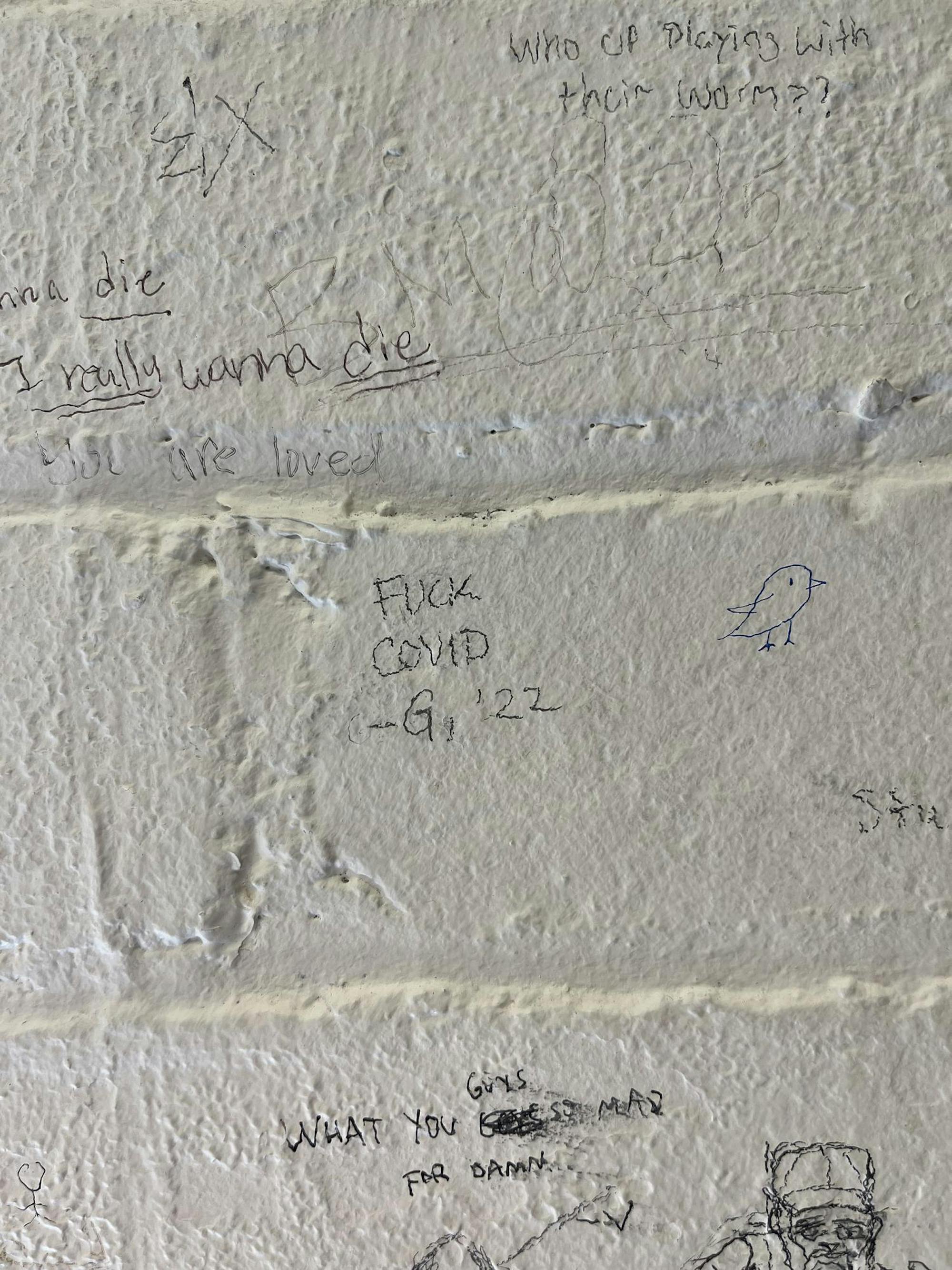
All across this section of the wall, people answered other students’ questions and responded to their comments. As my eyes shot across the wall in all directions, analyzing the interactions between the statements, written by different individuals all at different times yet all gathered in the same place, I started to think of the textbook my AP English Language teacher assigned to us in my junior year of high school. Specifically, the following term: the unending conversation.
The term was coined by literary and rhetorical theorist Kenneth Burke (1897–1993) in his 1941 book The Philosophy of Literary Form: Studies in Symbolic Action, in which he describes discourse through a short hypothetical about a person walking into a parlor: “You listen for a while, until you decide that you have caught the tenor of the argument; then you put in your oar. … However, the discussion is interminable. The hours grow late, you must depart. And you do depart, with the discussion still vigorously in progress” (p. 110).
This metaphor, I thought, was the perfect articulation of the Uris graffiti: Various individuals, across time, contributing to the same dialogue — the same conversation — that will never end. And I started to think about how not only do the books within a library symbolize an archive of human knowledge and experience, but so can the literal walls that surround those books.
The only aspect I’d add to Burke’s metaphor is this: Say, at a later date, you re-enter the parlor. You can come back as many times as you want — for the conversation is “unending.” You see some familiar faces, some entirely new. You can decide how frequently or infrequently you want to change your mind, but you will inevitably be exposed to opinions and ideas you hadn’t been exposed to before, and, of course, the conversation, being “unending,” shall never cease to be.
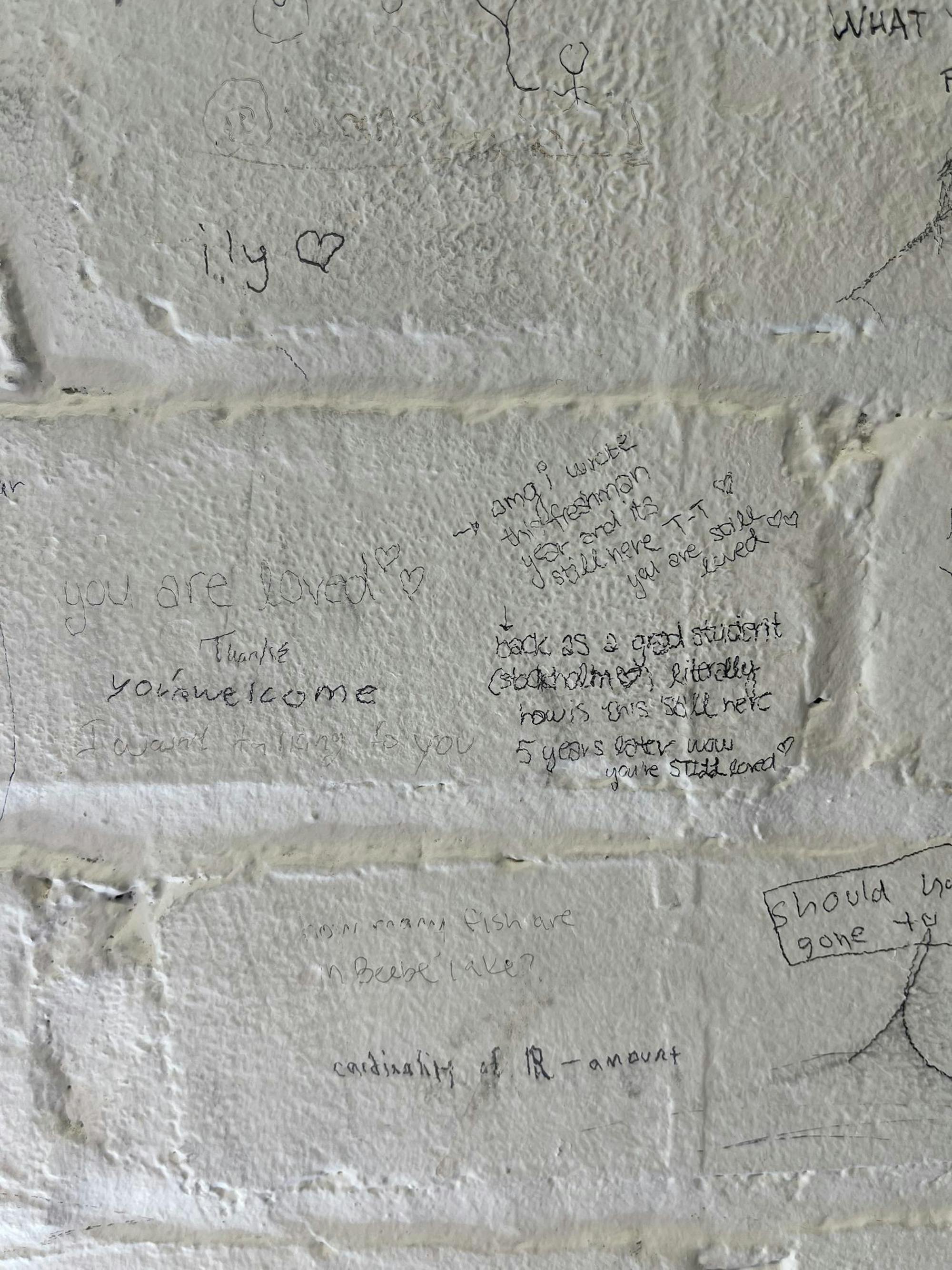
I write this because one of the messages in particular stuck out to me; it was by a student who left a note as a freshman, then came back later during undergrad, shocked to see it was still there, then came back once more while in grad school:
“you are loved [signed with two hearts]”
Arrow pointing from first message: “omg i wrote this freshman year and its still here T-T … you are still loved [signed with two hearts]”
Arrow pointing from second message: “back as a grad student (stockholm) literally how is this still here 5 years later … you’re STILL loved [signed with a heart]”
We’re perpetually surrounded by people and perspectives, past and present. Sometimes, they just show up where you might not expect to find them — the walls of an old, musty library. We just have to look a little harder to see them.

Tyler St. Cyr is a member of the Class of 2030 in the College of Arts and Sciences. He is a contributor for the Arts & Culture department and can be reached at trs262@cornell.edu.