


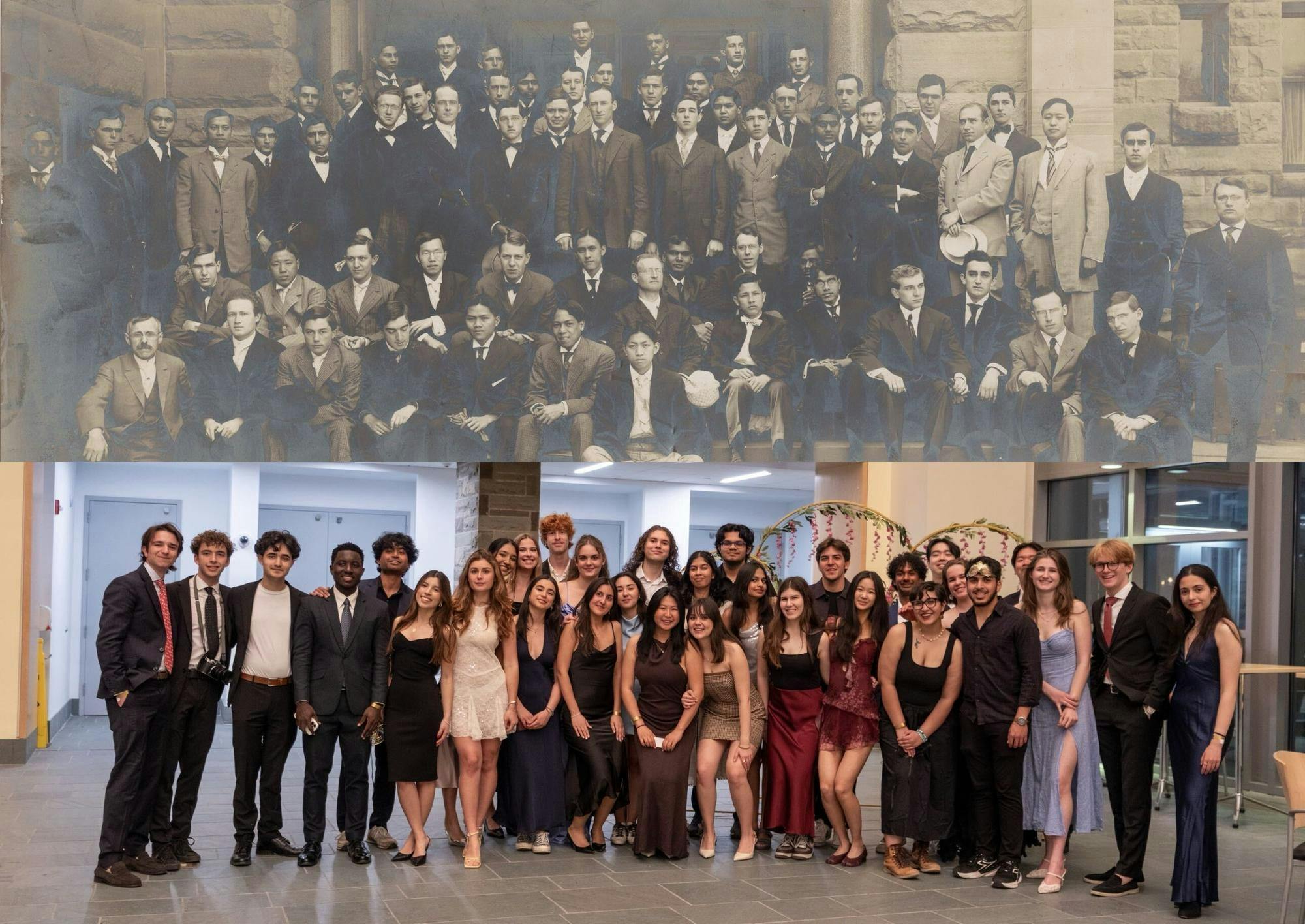
Everyone knows Ezra Cornell’s motto, “ … any person … any study,” but does anyone really know that Cornell, so bound to its international origins, once had a secondary motto, declaring, “Above all nations is humanity”?
Cornell has been international from the start. A little known part about Cornell’s history is related to A.D. White. Yes, the A.D. White we think about because the most beautiful place in Uris Library is named after him. But Andrew Dickson White was actually Cornell’s first president and a co-founder of our University. Before then, he was a well established diplomat, serving in both Germany and Russia. So, once Cornell was established as a university he traveled across Europe, recruiting famous academics and collecting textbooks and instruments to be used at Cornell. From the very beginning Cornell was built on the principle of bringing the best from all over the world to the benefit of its students. Internationalism was built into the University that we now know.
Cornell’s oldest cultural organizations include the Club Brasiliero and the Chinese Students Association, which has been functioning continuously since 1904. However, the most famous of all of these clubs, which set a precedent for universities across the country was the Cornell Cosmopolitan Club, founded in 1904 by an Argentinian student named Modesto Quiroga and Russian-born Armenian professor Vladimir Karapetoff, who served as the faculty advisor. Quiroga was the one who coined the motto “Above all nations is humanity.” His goal was to bridge divides between all nations. Quiroga believed that by bringing together people from various countries would be a way of bringing about international cooperation. It was such an integral part of life at Cornell that it had its own clubhouse in Collegetown on 301 Bryant Ave., which was dedicated to the organization with a 1911 speech by A.D. White himself.
Cornell was not the first to form this sort of organization, but it was by far the most well known and prominent. Other universities across the country began to open their own Cosmopolitan Clubs and International Clubs. Eventually, these clubs all came together as the Association of Cosmopolitan Clubs in American Universities.
Unfortunately, as the world of diplomacy faced wars and diplomatic failures, as did the Cornell Cosmopolitan Club. As World War II raged, members of the Cosmopolitan Club did not find themselves unimpacted. There were those that were conscripted into foreign armies, and those that had to worry for their home countries. Though historical records do not specify what caused the falling apart and decline of the club, it aligns with the post-war years and large increases in the student body.
That legacy is carried on today by the International Student Association. ISA was founded in 1981 as the International Student Programming Board meant to be of assistance to the various cultural organizations’ programming efforts. As of 2026, we have an over $100,000 external budget that is distributed across various clubs that apply to us for funding support. For instance, the very first event I ever attended at Cornell was a semesterly barbecue that was held by the Armenian Student Organization. That event was actually co-sponsored by ISA (then called ISU). Before I even knew this organization existed it was already contributing to my experience at Cornell.
In the present day, the new iteration of the Cosmopolitan Club functions as a support network for other international clubs at Cornell, but it also hosts semesterly galas, and has members from all across the world who come together to work on various projects that support the international community at Cornell. We produce a “Survival Guide” for international students, and run “Letters to Home” events where students can send letters home to any location free of charge. ISA sends many members to be mentors at the Prepare program, hosted and funded by the Office of Global Learning. We even run our own program called MINT — Mentorship for INTernational Students — where international students are paired with mentors that help them adjust to Cornell. In general, ISA does as much as it can to create a welcoming environment for international students. And for many people, including myself, it has become a second home.
The beautiful thing about ISA is how despite being a different organization than the old Cosmopolitan Club, it carries on its legacy of embracing internationalism so well. When applying for ISA membership, every applicant is asked to answer the question: “What does internationalism mean to you?” Every person who comes into the club is meant to display the very same characteristics that Quiroga spoke about in the first place. As the current vice president of publicity in ISA, I remember with every meeting that we have that we have a legacy that we carry on. This is a club that is passing on a tradition of inclusivity and acceptance, while building connections across cultural and national gaps and conflicts. The legacy that Quiroga once spoke of when he said “Above all nations is humanity” is alive and well at Cornell.

Lusine Boyadzhyan is a member of the Class of 2027 in the College of Arts and Sciences. She is a staff writer for the Arts & Culture department and can be reached at lboyadzhyan@cornellsun.com.


