


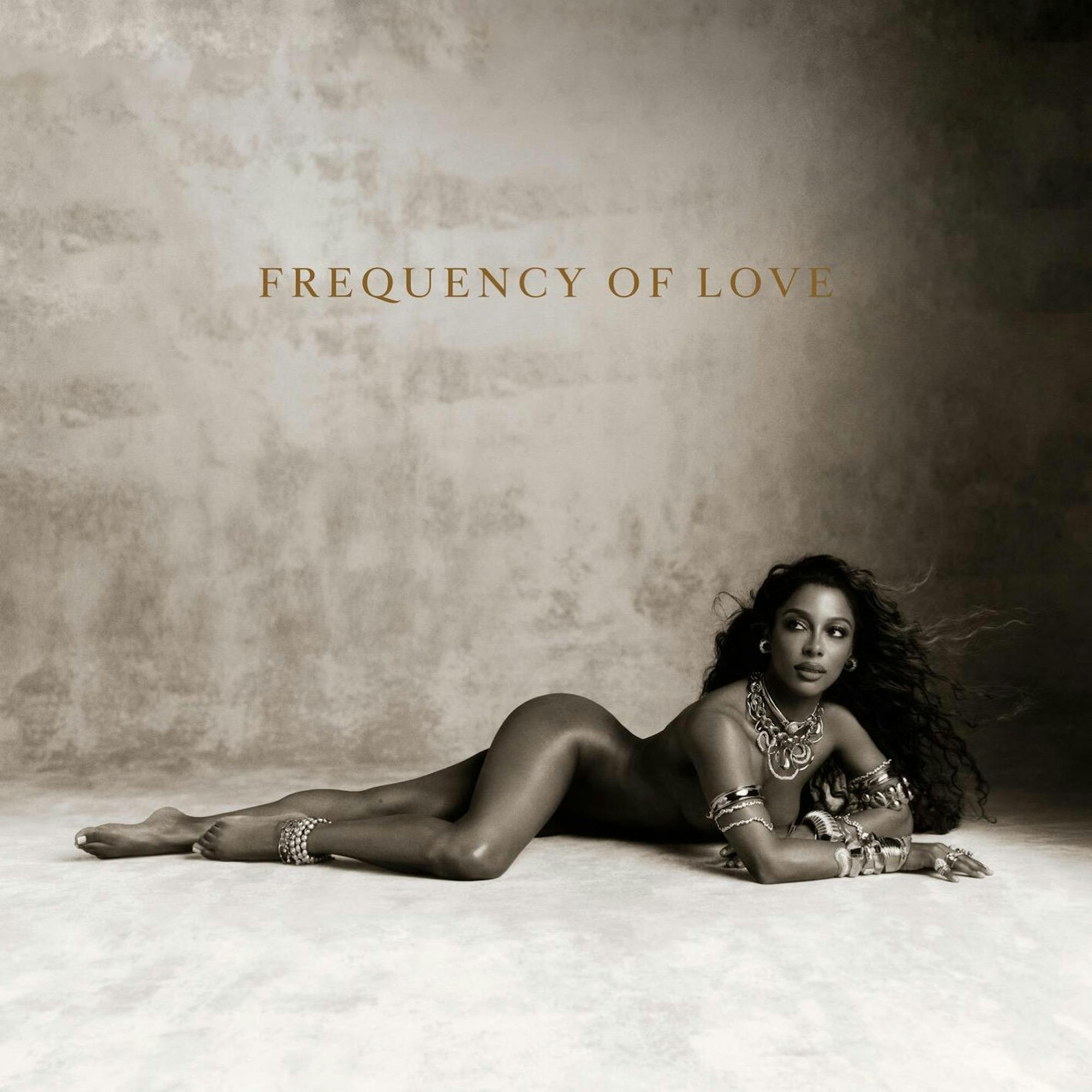
Victoria Monét knows what works. Having written songs for Selena Gomez, Fifth Harmony and Ariana Grande, including “7 rings” and "thank u, next" Monét has established herself as a genre-spanning, effective songwriter. But Monét had her own individual breakout through 2023's Jaguar II. The record was full of artistic risks — breezy, extended outros, experimental bass and horn-heavy production, and confident, sex-positive lyricism. And the risks paid off; the record brought Monét three Grammys, including “Best New Artist,” “Best R&B Album” and “Best Engineered Album, Non-Classical.”
So when Monét began the rollout for her sophomore studio album, Frequency of Love, with lead single “Let Me” in February, there was a noticeable shift in sound compared to the atmospheric Jaguar II — at least at first. The single features Monét gently riffing over a simple bass line and a trap drum sound, audibly minimalist. Even lyrically, Monét didn’t cut as deep, relying on cliché lines like “let me be your ride or die.” But the simplicity of the track only persists until the midpoint, when the breakdown outro brings “Let Me” into a hypnotic acoustic direction. She echoes “I’ve been waiting for this moment all night” right as the track converts its production — a vulnerable confession over stripped-back bliss.
After this double-sided lead single, fans were left wondering what the rest of Frequency of Love would sound like. The following singles, “Reach Out” and “Juicy,” released in July and September respectively, lacked emotional turns in production and lyricism, but are still catchy. “Reach Out” relies on a call-and-response chorus over a stagnant Afro-house beat, and “Juicy” on an exceptionally joyful bass and guitar line, leaving room for experimentation.
But with the release of the complete 22-track record, Monét expands in so many ways she cannot be confined to a certain sound. The record is a flood of features and interludes where Monét comments on the many different kinds of love, whether it be familial, romantic or platonic. She also spreads herself across many different production styles, even if the record is effectively built on her classic R&B backbone.
Major SZA collaboration “See You In My Dreams” employs laid-back acoustic drums, bouncing the production forward as SZA and Monét conversationally relay an experience about a lover who has “too many red flags.” An ascending guitar and bass line in the chorus synchronized with vocals feels like the reconvening of two girlfriends to cynically discuss their love life before all the walls come crumbling down. In a slower, magnetic outro, the singers confess “nobody ever has been a recurring character like you,” embracing the hold their lovers have on them.
Thematically, Bruno Mars’ collaboration sounds eerily similar to his hit song “Die With a Smile,” yet embraces romantic, innovative production. Opening with a snippet from “Ritornerai” (translating to you’ll come back) by Italian singer-songwriter Bruno Lauzi, Monét and Mars confess indefinite love “till the venues are closed and all the lights come on” over a bolero-style groove — castanets, gentle percussion and strings. In the verses, Mars and Monét’s vocals embrace a level of soft restraint until the tension becomes too much, releasing into tender confessions of love in the chorus.
While Monét frequently sings to a lover, she also confesses her love to her daughter Hazel, whose vocals are featured on the track “You Mean The World to Me” alongside Leon Thomas. Thomas and Monét confess the titular sentiment over jazzy chord progressions and admit “That’s why I try to save the world,” beautifully devoting themselves to building a better future for their children.
While Monét often shines through her collaborations on the record, she sometimes falls to a minimalistic level in isolation, like her lead singles. Opening track “All I Need” is two minutes and three seconds of Monét riffing “All I need” in any melodic iteration one can imagine — beautiful vocals, but highly repetitive. “Head to Toe” progresses with a blissfully seductive pre-chorus and verse, but the chorus of “Take your time / do it slow / Baby can you kiss me head to toe,” sounds almost nursery-rhyme-esque in its repeated delivery, disturbing the atmosphere of the track.
But even in Monét’s weaker moments, she is redeemed by the ordering of the record. Every track flows into the next, functioning cohesively like the relationships she establishes lyrically. On “Come Back to You,” Monét vows to always return to her lover after being away for work. She transitions into a darker guitar solo and softly riffs over it, concluding with an acoustic breakdown over snaps and an unexpected orchestra. The strings carry into the next track, “Care For Somebody (interlude)” with a sound reminiscent of Disney’s “A Dream Is a Wish Your Heart Makes.” With vocals as stunning as a Disney Princess, Monét croons her devotion to someone anywhere — whether it be “a cabin or a castle”— over 1950s-like whistling backing vocals and a horn. These two tracks transition seamlessly and build beautifully thematically.
Collectively, Monét will not be defined and cannot be defined. She builds a cohesive 22-track record, never veering too far away from her innovative R&B sound, but crafting something new — a track for every genre, every kind of love. Frequency of Love delivers for many different wavelengths, but will she stay on just one channel next?

Alessandra Gavris is a member of the Class of 2029 in the College of Agriculture and Life Sciences. She is a contributor for the Arts & Culture department and can be reached at akg93@cornell.edu.


