“If it gets too real, you can always turn it off.” This quote reoccurs often throughout Jane Schoenbrun’s Teenage Sex and Death at Camp Miasma, acting as a kind of summary of the film’s themes. It first appears as a tagline on a poster for the original Camp Miasma, a Sleepaway Camp-esque slasher with a problematic history being rebooted by the film’s protagonist.
The film satirizes both the classic ’80s slasher and the modern film industry successfully, but it is at its best when focusing on the relationship between the two main characters. While the film has received mixed reactions, I think that Schoenbrun is exploring something much more complicated than many online reviews give them credit for.
The film begins when Kris Williams (Hannah Einbinder) arrives at the abandoned campground used for the first Camp Miasma film to meet the original movie’s final girl. Fresh off a successful Sundance premiere, Kris is tapped to reboot Camp Miasma for a new generation. As an openly queer filmmaker, Kris is a palatable face for a new version of a film derided by modern critics for its extremely transphobic villain. When she meets Billy Presley (Gillian Anderson), a once iconic teenage actress who has since aged out of opportunities in the industry, the two immediately connect. Despite their generational differences, the two immediately bond over their love for the original film. Where Kris is quick to point out the many issues with the original film, somewhat embarrassed by her love of the campy slasher, Billy happily lives in what is essentially a museum dedicated to Camp Miasma, surrounded by its set, props and with her own movie theater where she projects a film print of her leading role. Billy prefers to keep in mind the motto printed on the huge Camp Miasma poster she keeps in her home: “If it gets too real, you can always turn it off.”
While the film follows what is technically a business meeting between these two characters, the real “plot” is the romantic connection between them and what it leads to. Kris eventually admits to Billy, after expressing her attraction for her, that she has never been able to enjoy sex without fantasizing about being somewhere else. Her favorite moment in Camp Miasma occurs during a sex scene between Billy’s character and the male lead, where Billy sees the villain, Little Death, coming to kill her over her partner’s shoulder. Kris is fascinated by the look in Billy’s eyes as she realizes she is going to die. Billy reveals that she was sexually assaulted during the shooting of that scene, and that in order to distract herself and take back power, she was able to enter the mind of Little Death. The look in her eyes that Kris has obsessed over for decades is the moment when Billy is able to see herself through the eyes of her killer, taking back power. The two women connect over their shared love of fantasy, and the real conflict is revealed as Billy makes it her mission to teach Kris how to achieve the same moment of ecstasy through fantasy.
Teenage Sex and Death at Camp Miasma is not a subtle film. Little Death’s name literally comes from the French expression for orgasm, “le petite mort.” While I’ve seen a lot of criticism for how directly Schoenbrun explores the themes of the film, I loved it. Just like the slashers it satirizes, the film is intentionally campy and over-the-top in its depictions of both sex and death.
In an early scene, as Kris clings to an academic reading of the film she loves so much, Billy tells her that it’s really only about two things: flesh and fluids. Audiences have always been drawn to the taboo, and while Kris is hesitant to admit how much she enjoys imagining herself as one of the hypersexualized victims of a classic slasher, it’s exactly those images of blood, sweat and guts that keep us coming back to the horror movies of the ’80s and ’90s. Schoenbrun is unabashed in reveling in images of Kris in skimpy clothing, covered in blood. After all, as Billy reminds the audience, it’s all just play.
Cinema shows us a fantasy that can be comforting or exhilarating to imagine ourselves in, without the burdens of the real world. Here that motto comes back once more. Fantasy can be fun — Kris and Billy bond over a shared love of candy, often consuming comical amounts of it — but the sugar rush always wears off, and the two return to the real world. Despite how real they can feel, movies are fiction, and we can always remove ourselves from the fantasy.
I’ve read the argument that Schoenbrun is presenting Kris’s obsession with fiction as a positive attribute, but I don’t think that’s the case at all. Just like her candy fixation, Kris’s love for the movies she first watched as a child is a barrier protecting her from the real world. She is unable to enjoy sex without pretending to be in a movie herself and has trouble separating fiction from reality. Her love of Camp Miasma and her acknowledgement of its transphobia and the effect that has on reality are constantly at odds with one another. What the film explores is the balance between fantasy and reality, and what Billy helps Kris realize is that it’s healthy to play: but you can always turn it off.
So, like Schoenbrun’s last film, I Saw the TV Glow, and its memorable throughline, “there is still time,” this tagline for Camp Miasma feels like a fitting thesis for the film at large. While the film might have trouble landing with some audiences, anyone who has ever been a little too into a piece of media might feel a connection with Schoenbrun’s latest.
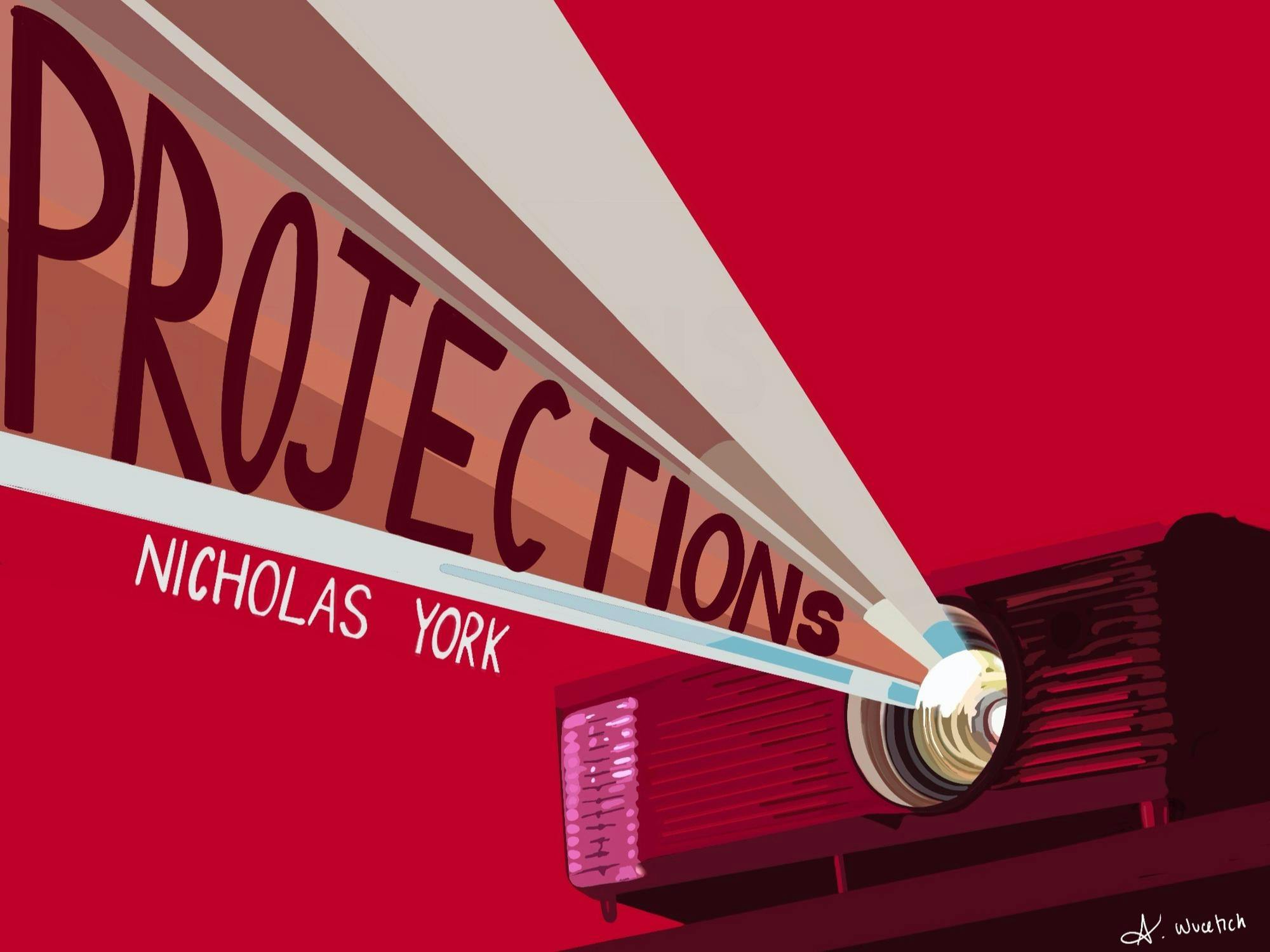
‘Projections’ is a column focused on reviewing recent film releases.
Nicholas York is a member of the Class of 2027 in the College of Arts and Sciences. He is a columnist for the Arts & Culture department and can be reached at nyork@cornellsun.com.