The Student Code of Conduct and Procedures have been updated for the first time since August 2021, per a July 30 statement by Ryan Lombardi, vice president for student and campus life. The changes went into effect on Aug. 1.
The most sizable changes were made to Section VIII of the Procedures, which discusses interim measures and emergency suspensions. Other changes include grammatical and language clarifications, the addition of a paragraph related to freedom of expression, changes to policy related to notations on student records and revisions to conduct prohibited for students and student organizations.
“The annual review of the Code and Procedures provides an opportunity for the university to ensure that its policies remain responsive to evolving student behavior, is consistent with applicable state and federal laws and university policies, and is as clear and effective as possible,” a University spokesperson wrote in a statement to The Sun.
Prior to the adoption of the revised Code, the Code and Procedures Review Committee, chaired by Marla Love, Robert W. and Elizabeth C. Staley Dean of Students, held listening sessions, reviewed resolutions passed by the Assemblies related to the Code and conducted a public comment period in Spring 2026.
The Student Assembly, University Assembly, Graduate and Professional Student Assembly and Faculty Senate all passed resolutions during the 2025-2026 academic year related to Code of Conduct revisions. The Student Assembly passed Resolution 10 in October 2025, the UA passed Resolution 1 in April 2026, the GPSA passed Resolution 5 in November 2025 and the Faculty Senate passed Resolution 209 in November 2025.
“The Committee took public comment feedback seriously and developed recommendations based on what it heard from the broad campus community,” the University spokesperson wrote. “While not every public comment results in a revision, feedback received will continue to be considered as part of each annual review.”
Emergency Suspensions
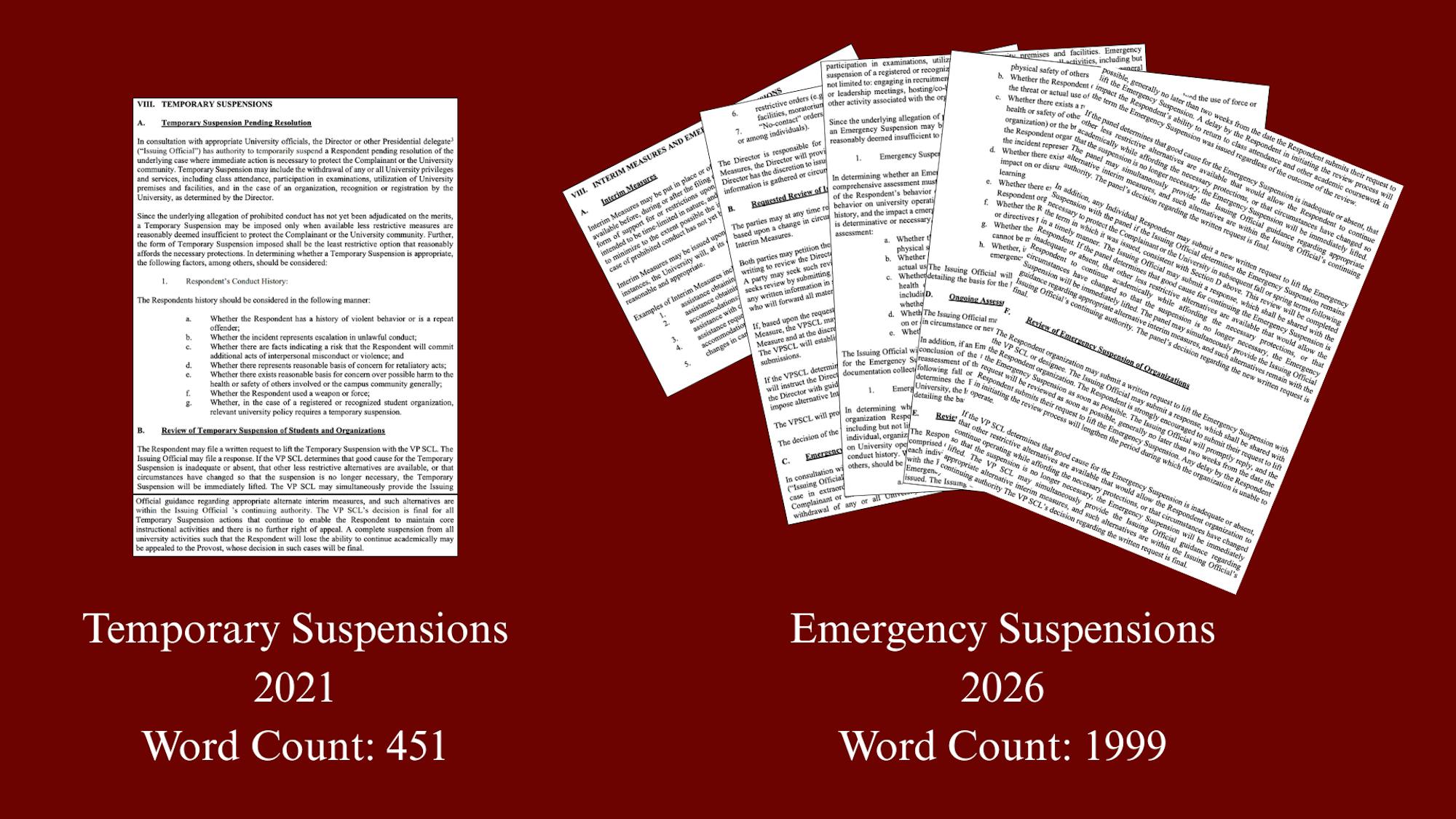
Article VIII of the Student Code of Conduct Procedures was expanded to over four times its previous length.
While most revisions involved phrasing changes, Article VIII of the Procedures, which discusses actions that the University may take towards a party involved in an ongoing conduct investigation, was rewritten. This section, previously titled “Temporary Suspensions,” was renamed to “Interim Measures and Emergency Suspensions,” and expanded to over four times its previous length.
“The term ‘temporary suspension’ was changed to ‘emergency suspension’ to more clearly describe the circumstances in which the measure may be used and its purpose,” the University spokesperson wrote.
In November 2025, the Faculty Senate claimed that temporary suspensions had been “overused.” There were 21 temporary suspensions issued to students in the 2024-2025 school year, up from nine from 2023-2024 and none from 2022-2023, according to data published by the Office of Student Conduct and Community Standards in its 2023-2024 annual report and in a presentation to the Faculty Senate in October 2025.
One of the changes made to Article VIII concerns the factors considered when deciding whether to suspend a student. While both the old and new Procedures included factors largely related to threats to safety, the revised Procedures introduces a factor related to the “possible impact[s] on or disruption to University operations, including teaching and learning.”
The revised article also creates a separate set of factors relevant to the emergency suspension of organizations. In addition to the same factors relevant to students, the new set of factors for determining suspension status includes failure to comply with previous interim measures, high-risk behaviors or if suspensions are required by University policy.
Changes to other interim measures, such as counseling, academic support and restrictive orders, are also reflected in the new Procedures.
Article VII Section B.2.b. of the previous Code of Conduct Procedures listed several factors considered in the implementation of interim measures, including protecting the safety and health of the University, preventing retaliation and “preserv[ing] the integrity of the investigation and resolution process.”
In the new Procedures, Article VIII Section A states that “the University will, at its discretion, determine whether any given Interim Measure is reasonable and appropriate.”
The Procedures also includes a new section — Section D — relating to the ongoing assessment of emergency suspensions.
Additionally, Section B of the previous Procedures, related to the review of temporary suspensions, was separated in the new Code to differentiate between the emergency suspensions of students and organizations. These new sections — Sections E and F — expand on the processes that occur when a suspended individual or organization requests that the suspension is lifted.
Conduct Records and Prohibited Behavior
In addition to emergency suspensions, the revisions include a terminology change from “alternate resolution” to “negotiated resolution,” the addition of a paragraph about freedom of expression and changes notations on student transcripts and prohibited conduct.
Throughout the Procedures, the phrase “alternate resolution,” used to describe a process in which individuals can resolve a disciplinary issue without a formal investigation, has been changed to “negotiated resolution.” Under an alternate resolution, the old Procedures stated that the investigation “will” be paused, while under a negotiated resolution, the revised Procedures state that the investigation “may” be paused.
Article I of the new Code of Conduct includes the addition of a paragraph encoding the University’s Expressive Activity Policy. This paragraph lists types of behavior prohibited by the Code, such as “unlawful entry, property damage, disruption of university activities, including disruption of university events or presentations, or other prohibited conduct.” Within its paragraph on expression, the revised Code specifies that it regulates expression based on these examples of prohibited conduct, rather than the expressed viewpoints or messages.
“The additions to the Code affirm the university’s commitment to free expression and expressive activity while clarifying that Policy 4.23 continues to not exempt students from the Code’s processes when their conduct violates university policy,” the University spokesperson wrote.
Notations made to transcripts, conduct record reporting and holds on degrees, addressed under Article III Section B of the Code, are also expanded upon in the revised Code.
While most policies related to transcript notations did not change significantly, the new Code includes an additional reason for a transcript notation: “withdrawal from the University while a Formal Complaint is pending.”
In regards to conduct record reporting, the revised Code includes a new provision stating that, as authorized by the Family Educational Rights and Privacy Act, the University will provide information “regarding a student’s conduct record that is responsive to the specific question being asked” by the requesting entity.
Under Article IV Sections C and E, the Code also introduces a new separation between behavior related to controlled substances and behavior related to cannabis and marijuanas — the banned behaviors are similar between the two sections.
Additionally, there is a new prohibited conduct related to retaliation, which prohibits interfering with an “individual or student organization’s rights” under the Code or Procedures.

Coral Platt is a member of the Class of 2029 in the College of Arts and Sciences. She is a news editor for the 144th Editorial Board and can be reached at cplatt@cornellsun.com.