

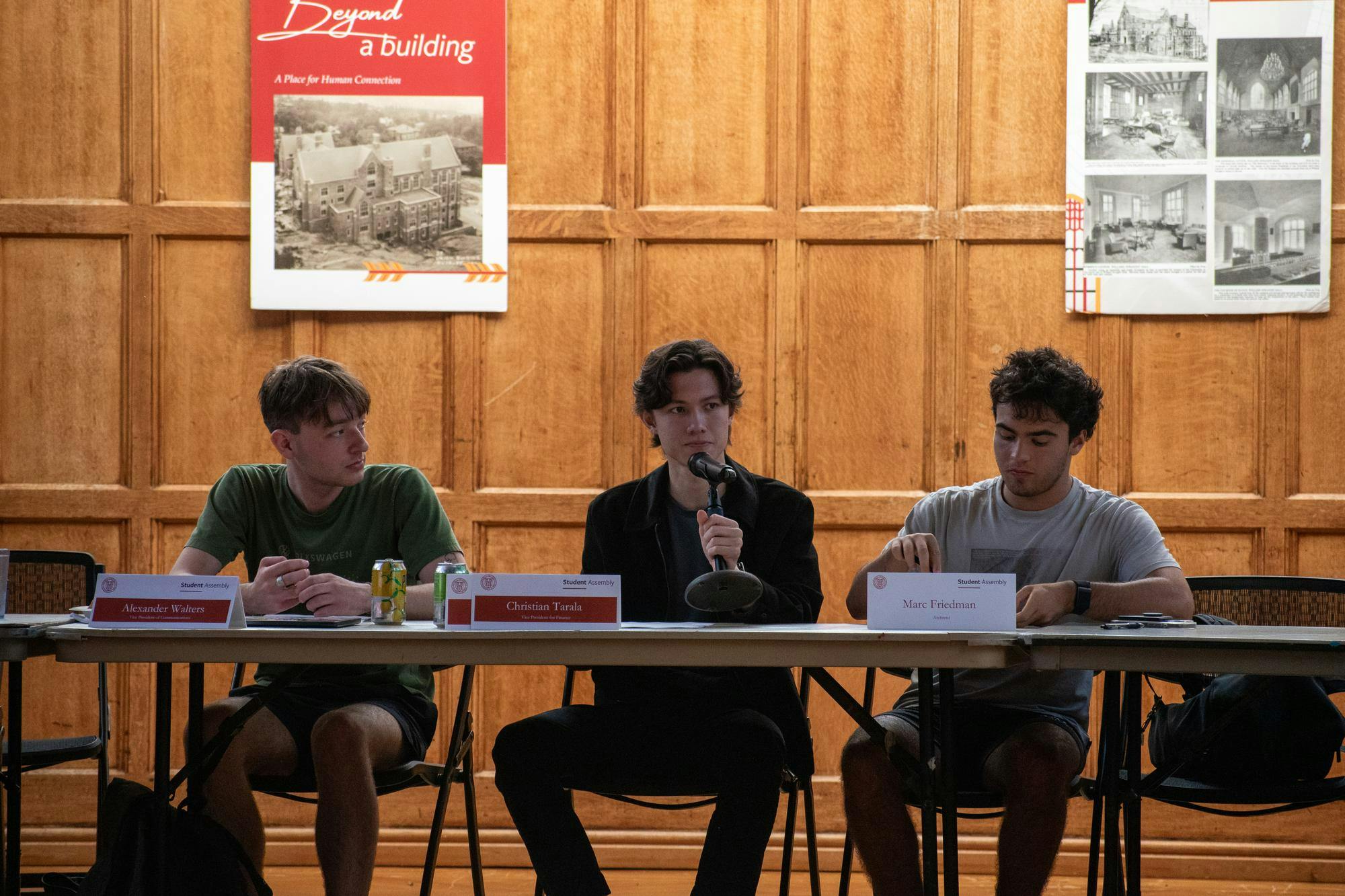
The Student Assembly passed four resolutions Thursday addressing international students’ work authorization, member outreach, its 2026-27 operating budget and Student Activity Fee allocations. It also advanced resolutions on disability representation, anti-bias training and syllabus publication, to be voted on in future meetings.
Resolution 2: Clarifying Practical Training Options for International Students
The Assembly unanimously passed Resolution 2, authored by Jinzhou Wu ’28, Darin Lee ’28 and Jana Orief ’29, which asks the University to provide guidance to international students about off-campus employment options after federal announcements narrowed eligibility for temporary work authorization.
The resolution calls on Cornell International Services to clarify recent changes affecting Curricular Practical Training and provide international students with more information about alternative ways to pursue internships and other employment, including Optional Practical Training.
CPT allows eligible international students to receive authorization for off-campus work connected to their academic programs. Wu, Lee and Orief wrote in a joint statement to The Sun that two August memoranda from the Student and Exchange Visitor Program restricted CPT pathways that many international students had previously relied on for internships.
To be approved, the work must now be “embedded” in a university’s curriculum and required for a student’s degree completion, according to Cornell International Services.
“With internship recruitment already underway, students need to understand how this affects their plans and what options remain available,” Wu, Lee and Orief wrote to The Sun. “Even though it’s early in the semester, waiting could leave students without enough time to make informed decisions or obtain the necessary authorization.”
They added that Cornell had already taken steps to address the changes by holding an Aug. 31 webinar and directly communicating with students who had submitted CPT applications.
“Those conversations can still be valuable, but a resolution brings public attention to the issue, communicates students’ concerns, and establishes a clear request for timely action and ongoing communication,” they wrote.
Resolution 2 passed unanimously and without debate.
Resolution 3: Introducing a Mechanism for Ensured Engagement and Outreach by Members of the Student Assembly
The Assembly passed Resolution 3, authored by Alexander Walters ’28, vice president for communications and writer for The Sun’s art department, and Assembly President Eeshaan Chaudhuri ’27, which creates a points-based requirement for representatives to participate in outreach outside of weekly Assembly meetings.
Voting members will be required to earn five outreach points before the final meeting of each semester. Members can earn points through activities including tabling, appearing in the Assembly’s “This Week in the Assembly” communications, organizing or collaborating on events, contributing to the Assembly Roundup or distributing flyers.
Walters said the measure was intended to address what he described as a longstanding problem of representatives doing little Assembly work beyond the body’s weekly meeting.
“Historically, people have had a really hard time doing anything for the Student Assembly outside of this 4:45 to 6:30 block,” Walters said.
The points will likely be recorded in a publicly viewable spreadsheet, Walters said, allowing representatives and students to see whether members are completing their outreach responsibilities.
“We want consistent, sustained, spread-out engagement,” Walters said.
The resolution passed 27-0-1, with one abstention.
Resolution 4: Approving the 2026-2027 Student Assembly Operating Budget
The Assembly unanimously approved Resolution 4, establishing a $33,039.36 operating budget for the 2026-27 academic year.
The budget distributes funding among the Assembly’s executive cabinet, committees and other programs. The largest allocations go towards administrative expenses, initiatives and special projects.
The budget followed discussion at the Assembly’s previous meeting over how much money should be placed in the Special Projects Fund, which student organizations can apply to to receive money from the Assembly, and a broader Initiatives Fund, a flexible pool for Assembly-led student and community programming.
While the initial budget proposal set the Special Projects Fund at zero and added over $10,000 to a broader Initiatives Fund, the final budget gives both funds equal starting allocations of $4,144.68.
Chaudhuri, who co-authored the resolution with Vice President for Finance Christian Tarala ’27, said the revised budget was “a healthy compromise” after concerns were raised at last week’s meeting about the previous budget proposal. He added that the Assembly has “hundreds of thousands of dollars in the reserves” that could supplement the budget if necessary.
Resolution 5: Removing the Fixed SAFC Student Activity Fee Allocation Requirement
The Assembly also unanimously passed Resolution 5, authored by Tarala, which removes a rule requiring at least 35% of the Student Activity Fee to be allocated to the Student Activities Funding Commission.
The SAFC distributes Student Activity Fee money to eligible undergraduate student organizations.
Resolution 5 does not eliminate SAFC funding. Instead, its allocation will be determined through the regular Student Activity Fee budgeting process, allowing the amount to vary based on factors including projected funding needs and money left over from previous years.
“[SAFC] literally say[s] that [they] get too much money in the byline process every single year,” Chaudhuri said. “We overfund them, and then they have extra money for rollovers.”
Resolutions Awaiting Final Vote
Resolution 6: Solidifying Students with Disabilities’ Representation in Assembly Programming
Resolution 6, authored by Executive Vice President Hayden Watkins ’28 and Strummer Dunn ’29, students with disabilities representative, would add the disabilities representative to the Assembly’s Campus Pulse Committee.
The Campus Pulse Committee is an Assembly committee responsible for programming intended to address discrimination and connect students with relevant resources.
“[Disability] stigma is one of the most pressing issues that students with disabilities face,” Dunn said, arguing that students with disabilities should be included in discussion of bias and related programming.
Unlike Resolutions 2 through 5, Resolution 6 was on its second reading and therefore was not up for final passage. The Assembly advanced it to the third reading calendar, to be voted on at the next meeting.
Resolution 7: Reforming Annual Anti-Bias and Transparency Training Procedures
The Assembly also advanced Resolution 7, authored by Yasmeen Masoud ’28, vice president for diversity, equity and inclusion, which would shift responsibility for the Assembly’s annual anti-bias and transparency training from the CPC to the Diversity, Equity and Inclusion Committee.
Masoud said she already created the training and provided it to the Assembly’s executive cabinet. If the resolution passes, committee chairs would administer it to their members, while Masoud and Watkins would confirm that members completed the training and discussed DEI issues.
Resolution 7 also advanced to the third reading calendar, putting it up for vote at the Assembly’s next meeting.
Resolution 8: Amending the Faculty Handbook to Require Syllabus Publication on the Class Roster and Encourage Common Syllabi for Multi-Section Courses
The Assembly spent much of the meeting debating Resolution 8, which recommends changes to the Faculty Handbook that would require instructors to publish syllabi on Class Roster and encourage instructors teaching different sections of the same course to use a common syllabus.
Under the proposal, instructors would attach a syllabus for pre-enrollment and publish an updated version by the first day of instruction. For courses with multiple sections, the resolution encourages common information on course descriptions, learning outcomes, required materials and grading categories and weights.
Chaudhuri, who authored the resolution, said students can currently have substantially different experiences depending on which instructor teaches their section.
“Who you get as a professor makes a world of a difference,” Chaudhuri said, pointing to courses such as First-Year Writing Seminars, where different instructors can teach sections of the same required course.
Much of the debate centered on whether instructors teaching different sections should be encouraged to use the same grading weights. Some representatives argued that consistency would make expectations clearer, while others said differences in grading structures can give students meaningful choices between sections.
Representative Myshay Causey ’29 was among those who pushed back on Chaudhuri’s argument that greater standardization would promote equity.
“There will be some kids who benefit a lot more from that type of grading system,” Causey said. “There are some kids who … benefit from having assignments every single week, and others who [benefit from] one giant test. It’s not fair just to say that one version is the best version because what’s hard for you might not be hard for someone else.”
The Assembly ultimately advanced Resolution 8 to the third reading. After the meeting, Causey and Chaudhuri indicated that they planned to discuss their differences over the proposal before it returns to the Assembly.

Emma Spindler is a member of the Class of 2028 in the College of Arts and Sciences. She is a senior writer for the news department and can be reached at espindler@cornellsun.com.


