


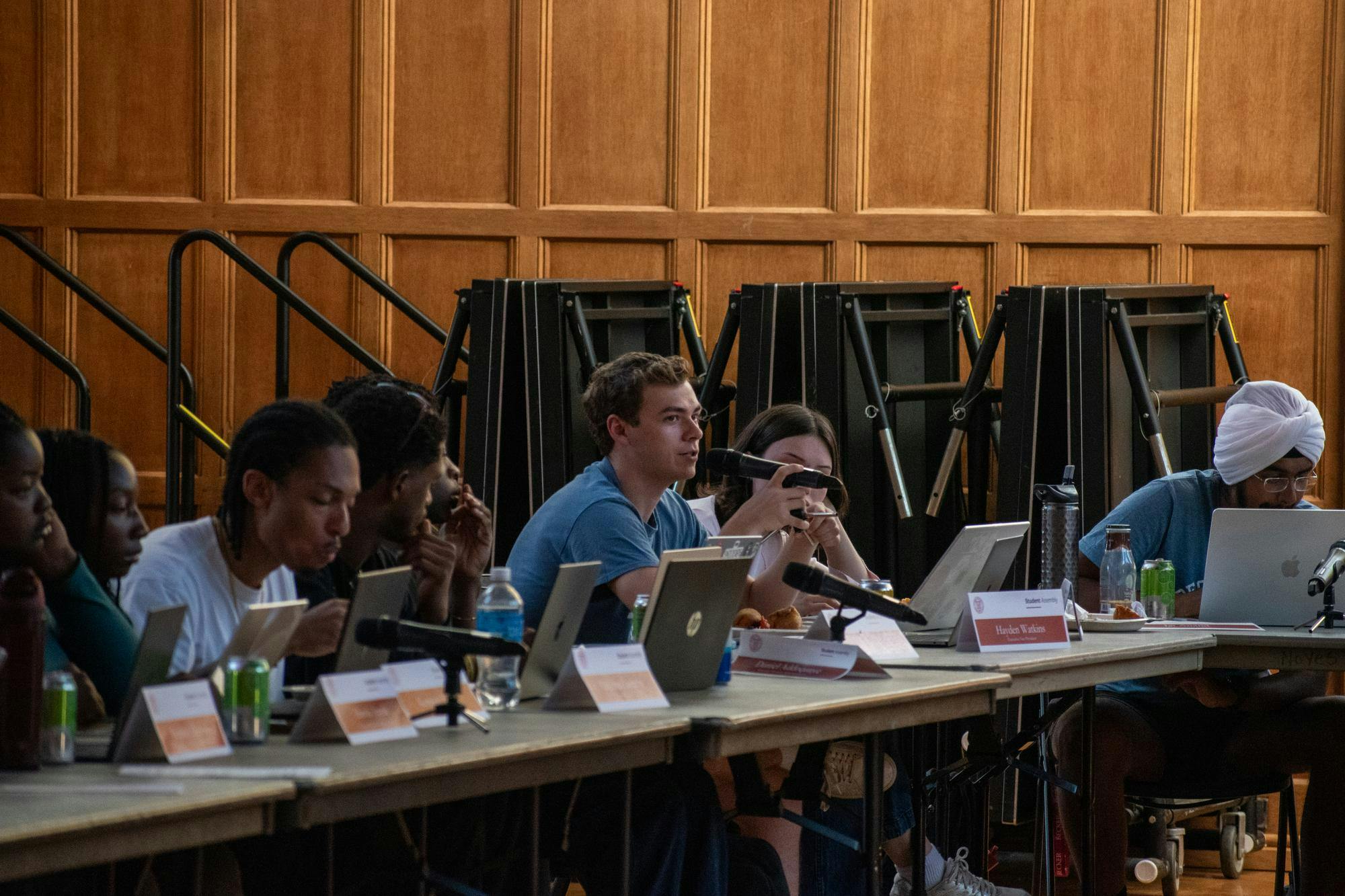
The Student Assembly passed a resolution on Thursday that would require syllabi to be posted by pre-enrollment and allow students to view syllabi from previous semesters, if successful.
Also at the meeting, Thorsten Joachims, vice provost for artificial intelligence strategy, and Steven Jackson, vice provost for academic innovation, presented on the University’s developing approach to artificial intelligence and end-goal of creating a centralized AI system for Cornell.
Assembly Renews Push for Syllabus Requirements
Resolution 8: Amending the Faculty Handbook to Require Syllabus Publication on the Class Roster and Encourage Common Syllabi for Multi-Section Courses, authored by Assembly President Eeshaan Chaudhuri ’27, was passed in a 21-0-2 vote and will now advance to the Office of the President for approval.
The resolution asks the Faculty Senate to amend the Faculty Handbook to require instructors to upload syllabi to the Class Roster by the first day of pre-enrollment and update finalized versions by the first day of classes. It also recommends an amendment to the handbook encouraging instructors to standardize syllabi across classes with different sections.
The measure seeks to provide students with knowledge of course grading breakdowns ahead of time so they can better understand the expectations of courses when planning their schedule.
“Incomplete information at pre-enrollment produces avoidable add and drop activity, which burdens students, instructors, advisors, and the Office of the University Registrar,” the resolution reads.
Chaudhuri added that keeping syllabi on Course Roster would aid students during course selection, as students could look back at materials from previous semesters when considering a course.
“There are drastically different expectations amongst [classes with the same course code], and it’s not fair to students,” Chaudhuri said.
Following-up on last week’s debate, Chaudhuri pushed back on the idea that sections of the same course should be identical, saying the proposal was intended instead to prompt faculty discussion about substantial disparities.
“I think there has to be some more grappling with the disparities when two kids are applying for a job … and they had the same class going on their transcript, but they had wildly different experiences,” he said.
The measure follows a similar effort last spring that asked for course outlines or abstracts to be posted before the opening of enrollment. The spring resolution was acknowledged by President Michael Kotlikoff, who wrote that the University would “explore” software to offer more support.
The Faculty Senate is “already aware” of the resolution, according to Chaudhuri, who said that this is “something that clearly students want.”
He added that he did not foresee pushback against the general content of the resolution –– in particular the recommendation for uploaded syllabi.
“I think it’s ridiculous that [syllabi] aren’t up,” Chaudhuri added.
AI Strategy Presentation
Following the votes, Joachims and Jackson presented on the University’s Cornell’s AI Initiative, its developing approach to artificial intelligence.
The presentation centered on the University’s efforts to incorporate AI across education, outlining initiatives ranging from AI literacy education to University-provided generative AI tools and sustainability efforts.
Joachims and Jackson shared an end-goal of creating a centralized AI system for Cornell that, in addition to providing access to chatbots, would allow the University to track aggregate AI usage, including the number of tokens used, to better assess the technology’s environmental footprint.
Joachims also explained how Cornell doesn’t want to be “locked in to a single [AI] company,” explaining how preserving privacy is a key focus.
“We really want to provide good tools, attractive tools, so that people move from [other models] onto our tools that they trust, that have been reviewed by our lawyers, that have been reviewed by our experts,” he said.
Joachims and Jackson described their educational approach as centered on academic integrity, experimentation and what they called “pluralism,” recognizing that appropriate uses of AI may differ substantially across disciplines.
“It would be weird if our AI stance made physicists teach more like creative writers, or creative writers teach more like physicists,” Jackson said when describing the University’s approach.
Joachims and Jackson also said the University continues to advise faculty against relying on AI-detection software in academic integrity cases, citing concerns about false positives and the ability to circumvent detection tools.
They also talked about the AI critical literacy program, which is required for first-year undergraduates, and the AI Undergraduate Fellows Program, a research grant which will allow students to conduct research about undergraduate AI usage on campus.
During the question period, representatives raised concerns about the environmental impact of AI, its use in military applications, potential effects on University employment and whether paid tiers of Cornell-provided AI tools could create inequitable access.
Joachims and Jackson said AI tools for students would likely be introduced at the beginning of a semester rather than midway through one, giving faculty and support offices time to prepare. Students would also be expected to complete an “AI training and attestation process” before gaining access.
Chaudhuri pushed back on delaying student-facing AI access around the academic calendar, arguing that students are already widely using generative AI regardless of whether the University provides its own platform.
Joachims and Jackson acknowledged the concern but said the rollout of University-wide AI systems would also require training thousands of users and preparing faculty and campus support systems, which are not yet in place.
“We’re actively working on providing these tools, but we won’t put them out until everything’s ready,” said Joachims.
The Assembly also passed Resolution 6 and Resolution 7 at Thursday’s meeting.
Resolution 6, sponsored by Executive Vice President Hayden Watkins ’28, amended Assembly bylaws to include a seat for a Students with Disabilities’ representative on their Campus Pulse Committee, which is intended to reduce discrimination on campus. Resolution 7, sponsored by Watkins and Yasmeen Masoud ’28, vice president of diversity, equity, and inclusion, moved anti-bias training responsibility from the Campus Pulse Committee to the Diversity, Equity, and Inclusion Committee. Both passed unanimously, 24-0-0.
Resolutions Awaiting Final Vote
- Resolution 9: Expanding the Office of Ethics and the Office of Elections, Requiring Continuity of Membership, and Establishing an ROTC Liaison
- Resolution 10: Upholding Cornell’s Health Excuse Policy and Ending Faculty Requests for Medical Notes

Emma Spindler is a member of the Class of 2028 in the College of Arts and Sciences. She is a senior writer for the news department and can be reached at espindler@cornellsun.com.


