


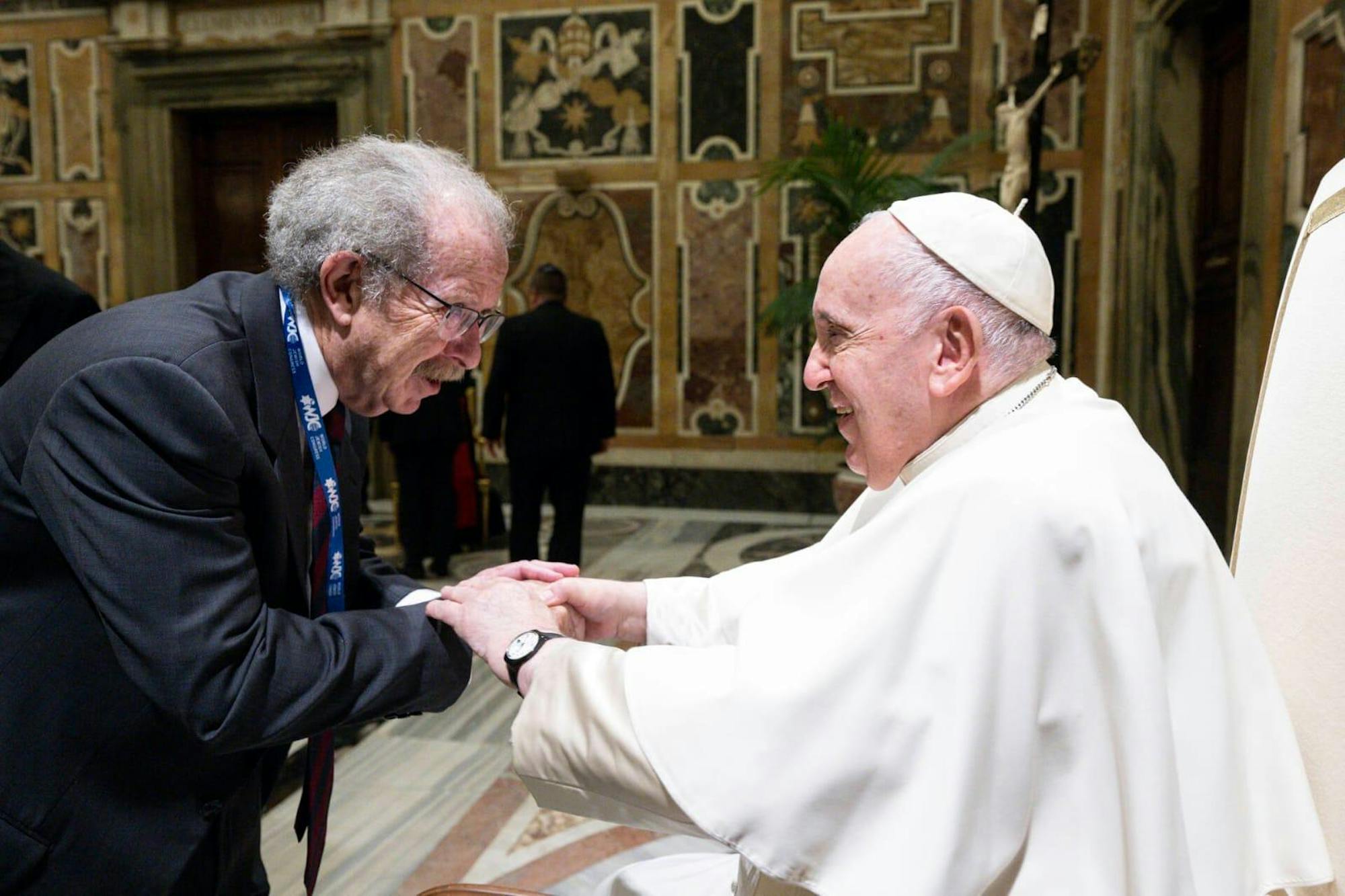
Menachem Z. Rosensaft was born in 1948 in the Bergen-Belsen displaced persons camp, the largest of the temporary housing facilities built for survivors in the aftermath of the Holocaust.
Now, after an illustrious career serving Jewish political and community organizations, he is a visiting professor of the practice at Cornell Law School.
He also serves as advisor to the Cornell Jewish Law Students Association as well as a lecturer in law at Columbia Law School. He obtained both his law degree and master’s degree in modern European history from Columbia. He also holds a master’s degree in creative writing with a poetry concentration from Johns Hopkins University.
Family, Childhood and the Birth of an Activist
Throughout Rosensaft’s career, he has demonstrated a strong commitment to preserving the memory of the Holocaust, particularly through law, a commitment that was born out of the lessons he learned from his parents, who are both Holocaust survivors.
“I grew up in a home in which my parents were very open about their experiences without being morbid,” Rosensaft said.
He was raised without the presence of an extended family, a common experience shared by many children of survivors.
“I knew I didn’t have grandparents,” Rosensaft said. “When we had a Passover Seder, it was the three of us.”
His mother, Hadassah Bimko Rosensaft, saved hundreds of lives at Auschwitz-Birkenau after her parents, husband and five-year-old son were immediately sent to the gas chambers upon arrival at the concentration camp. She worked in the infirmary, treating women’s ailments, performing surgeries with limited supplies and stealing medication to help inmates.
Rosensaft learned of his mother’s work from hearing women whose lives she saved thank her at survivor gatherings he attended as a child.
According to Rosensaft, she also helped to keep 149 Jewish children alive in the Bergen-Belsen displaced persons camp during a cold winter and amid a Typhus epidemic.
Following the war, Hadassah gave testimony at the first Nazi war crime trial.
“[It] gave me a very early appreciation for law…[and] for the judicial process as something that wasn’t an abstract,” Rosensaft said. “This was the mechanism through which my mother was able to prevail over the men and women who had tortured and mistreated her and hundreds of thousands or tens of thousands of others.”
His father, Josef Rosensaft, escaped and was recaptured at least three times from Nazi captivity. After the British army liberated Bergen-Belsen, Josef became a leader of Jewish survivors in both Bergen-Belsen and in Germany’s British zone, according to Rosensaft.
Hearing about his parents’ experiences gave him the impetus to do what he sees as the right thing without regard for how he would be perceived, he said.
“If I believe in something, what good is it…if I don’t act on those beliefs?” Rosensaft said.
Political Activism
Rosensaft has worked to fight antisemitism while promoting Israeli-Palestinian peace throughout his career.
He was one of five American Jews who met with Yasser Arafat, former chairman of the Palestinian Liberation Organization in Stockholm in 1988, and afterwards Arafat recognized the State of Israel. This meeting, he said, was initially unpopular with both the law firms he worked for and the Jewish community at large.
Rosensaft has also supported the work of the Israeli Labor Party and acted as the National President of the Labor Zionist Alliance.
“As a liberal Zionist, I believe that the solution to the Israeli-Palestinian conflict must be one in which both sides have their own right to self determination,” Rosensaft said.
Rosensaft is the General Counsel Emeritus and former Executive Vice President of the World Jewish Congress, where he focuses on fighting antisemitism in smaller Jewish communities around the world.
Rosensaft gave the keynote address twice at the annual commemoration of the 1995 genocide in Srebrenica, as part of his effort to foster Jewish-Muslim relations in Bosnia. In 2023, he led a WJC delegation to participate in the Srebrencia commemoration, Rosensaft wrote in an email to The Sun.
Rosensaft is also a former member of the U.S. Holocaust Memorial Council, appointed by Presidents Bill Clinton and Barack Obama.
In order to keep the memory of Holocaust alive, he said we must respect “its accuracy … by not allowing Holocaust distortion, Holocaust denial, Holocaust trivialization.”
Written Activism
He has also promoted Holocaust education through his books.
His 2014 book God, Faith & Identity from the Ashes: Reflections of Children and Grandchildren of Holocaust Survivors is a compilation of essays written by both children and grandchildren of survivors, including one from his wife Jean Block Rosensaft, who is also the child of two Holocaust survivors.
The idea for the book was conceived after Pope Francis personally emailed Rosensaft after reading a sermon that Rosensaft gave at a synagogue about reconciling belief in God with the atrocities committed during the Holocaust. A publisher then reached out to Rosensaft to create this compilation.
In his most recent book Burning Psalms: Confronting Adonai after Auschwitz, Rosensaft reacts to the 150 biblical psalms from a “post-Holocaust perspective.”
He says psalms usually praise God for helping the Jewish people, but that “the reality is there was no such thing during the Holocaust. There was no divine intervention. There were no miracles, and I felt that this needed to be at least addressed.”
Rosensaft also asks others to become aware of the necessity of adding an acknowledgement of the Holocaust in Jewish liturgy, or the standardized prayers recited during services.
In his book, he also includes a poem called “The Child” in which he discusses how tragedies such as the Oct. 7 attack and the war in Gaza “affect the innocent” Jewish, Palestinian, Israeli and Muslim children.
Teaching at Cornell
At Cornell, Rosensaft famously teaches LAW 4785/7785: “Law of Genocide and War Crimes Trials” and LAW 4013/7013: “Antisemitism in the Courts and in Jurisprudence” — courses offered to undergraduate and law students alike.
Rosensaft said that “above all,” his favorite part of teaching are the students.
“It is invigorating to spend several hours a week with them to hopefully learn from them, to be able to engage with them to get their perspective and hopefully to make a difference,” Rosensaft said.
He enjoys teaching and believes it to be a crucial medium with which to spread ideas.
“Education is, in my view, the necessary way of getting certain values across,” Rosensaft said. “It is not sufficient to say, ‘this is what has to be done,’ people want to know why.”
Although Israel and Palestine are not directly on the syllabus, Rosensaft says that all of his students want to discuss it.
“It’s the elephant in the room,” Rosensaft said.
He only permits them to do so after they’ve learned how the law has evolved and what the term genocide means under the Genocide Convention. He also expects all students to listen and be respectful of others’ viewpoints.
“You can disagree, but you can’t close your mind to it,” Rosensaft said.
Following the events of Oct. 7, 2023, Rosensaft wanted to give a voice to Israeli and Jewish students in his class and the Cornell Jewish Law Association who wanted to discuss their feelings about the event.
The following semester, in the spring of 2024, Rosensaft began offering his antisemitism course to undergraduates. He wants Jewish students to be able to equip themselves with the proper tools to combat antisemitism.
“The most important thing that we do is, one, know who we are … we need to know our own history,” Rosensaft said. “We need to know why we are proud to be Jews, why we want to be Jewish, and we need to know what is, what is not antisemitism, how to deal with it, how to react to it [and] how to explain to people when they’re wrong.”
He also encouraged Jewish students to connect with students who are from other cultures.
“It’s not enough to know why you’re Jewish and how you’re Jewish, but if you have a Muslim classmate, get to know them,” Rosensaft said. “If they’re willing to sit and talk with you, you will be able to create a bridge, and you have no idea where that bridge will eventually lead.”
Rosensaft hopes that his life has made a positive impact on others and has made a difference.
“The Jewish respect for human life and for human dignity is at the heart of what I believe and what I hope I can teach others,” Rosensaft said. “The idea that on Rosh Hashanah, the prayer is ‘hayom harat olam,' which means today the world was born. Not today the Jewish people were born. Not today the Jews were created. But today the world was born. And today the world was created. And that means everyone.”
Dina Shlufman is a member of the Class of 2027 in the College of Arts and Sciences. She is a senior writer and was an assistant news editor for the 142nd Editorial Board. She can be reached at dshlufman@cornellsun.com.


