


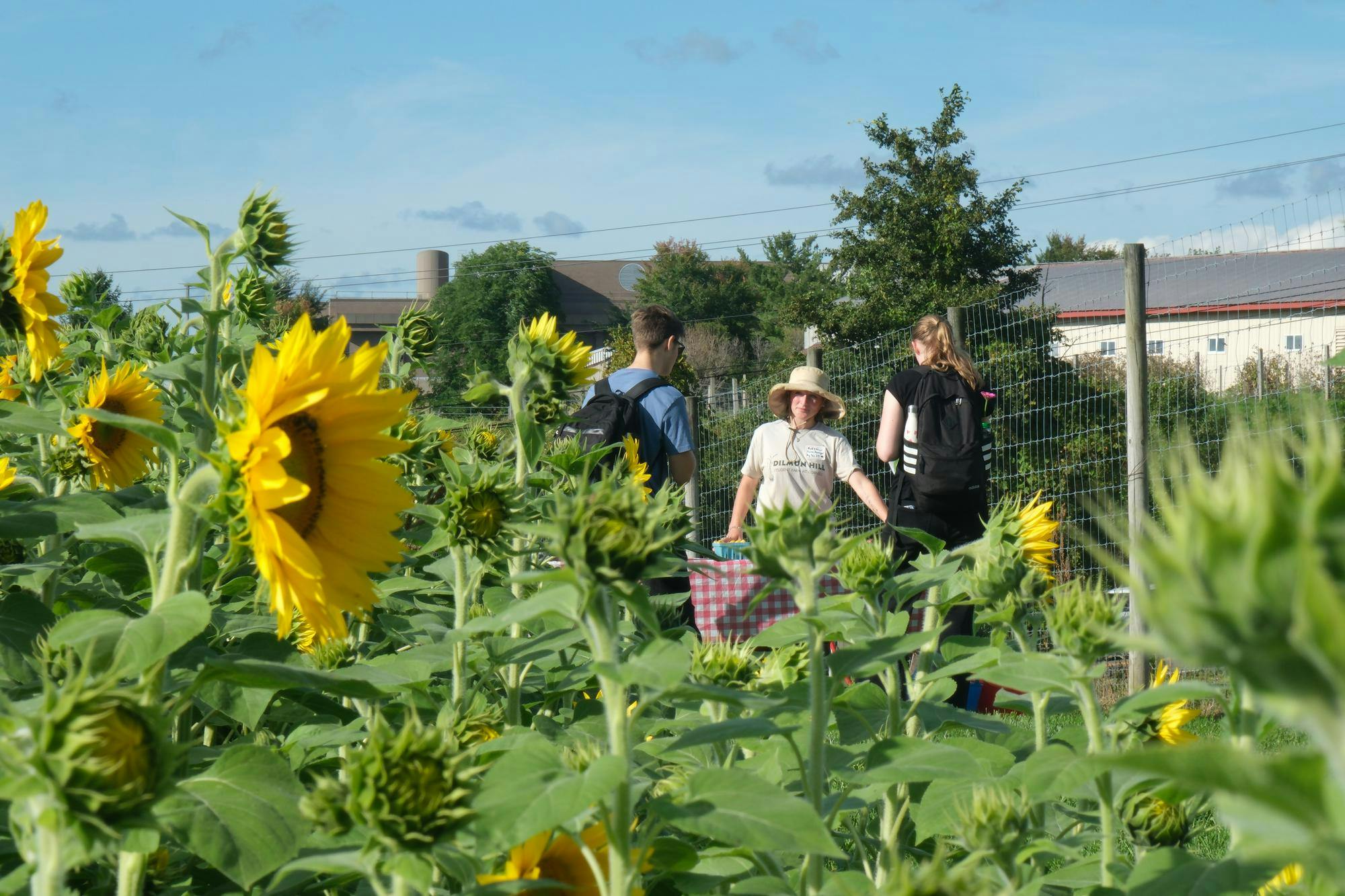
The gravel road of Dilmun Hill Drive, just minutes from Cornell’s main campus, passes nothing but trees and open fields. As it rounds its final bend, a barn comes into view.
More than 100 visitors took that turn on Friday afternoon, arriving for Dilmun Hill Student Farm’s 30th anniversary open house. The event ran from 3 to 6 p.m., allowing visitors to walk around nine stations spread across the farm before a catered reception and a performance from Cousins, a 3-man band of graduate students.
Dilmun Hill is a student-run farm, operating since 1996 by a group of students in the College of Agriculture and Life Sciences who wanted hands-on farming experience. The farm got its start when Cornell Orchards donated three acres to the students, according to a poster explaining Dilmun Hill’s history at the event.
Visitors were able to roam the farm for the afternoon and learn more about what students who work there do.
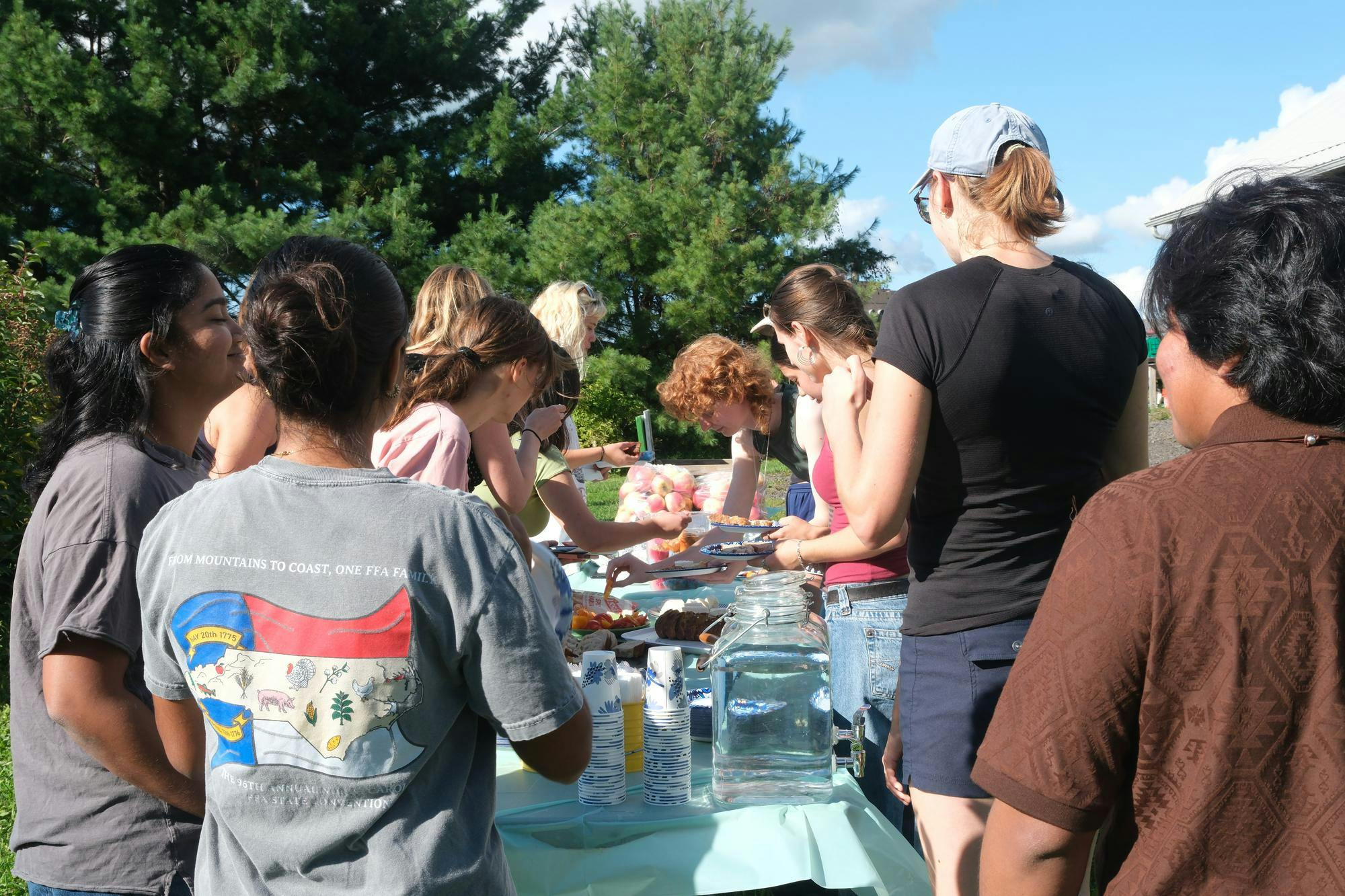
Attendees line up to try the food provided at the Dilmun Hill open house.
Four student managers now run the farm full-time each summer and part-time during the academic year, according to Shabana Mahdis ’29, a student manager at the farm.
“The farm has been evolving, it has been changing every year,” Mahdis said in an interview with The Sun. “Managers learn to do all this work — they choose to order the seed, plan where they want to plant every crop. It's very hands-on, and you get to lead, and you get to decide and make decisions about what you want to do on the farm.”
That student responsibility is documented in a stack of annual reports the farm’s managers have kept since its founding.
Mahdis said student managers began planning the open house over the summer, meeting weekly in the month before the event with Organic Farm Coordinator Ryan Maher to set up stations and coordinate catering and outreach. Mahdis said this process drew on projects and courses already embedded at the farm, from a student beekeeping club to ongoing faculty research.
The stations featured a variety of the work done on the farm: shiitake mushroom cultivation on logs, strawberry patches, beehives, a make-your-own flower bouquet table, a tasting of six tomato varieties grown across 300 feet of rows and a silvopasture research plot studying sheep grazing among pawpaw and black walnut trees.
Two stations covered research led by Prof. Rebecca Nelson, plant science, whose lab has spent about five years developing a fertilizer system that treats human urine and applies it to raised beds of wheat straw, compost and biochar. This helps crops grow safely above the certain areas of the farm where the soil is lead and arsenic-contaminated, a legacy of the orchard once there.
Xochitl Cuevas ’30, who hadn’t been to Dilmun Hill prior to Friday’s event, said the research reflects a direction she hopes the farm leans further into.
“With all of this climate change, we’re going to have to start looking forward to more sustainable practices,” she said. “It’s going to have to be our final line of defense — or just a chance for evolution.”
Friday also marked graduate students Becky Mai’s and Zhimeng Zhang’s first visit to the farm. They said that a trip to the Ithaca Farmers Market inspired them to learn more about Ithaca’s farms.
“[The Ithaca Farmers Market] left us [with] a really good impression,” Mai said. “That is why we would like to explore more about Ithaca and the farm culture.”
Walking the grounds, Zhang said she hoped the farm would stay the same even as Cornell’s campus continues to grow around it.
“We really enjoy the view and the nature, and I really hope this kind of place will not be destroyed or have a new building here,” Zhang said.
Cuevas, who learned about the open house from an Instagram post, said touring the stations reshaped her sense of how the farm operates.
“When I first heard it was a farm, I kind of assumed it would be [managed] under professors, and students would volunteer,” Cuevas said. “Learning that there are student managers … puts in perspective how student-led this is.”
Mahdis said the farm hosts volunteer work parties every Friday and posts ways to get involved on its Instagram and Substack newsletter.
“We’d love for people to find their way to come over here, learn about our work and get involved in any way,” she said. “This is a great place for them to experiment, do their work, lead and not be afraid to do that.”

Rowan Wallin is a member of the Class of 2027 in the Nolan School of Hotel Administration within the SC Johnson College of Business. He is a senior writer for the news department and can be reached at rwallin@cornellsun.com.


