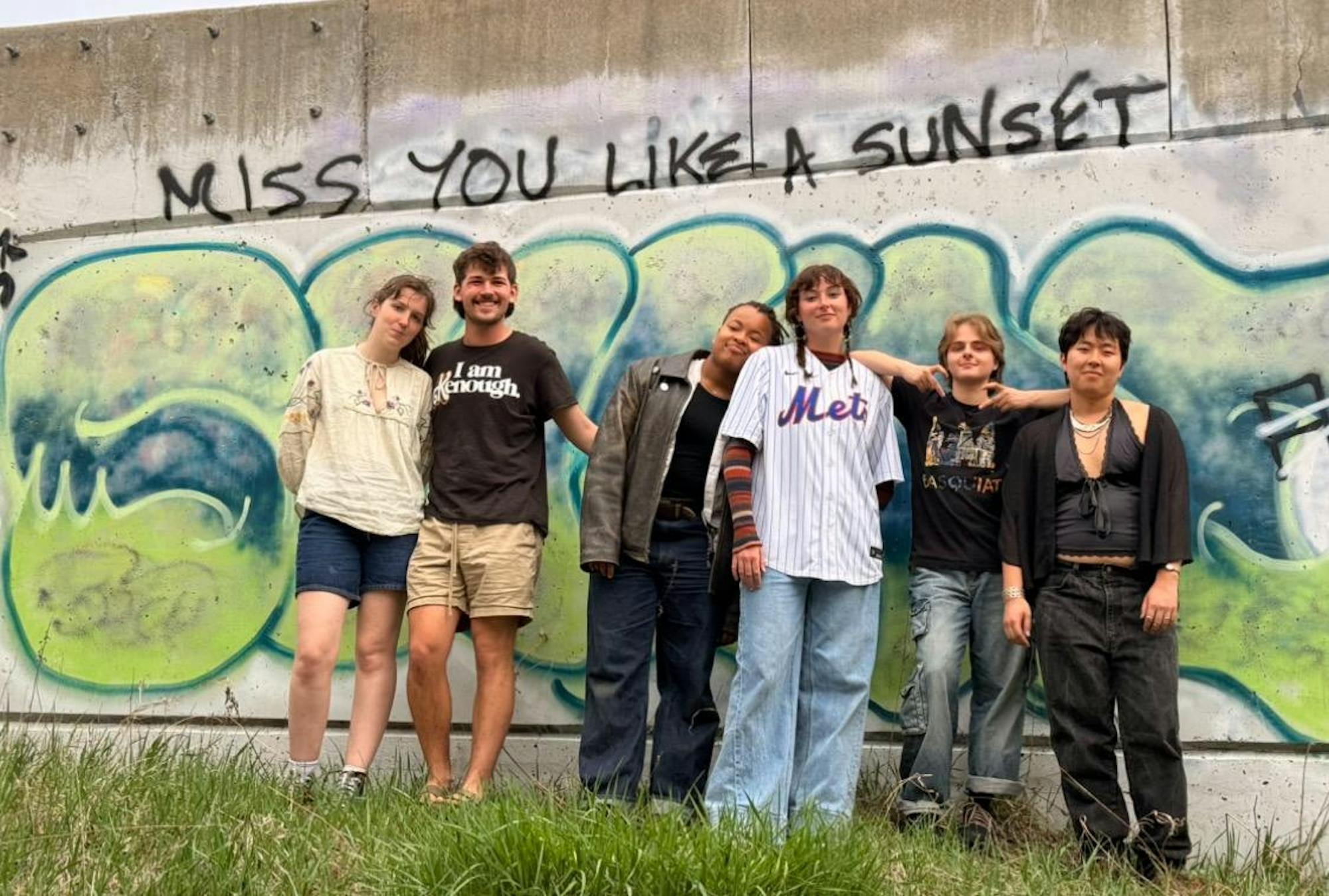
On April 17, Big Strong Man Productions performed Sunset Splatter in Goldwin Smith Hall, and on April 18, they traveled out to stage the play under a bridge. Sunset Splatter is special in that it’s a completely original, fully Cornell student-made production which premiered here on campus. The play was written by the recently graduated Lila Rallatos ’24, as the second collaboration between director Caroline Murphy ’28 and Big Strong Man Productions since Girls! Girls! Girls! this past January.
In 1987 New York City, three friends — Sid (Justin Lee ’26), Terry (Zoe Buddie ’26) and Cal (Astrid James ’27) — meet in a subway with the plan to commit suicide together, ambushed by Sid’s kid brother Preston (Hugo Keil ’27) who wants in as well. Lovers Sid and Terry are suffering from AIDS with only months to live, Cal is filled with guilt from her part in the suicide of her lover and Preston is riddled with angst drawn from his abusive father and neglect from Sid. However, their plans are disrupted when, as they jump, they realize the train has stopped. Someone on the track was run over earlier. Sid shouts, “Some Bushwick asshole stole our idea!” Stuck with each other, they wait for the next train. The four argue, joke and cry as the gravity of their pain flows strangely yet naturally between spit competitions, arguments of whose name should come first in their gang and one absurdly explosive debate over balls of gas and the color of the sun. The climax is an optimistic celebration of life. Sid readies to jump, but Terry calls to him to tell him that if he turns around, he’ll see Preston smiling at him. Just before the train passes, Sid turns, and he throws his arms around Preston in an embrace instead, realizing he needs to be there for him.
The characters are all incredibly rich — all portrayed with heart-rending depth by each actor — and each has come to the proposition of suicide from a different place. One of the most clever ways this is communicated is through the set design. At the Goldwin Smith showing, a white-tiled subway wall was covered by four posters; as assistant director and set designer Alex Miloszewski ’27 explained, “We have four characters. So, every poster represented a character.” Sid was represented by the Marlboro Man: “He’s like a cowboy. He wants to live for himself.” Terry was represented by an engagement kiss “because she loves so fiercely.” Cal was represented by a healthcare ad because she couldn’t save her lover, Rain, from death. Preston was represented by a cartoon representing the “childhood he lost by Sid.” Milowseski shared, “I was trying to show what each character’s ideal life would look like if they weren’t a queer person, victim of trauma or like a queer person living in New York — or afflicted by AIDS.”
Murphy said, “One thing I really wanted to hammer home was that a lot of the problems with the characters that felt internal were actually very external and were caused by a system that forgot about them, a system that really didn’t support them at all. [We] prefaced that by having these posters representing an ideal of how they’re supposed to move in this world, but an ideal they were not able to meet.” In the end, that truth was physicalized through the graffiti covering the posters.
The performance was sagacious at the same time as it was flippantly raw, as it sought to answer the essential question, “Is life worth living?" through the most quotidian interactions. The play engineers the spontaneity of friends riffing so naturally that it feels like improv. The seemingly silly act of Terry sharing grilled cheese sandwiches she had made — of course sparking more arguments over which local deli is best, what kind of cheese it should have, etc. — becomes something incredibly intimate, and, as Rallatos would argue, the reason to keep living. In our interview, she expanded on this idea: “These little moments in your life that seem so stupid when you take them in isolation … that’s what living is about … It’s about what you can do to make yourself and other people feel like they’re exactly where they’re supposed to be right now, and you do it on accident every single day.”
It’s those moments in life where you make fun of a bad movie, or tease your friend for some slip they made, or debate something ridiculous like whether a hot dog is a sandwich that are going to fill in the void in our lives. I felt myself wanting to be a part of Sunset Splatter’s world, wanting to be Sid or Cal’s friend. I wanted to live in it despite the surrounding circumstances of that world being horribly tragic and painful, which I think is a testament to the primacy of our experiencing of each other over everything else.
Tommy Welch is a member of the Class of 2026 in the College of Arts and Sciences. He is a staff writer for the Arts & Culture department and can be reached at twelch@cornellsun.com.