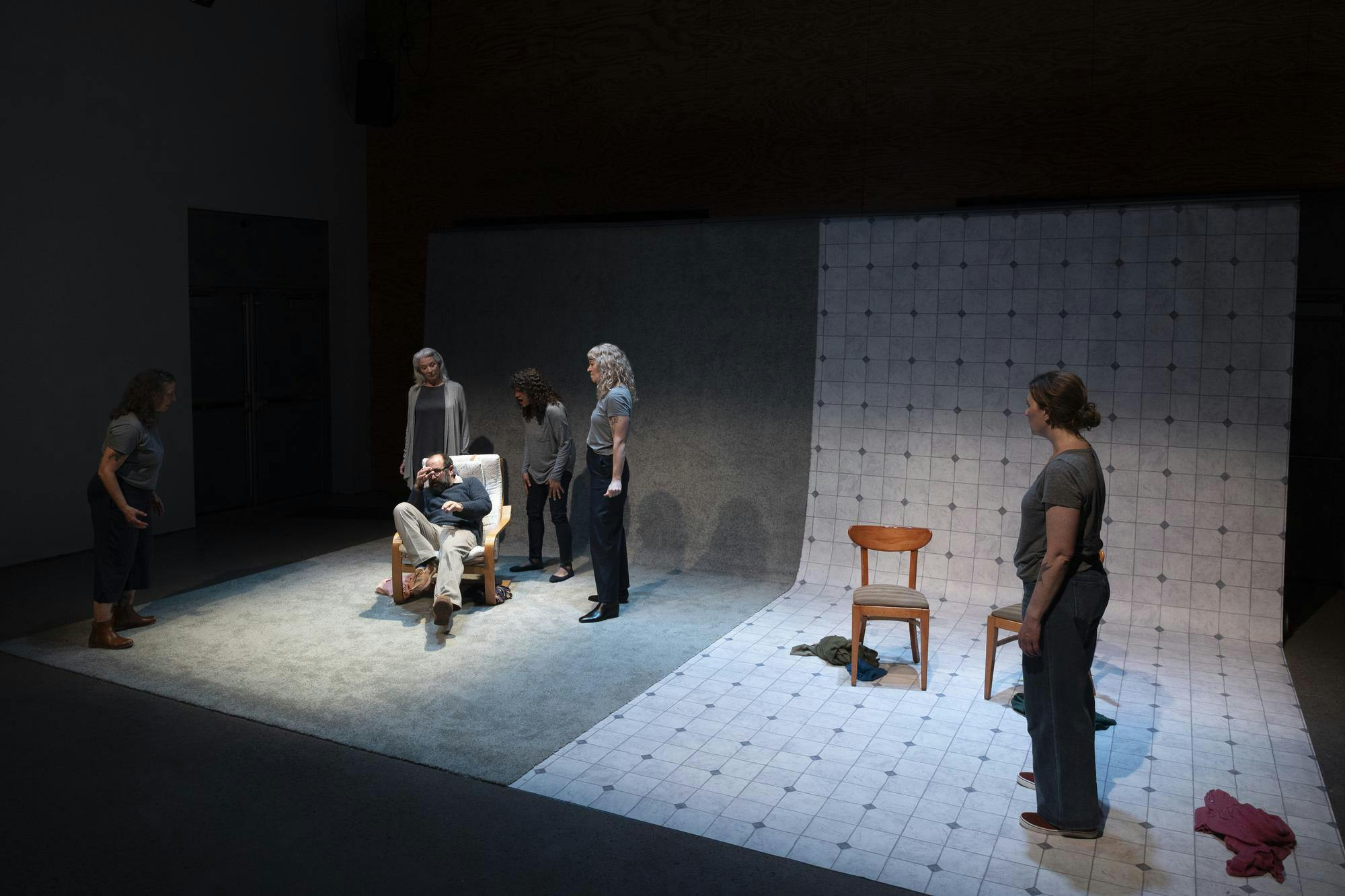
“The child is there. THE CHILD’S FATHER is there. Beyond that, nothing is certain,” reads the prelude for the American premier of Monica Isakstuen’s play, originally written in Norwegian. The piece is an abstract meditation on absent motherhood, although I hesitate to pin it down in such terms — or any terms, because the events of the play are truly as uncertain as they purport to be. Isakstuen’s elusive piece was staged in Ithaca this past week by the Cherry Artists’ Collective, an arts hub that often stages newly translated works. Their production, directed by the Cherry’s executive director Samuel Buggeln, speaks to the core of the show, shrewdly actualizing the diverging realities that Isakstuen contemplates in the piece.
The play wrestles with one central question: How could a mother leave her child? It depicts five versions of the child’s mother, called “The First I Could Be,” “The Second I Could Be” and so on. Each “I Could Be” sequentially shows up to the father’s house in the middle of the night, seemingly on a quest to come to a mutual understanding about why she left, to see the child, to take the child or some combination thereof. These characters are more ideas than individuals, and these ideas about who the mother could be are all efforts to work out the play’s fundamental question. The “I Could Be”s and the father’s conversations don’t play out as typical scenes (e.g., the mother and the father fight and she leaves, or something along those lines). Rather, the pair explicitly considers and debates the possibilities of their lives as they unfold. For instance, in a moment of tension, The First I Could Be does not just tilt her head back and look at the ceiling; instead, she says, “I tilt my head back and look at the ceiling,” as if she and the father are devising their own understanding of the mother she could be as they debate.
Some of the “I Could Be”s embody more standard archetypes than others. After The First I Could Be (Darcy Rose) tells the father that she wishes he would hit her, The Second I Could Be (Sylvie Yntema) spawns, exclaiming that “The Second I Could Be is a victim,” contrasting the First’s unrealized desire with the Second’s truth. Yntema’s portrayal of The Second I Could Be was particularly impactful. She leaned into the sanitization inherent in trying to devise a satisfactory explanation for the mother’s leaving, while still playing the character as an individual who truly believes the story she is telling the father.
The archetypes continue: The Third I Could Be (Erica Steinhagen) is an abusive mother, and the Fifth I Could Be (Elizabeth Mozer) is a dead mother. By the time the Fifth arrives, the show is explicating the ridiculousness of searching for a clean answer to the play’s central question. The Fifth I Could Be knows she represents the neatest explanation — “Death gives the mother a valid excuse for absence; death is simplest for all concerned” — and Mozer displays awareness of the silliness of portraying an already-dead creature, playing The Fifth I Could Be as more satisfied and smug than her fellow I Could Bes, who are less able to accept their own reasons for why they left.
The creative team visually materializes the increasing unreality of the father’s home as it populates with the I Could Bes. At first glance, the set appears to be a typical split stage, with contrasting wallpapers on each half of the set and furniture that seems contained to each side of the stage. But, upon closer look, the patterns on the walls continue onto the floors, and the characters never pay any mind to the furniture split. As the I Could Bes contemplate their possibilities, neon purple and red outlines of their bodies appear on the walls behind them. When the new I Could Bes spawn, scratchy sound cues fill the space and the lighting stutters. To state the obvious, Beyond that, Nothing is Certain does not intend to be a show that is entirely understandable. Yet still, such shows run the risk of confusing an audience more than they are prepared for. In this case, through the direction, which paints these scenes as off-kilter and unreal, the creative team gives the audience permission not to make sense of the show’s events, allowing us to take the uncertainties as they are.
Beyond that, Nothing is Certain takes up an inexplicable question and wrestles with it in the only way such questions can be wrestled with: considering possibilities but leaving them unresolved. By the show’s conclusion, we do not know which of the mothers She Could Be is the actual one, if there is an actual one or why any of the I Could Bes left their child. But the show ends as it began, with The First I Could Be, who now approaches the sleeping child. She is not certain whose mother she is, or who this child is, but she is a mother who has left a child, and the child is one who has been left. In Beyond that, Nothing is Certain, Isakstuen suggests that there is little anyone can truly know about absent mothers, but, as The First I Could Be tells the child, “I just want to say I hope you’re alright,” it seems that at minimum, she hopes that a mother who leaves her child still cares.

Chloe Asack is a member of the Class of 2026 in the College of Arts and Sciences. She is a staff writer for the Arts & Culture department and can be reached at casack@cornellsun.com.