


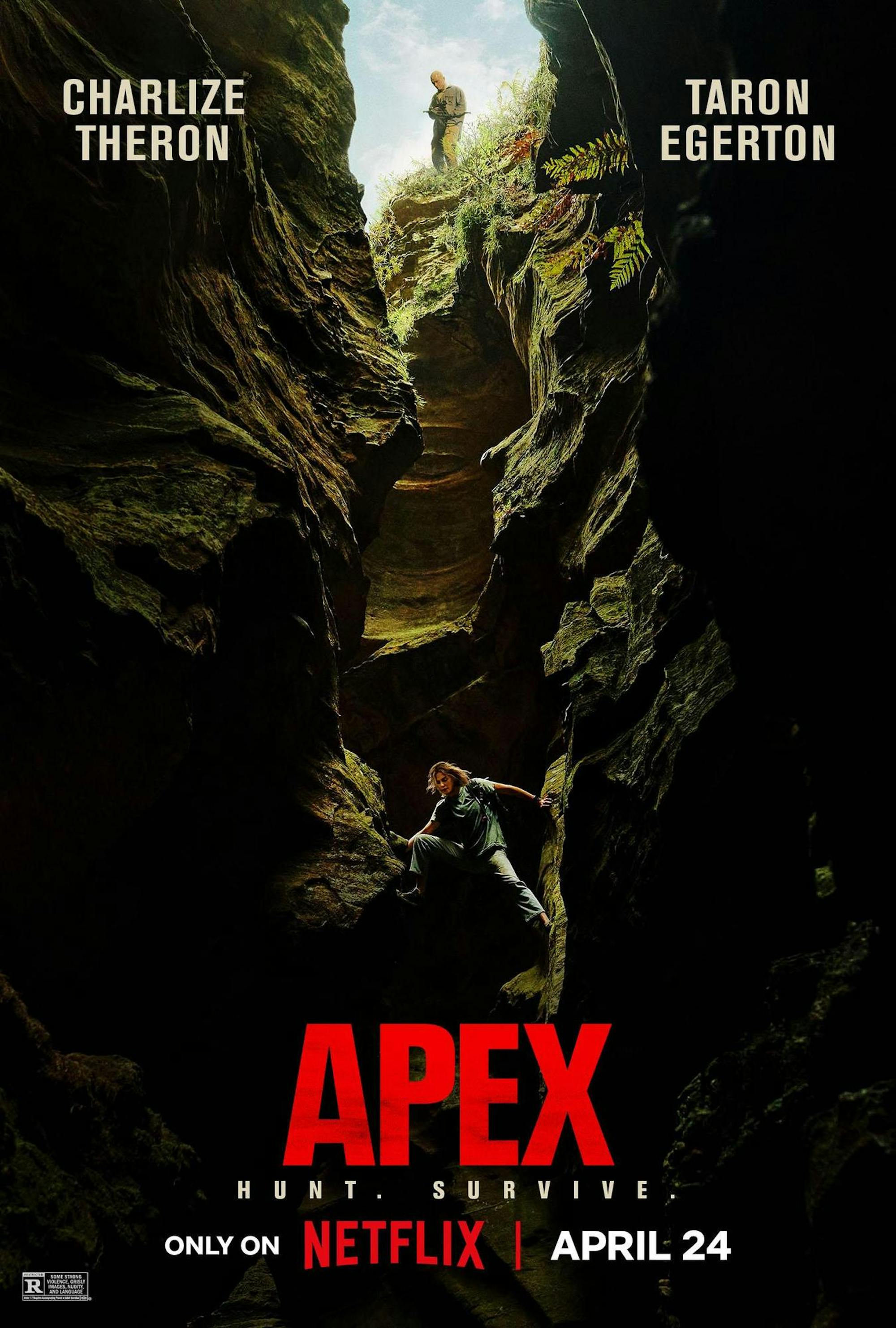
When I read Netflix’s one-sentence synopsis of Apex for the first time, I laughed: “Oscar winner Charlize Theron stars in this hunt-or-be-hunted thriller about a grieving adventurer targeted as prey while kayaking in the Australian wild.” As it turns out, that absurdly specific sentence ended up being the most coherent thing about this entire film.
Advertised as a hybrid slasher-survival flick, Apex follows protagonist Sasha (Charlize Theron) as she runs, kayaks and climbs for her life in the Australian wilderness. Who, exactly, is hunting her? A British serial killer with a questionable Australian accent named Ben (Taron Egerton).
As is the case with most protagonists in films like Apex, Sasha has a traumatic yet painfully predictable backstory. The film opens inside the cramped interior of a tent, where the audience is introduced to both Sasha and her Australian adventurer-in-crime husband, Tommy (Eric Bana). After bandaging calloused fingers, Sasha unzips the tent’s flap to reveal that the couple is perched precariously on a cliffside, thousands of feet in the air. Sasha and Tommy, despite being close to the summit of their climb, are ultimately forced to descend the cliff due to unforeseen weather complications. A few minutes before his descent, and ultimately fatal plunge off the mountainside, Tommy reveals that not only is Sasha an adrenaline junkie, but it is she who continues to push the couple on dangerous climbs despite their middle age.
It is with this context that the film jumps 10 months to the present day as Sasha prepares to embark on a kayaking trip in the remote Australian wilderness. Without much clarification, the audience must assume that Sasha’s decision to explore her late husband's homeland is driven by a desire for catharsis, yet the film never fully commits to exploring what that actually entails. While I understood the intention behind Sasha’s backstory, its inclusion felt disjointed and slightly irrelevant to the actual meat of the film. If director Baltasar Kormákur were to have started Apex from Sasha’s arrival in Australia before making a brief mention of her husband’s death at some random point in the film, my overall takeaway of its message would’ve stayed the exact same.
Apex’s main problem isn’t its plot, acting or cinematography. Rather, the real letdown lies in Kormákur’s choice to focus on insignificant details throughout the film without actually following through on them, leaving several loose ends and unexplored plot points in his wake. For one, Ben’s entire character design is incoherent and still has me confused days after my first watch. Posing as a friendly local amongst the several shady characters that Sasha encounters before her trip, it’s almost too easy to predict that Ben will be the primary antagonist of the film. Later, it’s revealed that Sasha is destined to become one of the many victims that Ben hunts down, chains up and then dismembers in a hidden cave. Despite being from Britain, Ben seems to be appropriating tribal practices and indigenous theology in order to conduct ritualistic killings. Where Ben’s tribal obsession stems from remains unaddressed throughout the film, and just ends up painting him as some sort of lunatic with no context behind his murderous inclinations.
Apex wasn’t all bad, though. The film does a decent job of marrying crime and survival elements, particularly through its high-stakes chase sequences, gore and use of the Australian landscape to heighten the tension between Sasha and Ben. Perhaps the film’s strongest moment is its unexpected twist toward the end, combining a free solo climb with unique metaphorical play to illustrate Sasha’s grief as she conquers a similar cliffside terrain to the one that killed her husband.
Yet, even in its strongest moments, Apex never quite reaches the narrative or emotional potential it originally sets out to achieve in its lengthy opening scene. While the film gestures toward a meditation on Sasha’s grief or perhaps a deeper exploration of survivor’s guilt, the majority of its non-action scenes feel rushed and randomly placed, without full context. What could’ve been an intimate character study on Sasha and Ben’s cat-and-mouse dynamic is replaced by scenes that prioritize spectacle and visual stimulation over any semblance of major plot development. While Apex is certainly a fun and heart-pounding watch at times, it lacks any sort of distinctive substance or inspiration, ultimately adding itself to an ever-growing list of soulless adrenaline flicks.

Charlotte Feehan is a member of the Class of 2028 in the College of Arts and Sciences. She is a staff writer for the Arts & Culture department and can be reached at cgf47@cornell.edu.


