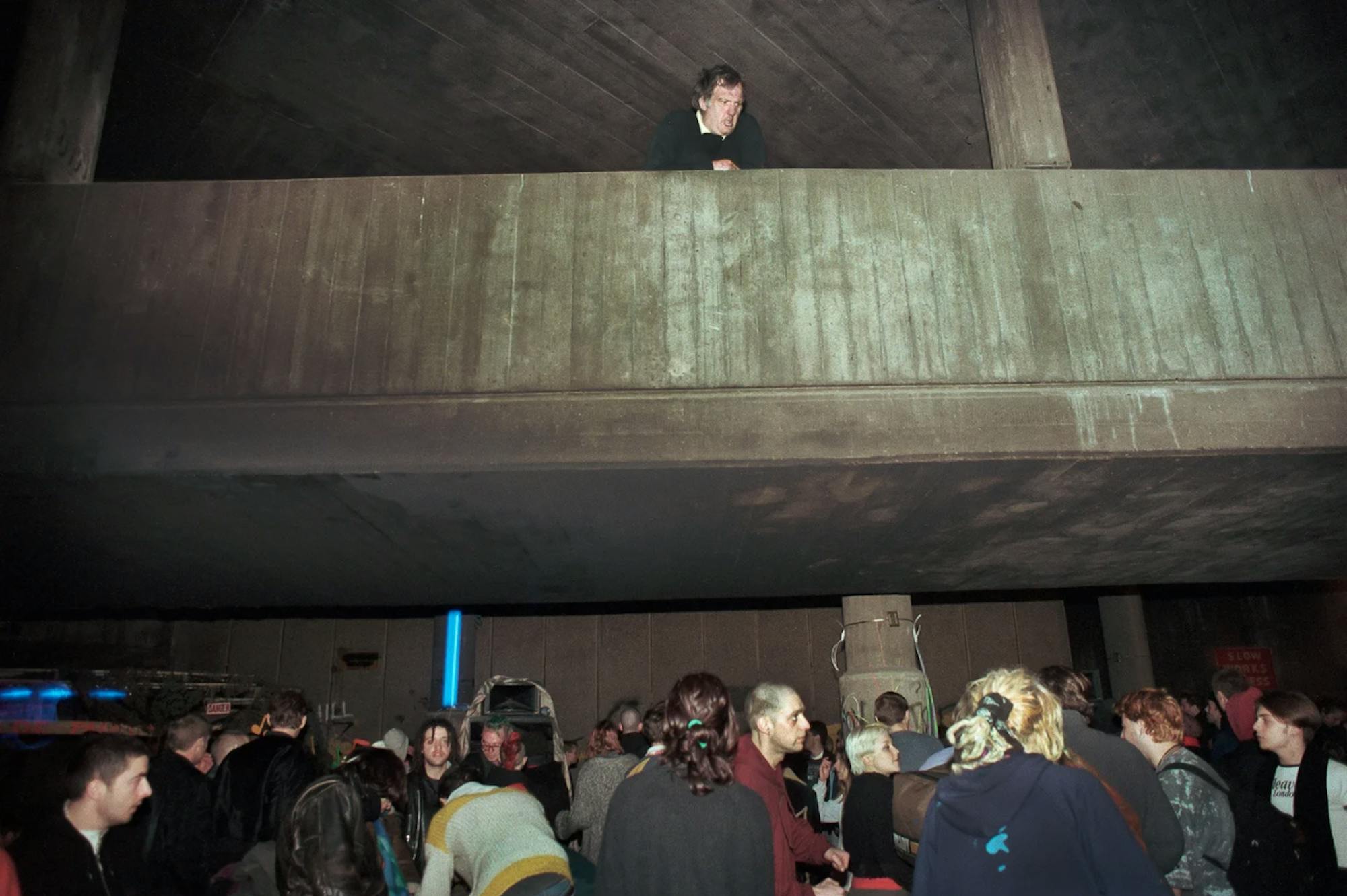
“Dance culture exploits the power of music to build a future on the desolate terrain of the present.”
— Drew Hemment, “e is for Ekstasis”
From Wasteland to Eden
Said aloud, Detroit, Michigan, Kyiv, Ukraine, Peckham, England, Toronto, Canada, Berlin, Germany, Brooklyn, New York and Tbilisi, Georgia are unsuspecting metropoles. Set apart by language, rivers and oceans, subcultures and relative wealth, the average Substack travel blogger might assume the sole dividing line between Williamsburg and London is the local connotation of ‘chips.’ Yet under repression and even revolution, each city similarly produced havens for a socially disenfranchised counterculture to finally surface in a medium — raves — that knew no direct ancestor.
Often condemned to the peripheries of cities, drained watersheds or factories left to waste by corporate exile and outsourced labor or recession, the scene birthed from aggression enables the liberation of mind, mouth and body — at least temporarily — from the grasp of malevolent politics and invaders.
Why has the innocuous rave taken root again in the most barren soils? And what leads Thatcherian aggressors to their boiling point as a result? The answer ranges from war to civil conflict to brewing revolution — but at its core responds to symptoms of an unrooted society.
At Oppression’s Root
In 2014, contempt for Viktor Yanukovych, a Russian cheerleader-turned-president, spilled into Kyiv’s streets. Post-industrial edifices assumed the role of insurrectionist meeting grounds and disgruntled students kickstarted Cxema, a rogue group planning secret parties that, if you know, you know, fostered the desire for rebellion.
Detroit’s underground rose quite literally from melted polyvinyl and ash when the White Sox’s “Disco Demolition Night” incinerated hopes for the ’70s genre to make it big, forcing pioneering Black artists into the far reaches of their city. The result? DJs like Frankie Knuckles engineered a new, soulful electronic wavelength, house and Ken Collier’s progressive groove that would entrance tech-heads for decades thereafter.
Under identical steel rafters discarded to the void of industrial history, the rootless, discarded chafe among these cities’ normies, relished in freer soil — and the counterculture rebelled more ferociously against its deniers.
In Knuckles’s words, “House music is disco’s revenge.”
The social fabric’s unraveling that followed each group’s exclusion was not limited to sonic evolution. After all, governmental attacks on art historically served by-proxy as soft power moves aimed at containing wider public outcry.
Conversations that were reserved for close quarters, outside of the normal range of public acceptance, could be conducted under the shelter of state-corrupted ruins but far from its surveillance. Sexual and psychedelic euphoria, the time-tested and sworn enemies of a nation in crisis and moral ruin, were frequently met with intellectual vigor, rapturing norms that towed what remained of societies into dark ages. In conditions unfriendly to the transgressive, a collectivism unfamiliar to the postwar model arose to drown out, and in fact overshadow, political malaise.
From America, a New Plot
It’s no secret that raves have risen to ubiquity in the young, sleazier hubs of our nation during the post-COVID years. But it’s not as clear that Bushwick, New York or Melrose, California or Orlando, Florida are quickly becoming imbued with a collective urgency to tackle battered and unenduring institutions — whether marred by incursion or domestic issues — what Hannah Arendt conceived of as “the revolutionary spirit.” It’s even more audacious to claim they’ve become not only havens for exploration and transgression, but the agora’s more contemporary (and drug-laden) offshoot — and it’s not entirely untrue.
In a decade marked by breakneck soft suppression and the ubiquitous multi-camera phone, seeking refuge from surveillance at, of course, Refuge isn’t a terrible idea. Surrounded, digitally and in real life, by a multitude of invented social archetypes, retreating to the rubble is more emblematic of social regrowth than meticulously planned, white savior flecked “No Kings! “ protests. Weary of all of the above, my baby steps into the scene assured me that above idealogues, the ravers, bereft of resonance and unity, were more like me and oftentimes exceeding in character.
Underground, heated commentary on America’s foreign imperium or imagining a reality in which the petrodollar fails, which could be minutes from the hour of publication, is commonplace. When my iPhone camera first got covered by stickers, I felt at once free to vocalize and hear out the discontent of my comrades in the chillout sections between sets. Glycerin-scented fog was pierced by strobes as circuit gays, refugees from Tehran, Iran and whatever overlap between the two exists (it’s larger than most think) danced aside me, synchronized to the bassline. Over Camels and infused LiquidIV, we’ll say ‘beverages,’ can all of the sanguine delusions that uphold the national mirage help but melt beneath the groove?
Keep Pushin’ On
I can’t count on two hands the amount of interactions, unexpected friends, lovers and insight I’m indebted to the humble rave for. Without being introduced to the tropical, house-oriented Nowadays or Basement NY’s circuitous floorplan, I may have remained kept in my stagnant suburban unconscious; had I not experienced my first illicit nightlong parties in the cramped foundations in the East Village, the conversation would be over my head, and my politics left unchanged out of comfort, or contempt for a genre and people I once doubted I’d love.
But like most thrills and locales of dissent, the dance floor is under threat.
Pestering bands of bureaucrats bent on silencing sidewalk-crumbling bass for the sake of order and maligned VCs hoping to extract coin from the technocratic contemporaries of the petit bourgeois (a.k.a. West Village couples hoping for a raunchy last hurrah! before domesticating in Greenwich) continue to mar these spaces regardless of era. Equally threatening is the sterilized appropriation of the culture, charging forth at the hip of equity firms, drawing out lackluster partygoers into cocaine-y palaces where John Summit’s signature sound evokes the same rush one gets when, as Resident Advisor prods, “whipping up a Soylent shake” (looking at you, Club Space and — rest in peace — Brooklyn Mirage).
Preserving the sacred grounds on which we collect in dance and cultivate unique forms of fellowship — an increasingly rare phenomenon tattered by our online, polarized communities — will be challenging. But through grassroots lobbying efforts, as practiced by Toronto’s ravers under pressure from paranoid municipal authorities; and by expressing dissent towards congressional bodies, an effort best exemplified by 50,000 British ravers marching against the 1994 Criminal Justice Act, legislation aimed at the “emission of a succession of repetitive beats” sounding throughout the countryside, the new American agora can live to see another night.
The Cornell Daily Sun is interested in publishing a broad and diverse set of content from the Cornell and greater Ithaca community. We want to hear what you have to say about this topic or any of our pieces. Here are some guidelines on how to submit. And here’s our email: associate-editor@cornellsun.com.

Francis Xavier Jaso '28 is an Opinion Columnist and a Government and Economics student in the College of Arts & Sciences. His fortnightly column A Contrarian’s Calamity defies normative, dysfunctional campus discourse in the name of reason, hedonism and most notably, satire. He can be reached at fjaso@cornellsun.com.