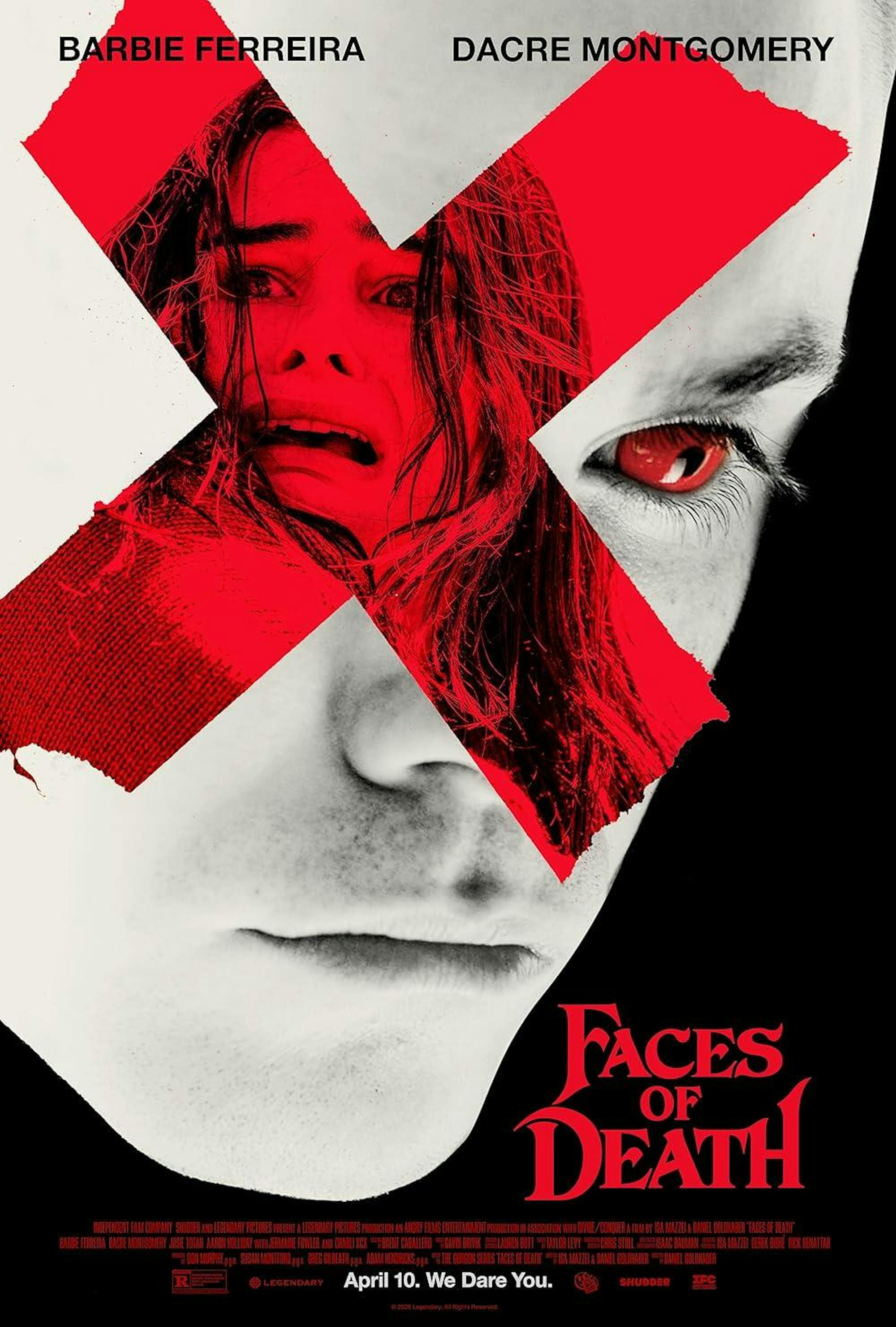
Anyone interested in the horror genre will have heard of the original Faces of Death. Framed as a real documentary, the 1978 film compiled a mix of actual footage and staged recreations, all depicting death and gore. Before the internet provided easy access to all kinds of violent content, Faces of Death was entirely unique. Faces of Death became a kind of mythologized cult classic, and the rumors surrounding it were perhaps more interesting than the film itself. The film is a complete product of its time, representing an urge to witness violence that couldn’t be quelled by a simple internet search. So, when it was announced that Daniel Goldhaber would be directing a new take on the Faces of Death series, I was interested to see how he would bring an older phenomenon into the digital age. While Goldhaber is definitely successful at creating an entertaining film, Faces of Death (2026), unfortunately, ends up falling into the tropes and story beats of every other modern slasher, keeping this reboot from becoming truly great.
Faces of Death follows Barbie Ferreira as Margot Romero, a content moderator for TikTok-equivalent Kino. While she is manually sifting through videos flagged for sexual content, drug use and violence, she comes across a series of realistic depictions of executions staged with mannequins. While she at first believes that they must be fake, the realistic gore both unsettles and intrigues her. Margot’s research leads her to uncover that these videos are recreations of scenes from the original Faces of Death. When she realizes that the subjects of these scenes match the descriptions of missing public figures, she fights to uncover the anonymous filmmaker while his videos only grow in popularity.
I was extremely excited for Faces of Death. I’ve always been interested in the cultural reception of films like the original Faces of Death which, despite low ratings from critics and audiences alike, made $35 million in its original box office run and quickly gained a cult following. The original film isn’t particularly well-liked by anyone, but it is still regarded as a staple in the horror genre, simply because it provides something different: real death. Even though we now know that many of the scenes in the film were staged, including the execution scenes recreated by the remake’s killer, the simultaneously tantalizing and horrifying urge to see real gore has kept audiences coming back for decades.
The remake touches on this with its depiction of Margot’s job. While it's her duty to flag videos that contain harmful content, she is simultaneously encouraged by her boss to keep up content that toes the line between real and fake. After all, the more real something looks, the more engagement the platform will receive. Whether we admit it or not, most of us are fascinated by the grotesque. The internet has certainly fostered an environment for videos like those featured in the film to thrive, and between creepypasta stories and found footage horror mockumentaries, the idea that we may be witnessing something real only makes this content more exciting.
Unfortunately, Faces of Death is ultimately less interested in digging deeper into this phenomenon than it is in providing an entertaining horror film. The third act of Faces of Death veers fully into classic slasher territory as Margot takes it upon herself to end the killer’s recreations. While this part of the movie is technically well done, it is significantly less interesting than what came before and ultimately left me wanting something deeper. Faces of Death doesn’t probe at the issue of violence, exploitation and popular media any deeper than its predecessors, like Funny Games and Blow Out, both of which have much more to say about our psychological need for violence. Not every movie needs to innovate, but it’s disappointing to see a film with such a unique plot falter back into safe territory.
The film is definitely entertaining throughout. With Euphoria returning for a third season after Barbie Ferreira’s departure, it’s nice to see the actress in a role that lets her show more range. Dacre Montgomery is a highlight as Arthur Spevak, a socially awkward, decidedly uncool serial killer desperate for attention, but unable to innovate beyond what’s already been created. Arthur presents an interesting perspective as he attempts to recreate the cool facade of the original film’s Francis B. Gröss, but fails spectacularly at coming across as dangerous. With Arthur, Goldhaber succeeds at twisting the slasher genre on its head, and while unpacking the psychological instinct to view cruelty as entertainment, Arthur represents the gritty truth of carrying out violent acts. Unfortunately, Margot’s role as a typical final girl brings the film right back into the usual slasher plot every time the film begins to go somewhere more interesting.
While I definitely enjoyed Faces of Death, I would have liked to see a film with such an interesting subject matter go further in its commentary. I still think the best filmmaker to capture the highs and lows of modern internet culture is Jane Schoenbrun, whose filmography (and upcoming book, which also follows a content moderator) succeeds at portraying the pull we feel towards violence and fear online. Despite its obvious references to TikTok, Faces of Death does not feel as contemporary as it hopes and doesn’t quite go far enough in its critique of violent content.
‘Projections’ is a column focused on reviewing recent film releases.
Nicholas York is a member of the Class of 2027 in the College of Arts and Sciences. He is a columnist for the Arts & Culture department and can be reached at nyork@cornellsun.com.