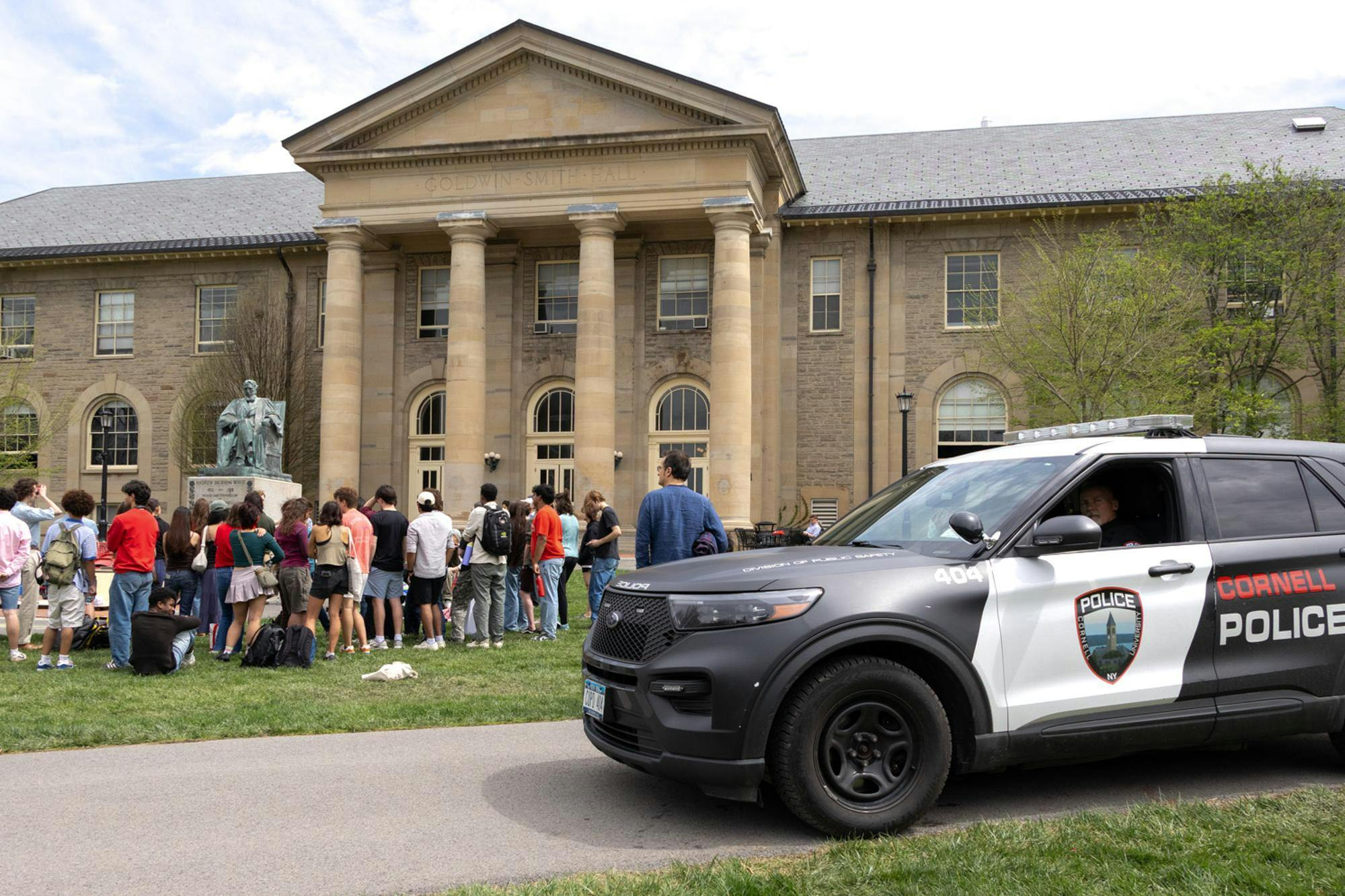
Approximately 40 students gathered on the Arts Quad on Saturday afternoon to express their concerns about the suppression of student speech and protest on campus. Students took a stand at the A.D. White statue alongside alumni from the 1960s and ’70s who participated in student activism on campus.
The “Day of Action,” planned by Students for a Democratic Cornell, took place during one of four Cornell Days, in which newly-admitted students were invited to visit campus. During the event, SDC members handed out flyers to admitted students passing by and wrote slogans criticizing the University in chalk across campus.
“[I]t’s admitted students day and a majority of students visiting this weekend are actually undecided,” said SDC Co-Founder Sophia Arnold ’26 in an interview with The Sun. “We thought that getting in the face of and making [Cornell’s] issues … unable to be ignored by admitted students … was a really good way to get the administration to pay attention and realize that they have issues severe enough that it might jeopardize students committing to Cornell.”
The event’s Instagram page listed five main concerns the event would address: a lack of student rights related to free speech and activity on campus, increased co-op housing fees, turning “program houses like the [Latino Living Center] and [Ujamaa] into general dorms to erase POC spaces,” “ICE, Anduril and Palantir” recruitment on campus and student suspensions.
The event featured three alumni speakers: Robert Gottlieb ’72, Margaret McCasland ’68 M.S. ’86 and Joe Rowland ’73, who shared their experiences with activism and student rights while they were students on campus.
Gottlieb was the first student-elected member of the Board of Trustees, a position that was created following the 1969 Willard Straight Hall Takeover, in which Black students occupied Willard Straight Hall for 36 hours demanding racial justice and an improved judicial system on campus. The takeover ultimately led to the Campus Code of Conduct, the University Senate and the addition of student-elected trustees.
The Campus Code of Conduct was overhauled in 2021 and replaced with the Student Code of Conduct. The University Senate was dismantled in 1977 and replaced by four assemblies – Student Assembly, Graduate and Professional Student Assembly, University Assembly and Employee Assembly — and later the Faculty Senate.
Throughout his speech, Gottlieb emphasized how the administration at the time of the takeover did not concede to external pressures from politicians.
“No one was punished. Nobody was disciplined, nobody was threatened to get out of [their] dorm room,” Gottlieb said. “That’s how an administration, in the face of fear [and] of tension … did not buckle [and] did not capitulate.”
McCasland spoke next, sharing stories from her involvement in the anti-Vietnam-War movement and anti-apartheid movement on campus. McCasland was arrested at an anti-Vietnam-War protest at Barton Hall in the 1967-1968 academic year and participated in the “Shantytown” encampments in 1985 to demand the University's divestment from the apartheid in South Africa.
The Shantytown encampment, which lasted over two months in 1985, received recognition from anti-apartheid activists in South Africa such as musician Hugh Masekela.
“I thought the whole thing just kind of fizzled and nothing happened and it didn't make any difference,” McCasland said in an interview with The Sun. “But then Hugh Masekela came to Ithaca several times. Every time he came to Ithaca, he would say, ‘Thank you, Cornell, for Shantytown. We heard all about Shantytown at home in South Africa, it made such a difference to us. Thank you, Cornell, for Shantytown.’”
Rowland, who arrived at Cornell the fall after the Willard Straight Hall Takeover, participated in a general strike across universities following the Kent State Shootings in 1970, in which four students protesting the Vietnam War at Kent State University were killed by the Ohio National Guard.
“What I found out from that experience was that when people and students act collectively, you can shut things down together,” Rowland said at the event. “You have a huge amount of power. What's the university going to do without students? Nothing.”
The alumni speakers expressed concerns regarding student rights on campus today. Gottlieb contrasted the administration's response to the takeover in 1969 to the settlement between Cornell and the Trump administration in November.
“The University then was viewed as an agent for social justice and diversity of students and courses and debates,” Gottlieb said at the event. “That's what Cornell was. That's what Cornell should always be. That's not what Cornell is today because of its capitulation to the threats of Donald Trump.”
McCasland also expressed concern over the shifts she has seen since her time as a student to today.
“When I was an activist in the ’60s, student governance and input from faculty and staff was not yet an option at Cornell,” McCasland told The Sun. “It is just so sad to see Cornell back in the dark ages with worse governance than what they had in the early and mid ’60s.”
In addition to the three alumni speakers, students attending the event spoke regarding their concerns about a lack of free expression on campus.
Aiden Vallecillo ’26 raised concerns regarding the Expressive Activity Policy, a University policy that regulates public speech and demonstrations on campus.
Vallecillo specifically mentioned regulations on protests on campus.
“Protesting is banned on Cornell's campus,” Vallecillo said. “We cannot protest. … Chalking is actually one of the only things that we're allowed to do.”
The Expressive Activity Policy limits “amplified or other loud noise” on campus to between the times of 5 to 9 p.m., or from noon to 1 p.m. at Ho Plaza or outside Day Hall. Additionally, there are limits on where posters and signage can be placed on campus and what size the posters may be.
Another student attending the protest, Max Troiano ’28, who is an opinion columnist for The Sun, expressed concerns about the Cornell University Police Department’s presence at protests. Troiano said that he noticed a CUPD vehicle drive by the event seven times, including once where an officer filmed the event.
“I think that level of intimidation, that level of police presence … is a living, physical representation of the pressure which free expression at this university is currently facing,” Troiano said in an interview with The Sun.
Protest attendees also spoke about the Student Code of Conduct and the Student Code of Conduct Procedures, which are used in the event of an alleged violation.
“[The Code] was never about providing guidelines for the kinds of protests that were acceptable at Cornell.” said Nick Wilson ’26, who was temporarily suspended for his participation in the pro-Palestine encampment on campus in April 2024. “It was about providing a means by which the administration could punish dissent and could make all students feel suppressed.”
Troiano said that he and his community have felt the effects of these policies on free expression.
“I'm certainly, personally not willing to participate in nearly the same level that I would be if I did not have a personal fear of retribution,” Troiano said. “The goal has been to limit the amount of expression, and that goal has succeeded.”
Adriana Vink, president of Students for Justice in Palestine, a student organization that was temporarily suspended for approximately seven months by the Office of Student Conduct and Community Standards following a protest in March 2025, spoke to recently-admitted students at the protest.
“Welcome to Cornell, Class of 2030,” Vink said. “Cornell, where over 100 students have been suspended in the last two years … where Michael Kotlikoff refuses to listen to students…. But this is also Cornell, … a campus where the student movement will never die. This is a campus where, if you come here, we will keep fighting until we win and we want to fight with you.”
The University declined to comment on the sentiments expressed at the event.
Mary Caitlin Cronin ’28 contributed reporting.
Coral Platt is a member of the Class of 2029 in the College of Arts and Sciences. She is a news editor for the 144th Editorial Board and can be reached at cplatt@cornellsun.com.