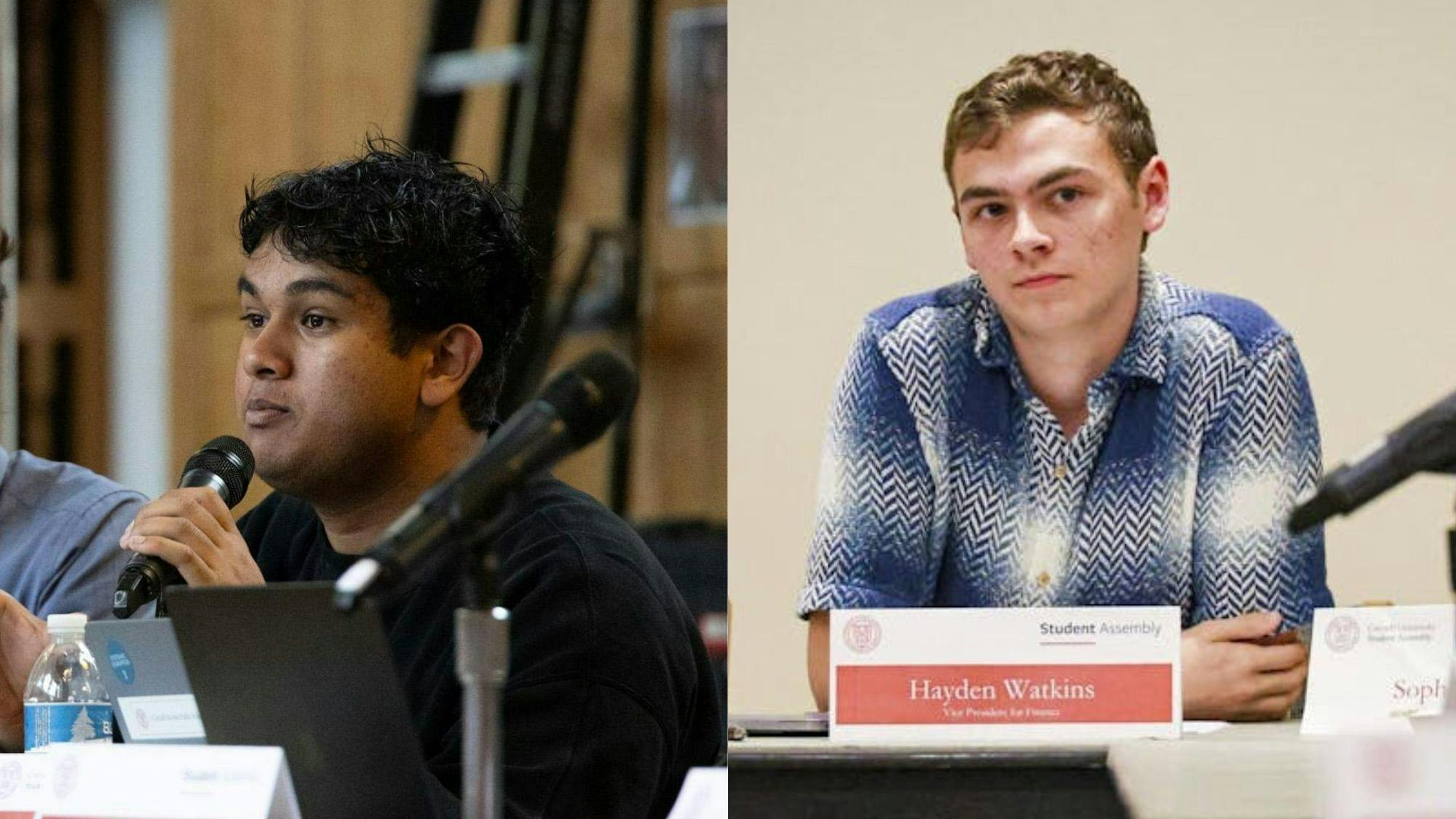
Eeshaan Chaudhuri ’27 was elected Student Assembly president and Hayden Watkins ’28 was elected executive vice president for the 2026-2027 academic year, according to election results released by the Assembly on their website at 4:15 p.m..
Chaudhuri won the presidential race against two-year incumbent Zora de Rham ’27 and Christian Flournoy ’27, while Watkins won the executive vice presidential race against Kennedy Young ’28. Voting opened at noon on April 20 and closed at noon on Monday, with undergraduate students casting ballots online through OpaVote.
Chaudhuri won the presidency with 719 votes after redistribution, defeating Flournoy (688) and deRham (279 first-choice, eliminated), with Flournoy taking Representative-at-Large as runner-up. Watkins won Executive Vice President with 643 votes over Young's 489.
The winners of the race will take their positions on June 15 after a re-organization meeting in May, according to Director of Elections Ian Gilenson ’27.
The runner-ups in the presidential and executive vice presidential races will serve as Assembly representatives-at-large for the 2026-2027 term, according to the Office of the Assemblies website. Flournoy and Young will therefore join the Assembly as voting members despite losing their executive races.
Chaudhuri’s victory marks the first change in the Assembly presidency in two years and ends de Rham’s two-term tenure. Chaudhuri emphasized a reform-focused platform after a campaign in which he openly criticized the Assembly’s effectiveness and argued that the Assembly should prioritize policies with realistic paths to implementation.
Watkins will take charge of the Assembly’s internal operations after a campaign centered on Assembly member attendance, committee accountability and a more active Assembly presence in students’ daily lives.
The results of the other Assembly positions also reflect a shift in the Assembly’s political endorsements during campaigning. This year marked one of the first cycles in recent memory where progressive student organizations –– Progressives at Cornell, Young Democratic Socialists of America and Students for Justice in Palestine –– publicly endorsed candidates across multiple races. Every single candidate endorsed by these three organizations won their election.
Notably, the presidential and executive vice presidential races were among the few positions that did not receive coordinated progressive endorsements.
Presidential Race
All three presidential candidates –– de Rham, Chaudhuri and Flournoy –– entered the race with prior Assembly experience. de Rham has served as president for the past two terms, Flournoy serves as executive vice president and Chaudhuri serves as the undergraduate student representative to the University Assembly.
During her campaign, de Rham framed her candidacy around continuing existing initiatives and strengthening coordination between the Assembly and University administration. She pointed to her work on the Student Activity Fee through Resolution 66 and said much of the Assembly’s implementation work happens outside of public meetings.
“A resolution is the initial germ of an idea, and many conversations have to happen behind the scenes after [it] is written and passed,” de Rham previously told The Sun.
Chaudhuri campaigned on structural reform and policy accountability, arguing that the Assembly needs to prioritize proposals that are realistic and implementable. He noted his work on Resolution 62 that calls to allocate $20,000 toward campus health vending machines stocked with items such as contraceptives, Narcan and over-the-counter medication as an example of a direct-impact policy initiative.
Chaudhuri’s campaign centered on the idea that the Assembly has passed too many resolutions without sufficient planning of follow-through.
“As a student who studies policy every single day, I could just see that we were passing policies that had no chance of working,” he previously told The Sun.
Flournoy emphasized mental health resources, equitable access to special project funds and building a more unified student body. As executive vice president, he previously identified improving University responses to student death and loss as one of his priorities.
“We need to make sure Assembly members are doing more to get out there ... [by] actively listening to communities that we’re a part of as well,” Flournoy previously told The Sun.
EVP Race
The executive vice presidential race featured Watkins and Young, both Brooks School students currently serving in Assembly leadership roles. Watkins currently serves as vice president for finance and representative-at-large, while Young serves as vice president of diversity, equity and inclusion and minority students representative.
Watkins’ campaign focused on internal accountability and operational reform. He previously told The Sun that the executive vice president is “the backbone of the Student Assembly” and said the role requires ensuring that members are actively contributing behind the scenes. He also pointed to attendance and inconsistent committee work as ongoing issues within the body.
Watkins outlined his three main priorities in an interview with The Sun: “improving function [of the Assembly], quality of life for students and building more widespread resistance [to the Trump administration].”
Young’s campaign centered on accountability, transparency and student representation. She pointed to her work on a unanimously passed resolution requesting more transparency in first-year program house placements as an example of her approach to data-driven advocacy.
Young previously wrote to The Sun that “students need to see not just what we pass, but what we actually change as a result.”
Other Races
In addition to the presidential and executive vice presidential races, students voted to fill 32 Assembly seats across colleges and constituencies.
Among contested races, Yasmeen Masoud ’28 won the Brooks School representative seat, while Amelia Lyons ’29 secured the seat for College of Architecture, Art, and Planning representative. Adam Sendelbach ’27 was elected School of Industrial and Labor Relations representative and Saphira Augustin ’29 won the first-generation college students representative seat. Darin Lee ’28 was elected international students representative and Jana Orief ’29 and Daniel Addoquaye ’28 won the minority student representatives position. Sun opinion columnist Adriana Vink ’27 was elected student workers representative.
Of the eight contested positions, five winners, Masoud, Lyons, Sendelbach, Augustin and Vink were endorsed by CU Progressives and YDSA. Masoud, Lyons, Sendelbach and Vink were also endorsed by SJP.
Several races were uncontested. Lydia Blum ’27 and Tin Cho Aye ’28 will represent the College of Agriculture and Life Sciences, while Jeffrey Chung ’29 and Jocelyn Swavy ’28 will serve as the College of Arts and Sciences representatives, with one seat remaining unfilled. Arman Fard ’29 will represent the Dyson School of Business and Christian Tarala ’27 was elected Nolan School of Hotel Administration representative. Tarala will also serve as one of two undergraduate representatives to the University Assembly alongside Akshara Keshri ’28. Katherine Krishtopa ’28 and Julian Kimball ’28 were elected College of Engineering representatives, and Abisola Ayoola ’28 will represent the College of Human Ecology. Additional representatives include Alexander Walters ’28 for LGBTQIA+, Strummer Dunn ’29 for students with disabilities and Saanya Agarwal ’27 for women’s issues.
Six students were elected representatives at large: Christian Flournoy ’27, Young, Myshay Causey ’29, Tyler Japal ’27, Ellie Porter ’29 and Jai Anand ’29.
Of the uncontested positions, Chung, Dunn and Porter were endorsed by SJP, CU Progressives and YDSA.
The newly elected representatives will serve during the 2026-2027 academic year.
Update, April 29, 6:45 p.m.: This article was updated to include the vote counts from each round of tabulation.

Emma Spindler is a member of the Class of 2028 in the College of Arts and Sciences. She is a senior writer for the news department and can be reached at espindler@cornellsun.com.