


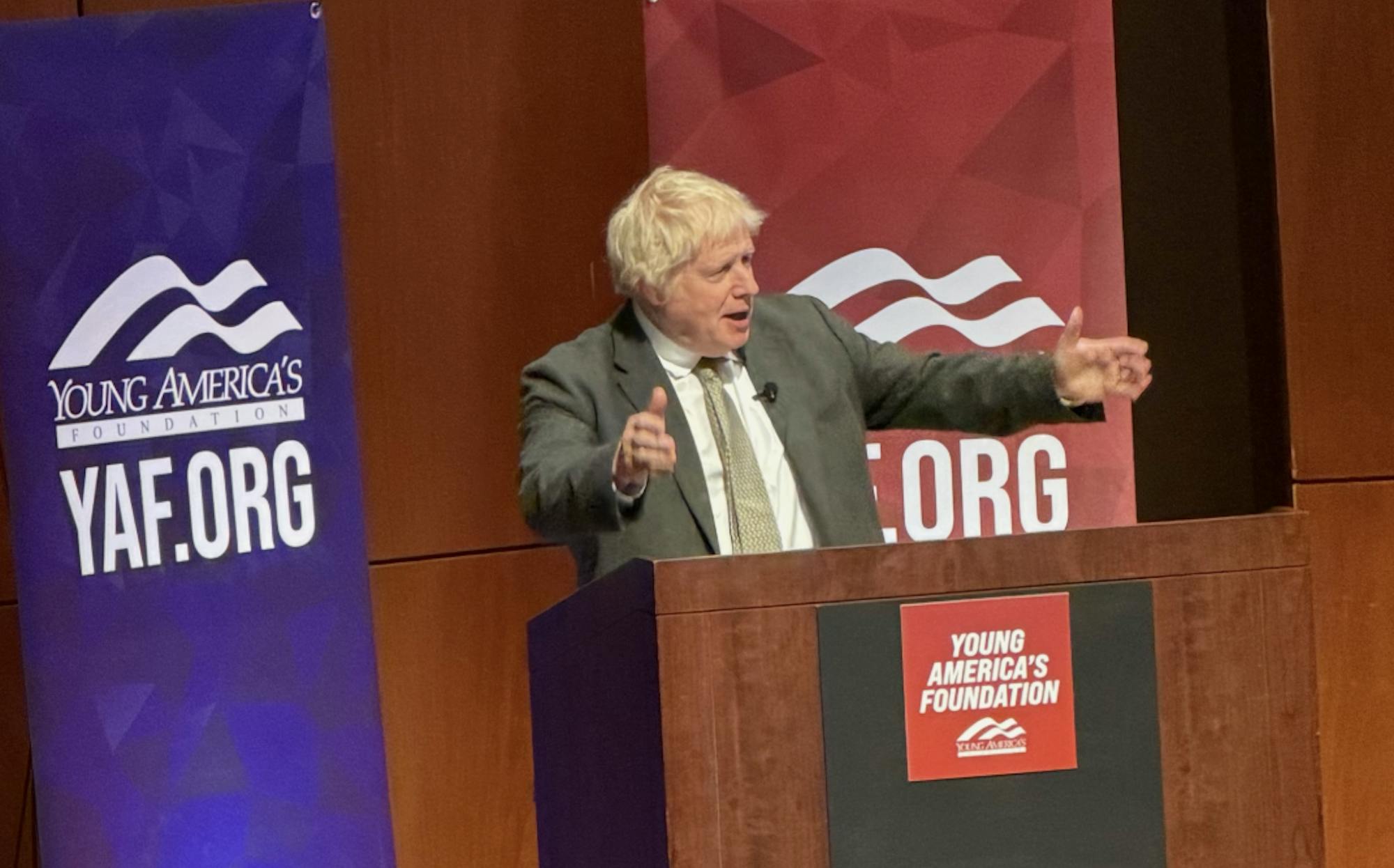
Former prime minister of the United Kingdom Boris Johnson spoke to a sold-out crowd in Call Auditorium about Iran, democracy and sovereignty during an event hosted by Cornell Republicans on Monday.
The event, named “The West is Worth Saving,” was sponsored by Young America’s Foundation, a nonprofit that works to promote conservative ideas on college campuses.
Johnson, a member of the U.K.’s conservative party, served as prime minister from July 2019 to September 2022, when he resigned amid a revolt from his ministers and a series of scandals. This included ‘Partygate,’ a series of parties hosted by Johnson that violated COVID-19 lockdown protocols, the details of which Johnson was found to have repeatedly lied about.
Notably, Johnson spearheaded Britain’s exit from the European Union in 2020, informally known as ‘Brexit.’
Associate Dean of Students Christine Nye, Provost Kavita Bala and Cornell Republicans President Max Whalen ’26 took the stage to introduce the former prime minister and emphasize the necessity of protecting free speech on Cornell’s campus.
Nye gave the disclaimer that “audience members who disagree with the speaker may make their views known, so long as they do not interfere with the speaker's ability to be heard or the right of others to listen and see the member.” Any violators could be referred to the Office of Student Conduct and Community Standards, she warned.
Johnson stepped up to the podium to speak for about 30 minutes before the event transitioned to a Q&A, moderated by Whalen.
Johnson began by expressing his sadness regarding the recent “crazy attack” on President Donald Trump, referring to an assasination attempt at a White House Correspondent’s dinner on Saturday.
Johnson noted his own connection to Cornell, sharing that his great grandfather graduated from the University in 1902 and praising the University’s rejection of “proprietary, ideological or religious dogma.”
The foundation of Johnson’s speech focused on the reasons why western democracies, such as the U.S. and the U.K., must fight against countries Johnson described as autocracies, and the methods they should take to do so.
Repeatedly, Johnson mentioned the current conflicts in the Middle East.
Johnson described a 2010 attack on a water park in Gaza, called Crazy Water Park, that occurred two weeks after Hamas had shut the park down.
He described that women would visit in their “undraped form” and that the park was widely successful. “It was such a success that Hamas couldn't stand it,” Johnson said.
Johnson asked the audience: “Whose side are you on? Are you on the side of Hamas? Or are you on the side of Crazy Water Park?” and was met with a ripple of laughter from the audience, followed by applause.
He also praised the U.S.’s recent attacks on Iran, calling President Trump’s objectives “sensible.”
Johnson described Iranians as “absolutely ruthless brutal liars,” and referenced incidents where the Iranian government has exerted violence against women and protestors.
“Iran is the black widow spider at the center of a web of terror,” Johnson said.
He condemned the nation launching drone attacks on “blameless” allies of the U.K.
Johnson argued that “it is frankly in the interest of every country in the world, including Iran, that we should have a peaceful and non-nuclear Iran.” He believes that at the end of the war, Iran’s military will be diminished and western democracies will benefit.
Iran was also mentioned among a “mutually reinforcing coalition of autocracies” who are against western democracy — including Russia, China and North Korea.
Because these nations benefit one another, Johnson emphasized the importance of a Ukrainian victory, as it would not only mean defeat for Russia, but also for the other nations in the group he described. He said that he “[doesn’t] like to see America isolated,” and expressed his desire for the rest of Europe to aid in the U.S.’s efforts to end the Russia-Ukraine war.
Johnson also argued against the drawing of “false moral equivalencies” between the nations he named as autocracies and democracies.
Throughout his lecture, Johnson praised the U.S.’s global interventions and technological innovations. Specifically, he praised the U.S. for the invention of rock music, sang his praises for Elvis Presley, and then sang a rendition of “Can’t Help Falling in Love” in French, referencing the original arrangement by Jean-Paul-Égide Martini.
Johnson rounded out his speech by reemphasizing the importance of allyship between western democracies, arguing that “the transatlantic alliance is simply the most important geostrategic act of the past 200 years.”
While things are difficult when we are divided, when the U.S. and the U.K. stand together “there is absolutely no power on Earth that can prevail against us,” Johnson said.
Attendees were then prompted to ask Johnson their own questions. Guests could submit questions by scanning a QR code. Whalen read two questions from these submissions, and asked three questions of his own.
One of the audience submitted questions, from a senior named Hayden, asked: "[is] multiculturalism compatible with western ideas, especially in the context of the United Kingdom, and should immigration policy be restrictive?”
Johnson responded that the central issue with immigration is not about identity, but whether or not you “love the country you’ve chosen [and] respect its history and its values.”
Johnson had said that immigration was about “assimilation” and “your willingness to be part of a society.” He criticized situations where some immigrants in London can not speak English.
“We should insist that if people come into our countries they should speak the language,” Johnson said, and was met with booming applause from the audience.
Whalen also asked Johnson if he believed that current western leaders were too risk averse to make "destructive decisions” similar to Brexit in the defense of their nations.
Johnson strongly disagreed with the notion that western leaders are risk averse, citing Trump’s intervention in Venezuela and the capture of their president Nicolás Maduro.
Johnon said that Brexit was “the right thing to do,” despite a lack of “institutional support.” He listed its positive consequences, including how it had given the U.K. a newfound sense of sovereignty and how it allowed them more freedom to quickly respond to COVID, according to Johnson.
He related this to the freedoms of the U.S., raising the idea that the U.S. would never agree to be a part of an institution like the E.U.
Nearing the end of the event, Johnson shared that he had attempted to keep his remarks “as moderate as he [could],” so as not to “trigger anybody or whatever.”
Though many student attendees’ personal viewpoints are ideologically to the left of Johnson’s, many students resonated with the ideas that Johnson conveyed.
“I agreed with him a lot more than I thought I would,” Ezra Galperin ’27, a Sun opinion columnist and representative for Student Assembly, told The Sun after the event.
Galperin was surprised by Johnson’s comments on immigration, stating that since the U.S. is a country “built off of immigrants,” we need to set them up for success. Galperin also noted his surprise regarding Johnson’s praise of former president Ronald Reagan.
Johnson had said that if he had a “hero” in American politics it would be former president Ronald Reagan. Johnson also expressed shock that some members of the audience hissed when Reagan’s name was mentioned, asking: “what did he do wrong?”
When an audience member responded by saying that Reagan was “staunchly” anti-union, Johnson replied “sensibly.”
Johnson criticized unions and those advocating for increased labor rights, stating that Reagan was “right about Russia… communism… socialism… [and] enterprise.”
“When it was pointed out that Reagan was anti-union [and Johnson defended that]… you don’t hear that a lot [at Cornell],” Galperin said.
Ukrainian student Roman Vaksich ’28 said that he spoke on the behalf of all Ukrainians when he said “Boris Johnson is our G.O.A.T.,” praising how Johnson had continuously raised awareness of the Russia-Ukraine war and fostered European support.
Compared to other right leaning parties in Britain, Vaksich said that “Boris Johnson is one of the European conservatives who still has sensible opinions.”
The Cornell Republicans declined to comment but shared a press release prior to the event stating Johnson would bring “a firsthand understanding of the modern challenges facing Democracies” and “a sense of their enduring strength in the 21st century.”
“He’s kind of a meme,” Galperin said. “It's rare you get to see a meme in person.”

Giselle Redmond is a member of the Class of 2028 in the College of Agriculture and Life Sciences. She is an assistant news editor for the 144th Editorial Board and can be reached at gredmond@cornellsun.com.


