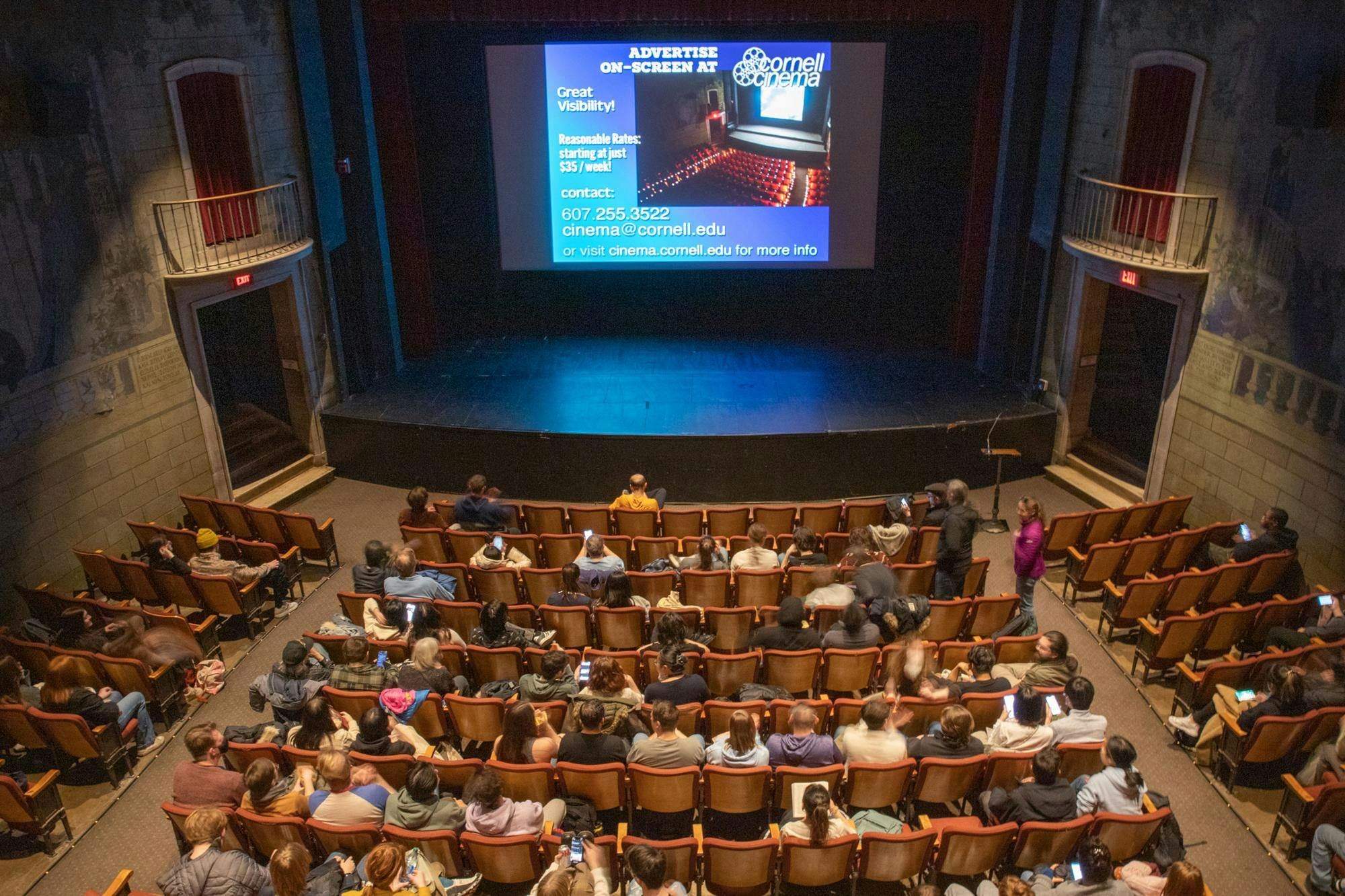
As a house manager at the Cornell Cinema, every shift without fail, somebody stumbles into the theater as a mistake looking for the stairs to the fourth floor or curious about what is inside. Although the cinema has a loyal following amid the Cornell and greater Ithaca community, it remains relatively undiscovered for some undergraduates. In its nearly 56 years of existence, the cinema has exhibited an immense amount of digital and 35mm film screenings, hosted guest panels of industry giants and simply been a place of community for film-goers to see a movie they might not be able to at a commercial cinema.
Since the COVID-19 pandemic, there is an assumption that cinemas have not been able to fill seats due to an increase of streaming platforms acquiring films before they can get a box-office release. While this may be true in some respects for some older audiences, studies show that Gen Z audiences have not lost their connection to the cinema. In recent years, many have claimed seeing art-house, experimental or classic movies as performative or too niche, but there is nothing performative about the conversations that ensue outside the Willard Straight theater after a viewing of a cult classic or documentary. The steady incline of younger audience attendance at the cinema is proof that the art of filmgoing is not lost, and it is merely waiting to be fully realized by our generation. The cinema is still a landmark of community for many, and the Cornell Cinema prides itself on being this exact third space of culture.
I had the opportunity to speak to the Director of Cornell Cinema, Molly Ryan, about what makes the cinema special in terms of community and engagement with art in a post-covid world. Ryan described her entrance to Cornell Cinema after the pandemic in 2022: “This kind of global catastrophe had shattered ways of being in community, had disrupted these patterns of cultural activity and behavior and had made a lot of people really anxious about being in community and crowds.” Throughout her time at Cornell Cinema, Ryan highlights an increase in student attendance at the cinema especially since the introduction of the mystery screening and the suggestion box. The incorporation of customer input, the student advisory board and Ryan’s film expertise has culminated in varied films series meant to tap into the curious nature of the Cornell community. Ryan continues, “The news media loves a story about how cinemas are dying and I would say Cornell Cinema stands as a counter example to that idea. We are seeing a lot of appetite for coming together to enjoy films on the big screen as they're kind of meant to be experienced as an art form.”
The Cornell Cinema has experienced this rise in Gen Z interest in attending independent theater, looking for an experience they cannot receive from a subscription. Ryan echoes this sentiment, “The experience of going to the cinema fits in this kind of like sense of nostalgia and sort of an embrace of opportunities that feel a little old school, but remain as cool as they ever were. … I think this is similar to polaroid cameras and vinyl records.”
In a post-pandemic world, many are looking to recreate, or rediscover, the art of community in spaces that are not purely school or going-out. Gen Z is hungry for conversations, shared interests and connection through something that is bigger than a weekend party. The cinema is a special part of Cornell campus because it encourages the Cornell community to actively engage with a film in a way that a commercial cinema experience or required film for class does not. The curation of the film series is a work of art in itself, combining high-brow, popular, art-house and classics into a semester where anyone should be able to go watch a film they love — or hate.
In our discussion about the differences between what is played at a commercial cinema in comparison to the Cornell Cinema, Ryan explains her process of choosing the films each semester as an effort to blur the lines between what is scholarly and what is entertainment, arguing ultimately that all films can be both. Ryan stated, “I am always deeply interested in kind of educating on the complex history of cinema and film as an art form. There's also kind of a balance of doing things that are well known and fun, doing things that are more esoteric and niche. … We are trying to reflect the pulse of this university, which is like a community of people thinking about the world in big and exciting ways.” Ryan goes on to note the ways in which many commercial cinema experiences, which are still valuable, sort of reflect the algorithmic ways in which we all consume media these days. The cinema strives to bring something new, that doesn’t necessarily mirror what you have already seen or what will give you the most immediate pleasure feedback all the time. A positive feedback loop isn’t always the surest path to community, and that can be seen through the conversations post-screening inside and outside the theater.
This fundamental aspect of community can not only be seen in the customer experience but also in the employee experience. The box office is filled with generations of cinema attendant musings sharpied onto the walls. From dates, signatures, quotes and doodles, each passing class of student workers has seemingly felt personally attached to the space and, in their scribbled writing, immortalized their time there. There is as much community amongst the cinema-goers as there is for the cinema workers, wherein house managers, attendants and ushers are themselves film-lovers and often break out in debates about the movies played.
There is something to be said about the timelessness of going to the cinema, and it's time that people remembered that going to see older or less well-known films has real value. It strikes up conversation and, in turn, strengthens community.

Presley Grauer is a member of the Class of 2028 in the College of Arts and Sciences. She is a contributor for the Arts & Culture department and can be reached at pjg225@cornell.edu.