


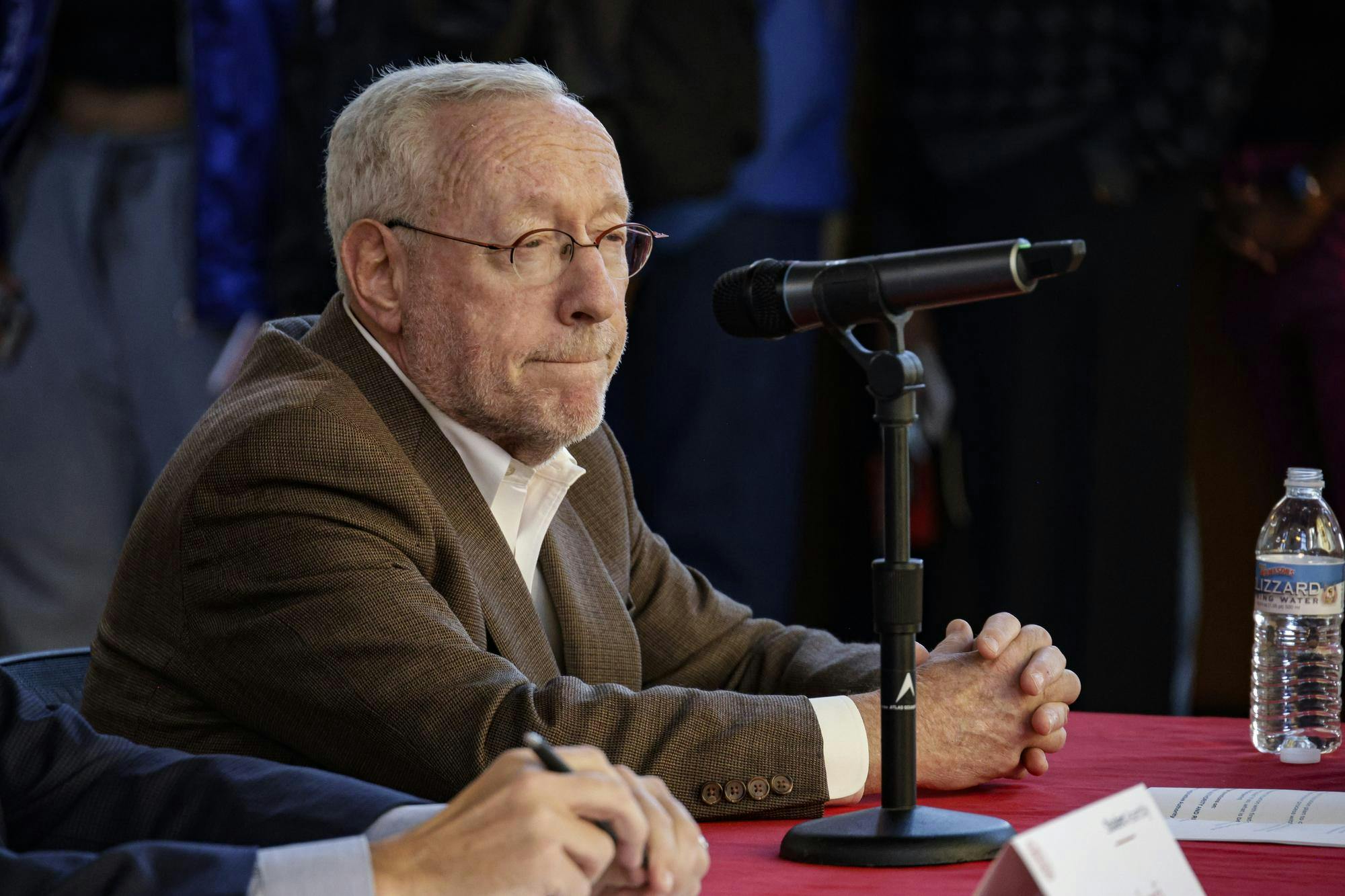
President Michael Kotlikoff fielded questions regarding Resilient Cornell, University restructuring efforts, fiscal policy and artificial intelligence in an Employee Assembly meeting Wednesday afternoon.
During the meeting, Kotlikoff responded to questions from E.A. members, who were invited to submit questions following a Feb. 4 meeting, where the E.A. discussed the University’s Committee on the Future of the American University, staff welfare and austerity measures.
Kotlikoff began his remarks by acknowledging that these are “challenging times for all of us.”
Most of the questions that Kotlikoff answered regarded the University’s financial challenges and plans to address them.
Kotlikoff specifically answered questions about Resilient Cornell, an initiative launched in October with the purpose of ensuring “Cornell’s long-term financial sustainability while reimagining how we operate across all campuses,” according to its website.
Kotlikoff said that throughout March and April, the initiative’s reorganizational and efficiency models, aimed at reducing spending, will be distributed to heads of units across campus. Then, in April and May, the administration will provide workforce planning and transitional support to programs affected by the initiative. In June, implementation of Resilient Cornell’s recommendations will begin.
When asked how much money the University is seeking to save through restructuring, Kotlikoff responded “as much as we can.”
Kotlikoff also addressed broader concerns about Cornell’s financial situation and the University’s plans to improve it.
He explained that while Cornell has always been running on a tight budget, recent accumulated factors have led to current financial issues. These factors include overhead costs, uncertainty about the future of federally funded research, financial aid cutbacks and issues with international student enrollment, Kotlikoff said.
The Trump administration’s freezing of over $290 million in federal funding for Cornell, while restored with by a settlement in November, had caused “real independent damage to faculty, to faculty careers, to young people’s careers, to graduate studies and [to] post doc careers,” Kotlikoff told the Faculty Senate in January.
The One Big Beautiful Bill Act, passed by Congress in July 2025, affected federal financial aid in the form of “new loan limits, new loan repayment options, and updated eligibility requirements, for both current and future students,” according to the Cornell Office of Financial Aid.
Additionally, international student enrollment is at risk due to visa changes, international student concerns about job opportunities and political concerns, Kotlikoff said, adding that both international graduate student enrollment and applications have decreased.
To address the financial challenges caused by these issues, the University is undertaking a workforce realignment and the centralization of student resources and programs with the intention of improving efficiency, Kotlikoff said.
He added that while the University is continuing to hire new applicants, the process is occurring at a slower pace.
Kotlikoff also stated that the University is not planning to change the size of the student body as a result of financial challenges, but that they are expecting reductions in graduate programs —- Ph.D programs specifically — and are “watching [graduate enrollment] carefully.”
In addition to concerns about the financial state of the University, Kotlikoff responded to questions about artificial intelligence, stating that the University is considering ethical issues and is working on addressing AI in research and operations.
Following Kotlikoff’s response to the questions submitted in advance, the floor was open to live questions by meeting attendees.
Kotlikoff fielded three live questions, regarding the University’s debt, whether internal job candidates receive priority over external candidates and why Cornell’s budget has been so “chaotic” this past fiscal year.
Kotlikoff responded to a question raised by Michael Boggs, E.A. facilities and campus services representative, about debt by stating that the University faces legacy debt built up from capital projects, alongside debt as a result of a liability case against Weill Cornell.
However, the University is intending to limit debt on “any of the normal things that we require debt for,” Kotlikoff said.
When University Assembly Employee Representative Alison McCauley asked about the reasons for “chaotic” budgeting in the most recent fiscal year, Kotlikoff responded, stating that budgets were developed anticipating restructuring, but that it was difficult to determine exact fiscal plans.
While Cornell is still in the process of developing and implementing restructuring, Kotlikoff said that he is aware of the Cornell community’s desire for “clear answers about what’s happening" within the initiative and that the administration is “trying to up [its] communications as much as possible.”

Coral Platt is a member of the Class of 2029 in the College of Arts and Sciences. She is a news editor for the 144th Editorial Board and can be reached at cplatt@cornellsun.com.


