

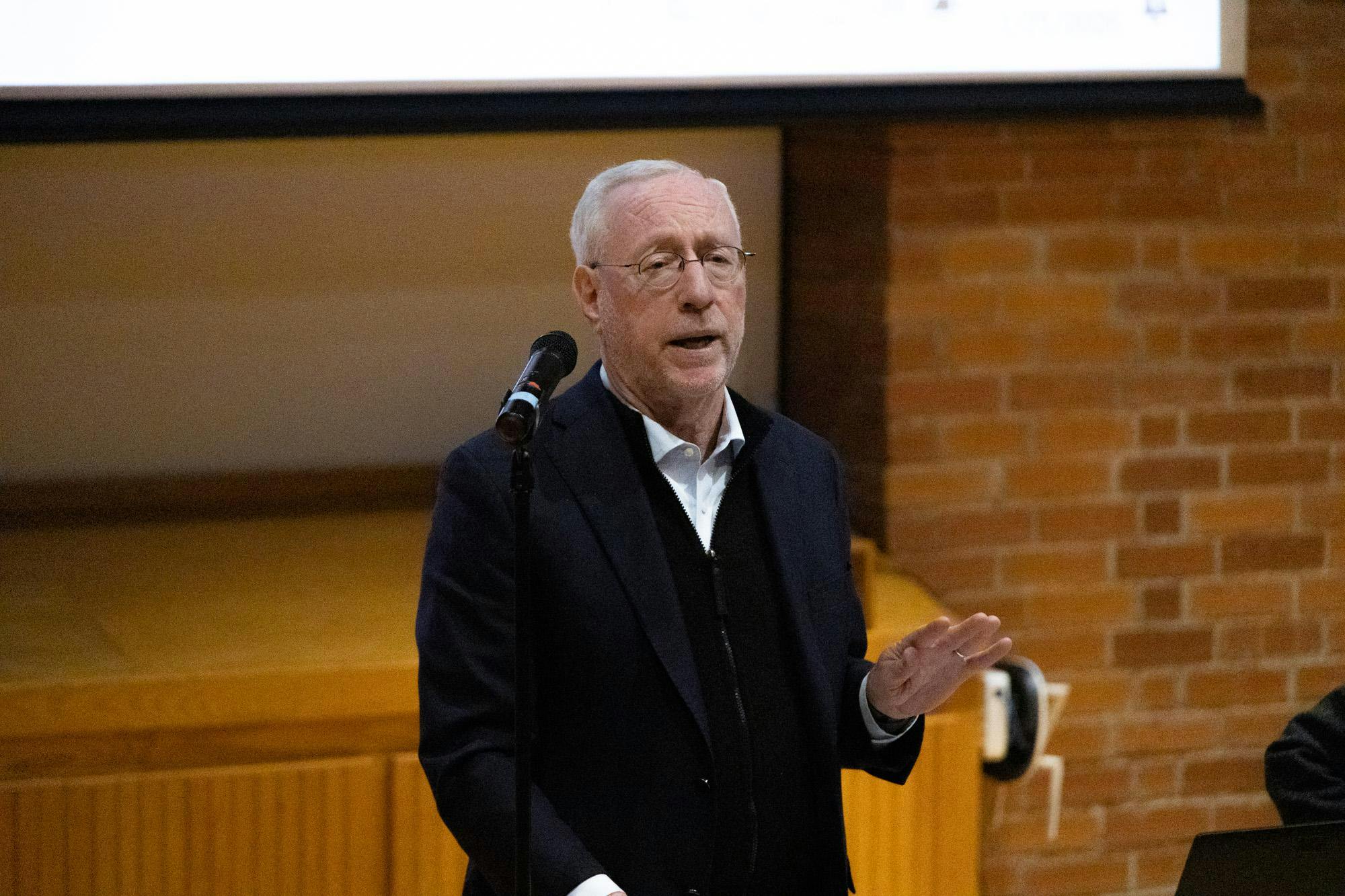
President Michael Kotlikoff and Provost Kavita Bala spoke to the Faculty Senate about the Student Code of Conduct, the upcoming Faculty Senate resolution on Policy 6.4, the Committee on the Future of the American University and Resilient Cornell during its March 11 meeting. They also fielded questions ranging from Cornell’s financial challenges to the October settlement between Cornell and the Trump administration.
Senate members also discussed the Code of Academic Integrity and addressed two upcoming Faculty Senate resolutions regarding a request for an annual university report on academic freedom and Policy 6.4, which addresses bias, discrimination, harassment and sexual misconduct.
Kotlikoff’s and Bala’s Remarks
Kotlikoff spoke first, providing details on the ongoing revisions to the Student Code of Conduct and expressing support for the resolution on Policy 6.4
The revisions to the code serve the purpose of “ensuring that these documents remain relevant, equitable, and effective,” according to the Student and Campus Life website. These revisions are part of an annual review.
“[The revisions] largely address issues of clarifying emergency measures and providing some appeal process for suspension and shortening the process to an ultimate adjudication of the issues,” Kotlikoff said.
The revisions are currently undergoing a period of public comment, which will last until April 20. Following this period, Kotlikoff will review the comments and the revisions will be implemented beginning on July 1.
Kotlikoff also mentioned his support for an upcoming Faculty Senate resolution which would create an ad hoc committee to evaluate and recommend revisions to Policy 6.4. Policy 6.4 addresses matters of discrimination, bias and harassment within the Cornell community as well as the procedures for the report, investigation and resolution of a claim.
Following Kotlikoff’s remarks, Bala discussed the progress of the FAU committee and Resilient Cornell.
The FAU committee, which was established in October, evaluates how the University can “evolve to best serve future generations while pursuing its core mission of education, scholarship, public impact, and community engagement,” according to its website.
“They're now moving into a phase where they'll start coming up with their recommendations,” Bala sai, adding that the committee will be holding town halls later in the semester and releasing their final report either over the summer or the beginning of the fall semester.
Bala also spoke about the University’s progress on Resilient Cornell, describing the initiative as an “umbrella term” for their “multi-pronged approach” to ensure Cornell’s financial resilience. As part of this approach, the University hired Michael Henderson, chief procurement officer and associate vice president, to reduce external spending, established a position control committee to limit headcount growth, designed a voluntary retirement program for employees and is working on restructuring various functional groups including I.T. and communications, Bala said.
“There's been a lot of simmering going on in the background as [Resilient Cornell has] been wrapping their brains around new models,” Bala said. “We're now ready to actually start thinking about the execution and get feedback from the community.”
Q&A Session
The meeting then transitioned into a Q&A with Kotlikoff and Bala for attendees.
In response to a question from Prof. Linda Canina, finance, Bala clarified that Resilient Cornell’s changes to the University’s hiring policy to control “the amount of growth that we are seeing in our headcount” only apply to staff and administration, rather than those holding academic positions.
Several other attendees asked questions about the University’s finances related to Cornell’s settlement with the Trump administration and research funding.
In response to a question by Prof. Paul Ginsparg Ph.D. ’81, physics and information science, about the aftermath of the October settlement that restored over $250 million in federal funding, Kotlikoff stated that “the government has restored all of our research funding.”
Both Prof. Itai Cohen, physics, and Jason Oliver, a senior extension associate and dairy environmental systems engineer, expressed concerns about research funding.
“Even though the funding agencies are being nominally funded at the rates that they were previously funded at, the money is coming in at a trickle,” Cohen said. “That’s creating a pressure on faculty. We’re not getting the same number of grants that we used to get. … If by some miracle everything goes back to the way it was before, when this administration is over, we may not have anything left in our labs to be able to build on.”
Bala responded by explaining that the FAU committee is creating recommendations regarding “how [we] should think about resilience to the research enterprise,” while Kotlikoff added that “so many of us are engaged in Washington [D.C.] on this very topic.”
Oliver asked about funding provided by industry partners and restructuring indirect cost rates, or funding that is necessary for research facilities and administration.
“[This issue has] always been a tough one,” Kotlikoff responded. “Even at the negotiated IDC [indirect cost] rates that we get with the federal government, 69% on the Ithaca campus on the endowed side, we lose money on research. Basically, … the university is investing in that research itself.”
Kotlikoff added that he desired a consistent policy on agreements with industry partners.
In addition to funding concerns, one attendee, Prof. Yuval Grossman, physics, expressed worry about the safety of Israeli students, claiming “Cornell is still failing Israeli and pro-Israeli students, and people are unsafe on campus.”
Kotlikoff responded to Grossman, pushing back on his concerns.
“I do believe that our Israeli students are safe on campus,” Kotlikoff said. “One of the things that I'm pleased about is that this entire academic year, we've not had the kinds of infringement on other people's rights that we've seen in the past.”
Prof. Gilly Leshed, information science, voiced concern that the FAU committee is largely composed of tenured faculty, she said.
“We're doing a shaping our future follow-up to build strategic initiatives that we use across, and we are thinking about the membership of that going forward,” Bala responded. “In the current committee, there are subcommittees [that] do have membership from the broader community.”
Upcoming Resolutions
Following Kotlikoff’s and Bala’s discussion, Kyle Kimball, vice president for university relations, introduced himself to the Senate, and the meeting shifted to a discussion on two upcoming resolutions.
The first was the resolution to create a committee reviewing Policy 6.4, and the second would request an annual University report on academic freedom from University administration.
If passed, this report would ask administrators to provide data on “external requests and internal disciplinary proceedings that involve the University Administration regarding faculty, student, and staff speech and behavior,” according to the resolution.
Both resolutions were amended to remove a reference to a recommendation by the American Association of University Professors, a union and membership association for academic professionals.
The removed sentence stated that faculty serve as “guardian[s] of academic values against unjustified assaults from its own members,” which is a statement originating in the AAUP recommendations.
While the phrase was intended to be a statement about the purpose of faculty governance, according to Prof. Bryan Sykes, public policy, who presented the resolution to the Senate, many Senate members felt as though it did not represent the entire Cornell faculty.
The meeting also provided an update on Accepting Responsibility, a pilot program designed to promote academic integrity through educational intervention rather than grade penalties.
Under the program, students who have committed their first small violation of the Code of Academic Integrity can attend a workshop instead of receiving a recorded violation. The program must be accepted by both the student and professor involved in the incident.
“Cornell's approach to academic integrity is currently rather putative in nature, especially as compared with many other universities and our peers,” Prof. Michael Clarkson, computer science said. “[Accepting Responsibility] means that the event that led to this doesn't have to have a permanent lasting stain on their future.”
A resolution for a university-wide implementation of Accepting Responsibility will likely be introduced to the Senate in April, according to Clarkson.

Coral Platt is a member of the Class of 2029 in the College of Arts and Sciences. She is a news editor for the 144th Editorial Board and can be reached at cplatt@cornellsun.com.


