In the hopeful summer of 1989, history itself laid in limbo.
As the Soviet Union’s overexpansion placed yet another tombstone in Afghanistan’s ‘graveyard of empires,’ her occupied Eastern Bloc later sought arms against its Russian imperialist elders in ‘autumn of nations’ and Gorbachev’s glasnost and perestroika diminished the last flares of hope for the centennial Marxist-Leninist ideology his policy intended to reinvigorate, the international community, for decades at apocalyptic odds, stood on the cusp of reinvention.
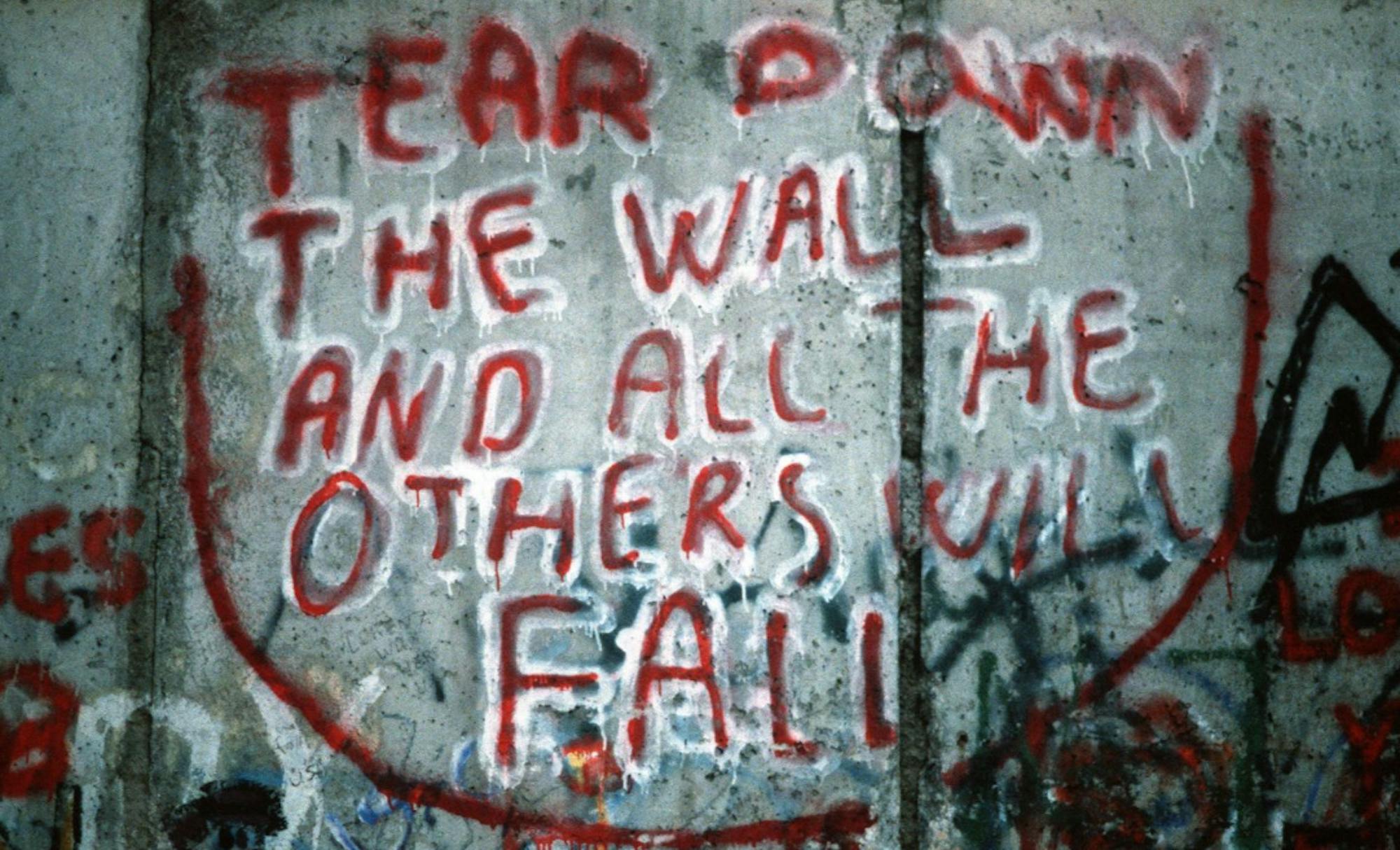
Accompanying the regime divide was a metaphorical and physical line which divided a slumbering totalitarian East from the alleged bastion of freedom across the Atlantic. The Berlin Wall, or “Iron Curtain,” was by 1990, on the cusp of collapse. Once it did, men and women of the free world welcomed — with half-vacuous, McCarthyist pride — the weathered nations that rejected outright idealist ideologies and maimed nation and man in equal measure. And the counterrevolutionaries, breaking from the scourge, scurried to the deceptive, yet warm teat of ‘capital-C’ capitalism and its scaffolding: democracy.
Like academics so often do, naive and reclused in cloisters of their own invention, they scrambled to either justify or dismiss the events unfolding at warp speed. One man who shares with me a first name and undergraduate stomping grounds, opted for the former. Francis Fukuyama, scholar of international relations and neoconservative-turned-classical liberal, a Reaganist who later transcended to neoliberal icon status, believed the fallen curtain marked a literal finale in the course of history.
That pesky yet symbolic wall, to Fukuyama, signified an end not limited to Communism’s reign across Eurasia. In nationalist hotspots like Chile and Cuba, agents of the Global South aided by USSR ministries loyal to a Stalinist strand implicated the capitalist ‘world-system’ as, under Immanuel Wallerstein’s view, both the “[natural] … endpoint” to which states modelling a liberalized Pax Britannica strived for, as well as the macro cause of Marxism’s weak imprint abroad. First in a brief treatise in ’89 and in the immediate tailings of the fallen hegemon two years later, Fukuyama, still bound to Reagan’s State Department, argued that the Hegelian “Absolute” — an ultimate point at which political science, its aggregate cultivation and application finished — was realized.
Hegel’s belief in a history compounded is still widely unconscious knowledge, even among those who've never read his hefty words. Greek logos (λόγος) stuck around for thousands of years because its off shooting ideas, like reason, were durable and transferrable, not due to its armies’ might. Asian legalist paternalism ran a tight ship over the course of dynasties, but its younger cousin, striver culture, was kept insular from Western societies to which they propagated; and Protestant-Capitalism, Max Weber’s theory linking comparative wealth in the West to Calvinist attempts to uplift the soul whilst grappling predestination’s spiritual tension, despite all of its faults, was not so much applicable to the deep rooted Germany or France as it was in America: where men were freed from both Europe and “common tradition,” hence inviting capital to the role of a moral capstone.
Such are mere examples of our tendency to supersede systems that carry the seeds of their own demise and attract newer, particularly more liberal ones. Yet a budding American primacy, springing from the latter, stood apart and above old theories and religious monarchies, so much so that by the mid-20th century it seemed inevitable that all the world wanted a piece of the action, a liberal democracy of their own. The imperium certainly helped its propagation, but no counter arms could possibly silence the tune that fallen fascists, protectionist empires and knee locked Warsaw Pact nations sought to hum alongside it.
With these transformations and the wealth, then-healthy globalism, diminution of U.S.-Soviet bipolarity and more that followed, Fukuyama and scores of fellow libs theorized that that pinnacle of human society had been finally met. The democratization (and a helping hand from the State Department) that formerly drew Axis powers out from under the rubble and the consequences of their own illiberal faults would, too, rope in international bodies sore from authoritarianism and economic exclusion. And for the resistors of this “universal homogenous state,” North Korea, Iran and South American revolutionaries alike; the balance would at some point shift too inexorably to sustain their petty isolation.
And yet, here we stand, under no greater stability than the times of nuclear armageddon, questioning widely a globally-defined capitalist democracy — if such a system can even be democratic on principle — how its departure from landed to stock-based wealth, from tradition and nationalism to ‘rules-based international order,’ has visibly failed to enspell the free world’s excluded caste, create universal value systems, cultivate financial prosperity at home and generate, through peaceable measures alone, a utopian global community.
The singularity that was Pax Americana never sought the input of a neighboring — or ancestral — European region on matters of cultural and economic continuation, leaving the once briefly independent cluster of nation-states vulnerable to their current financial stagnancies and untamed influence of migration and Russian incursion. The World Bank, U.N. and NATO, organizations and pacts of our own loin, do not and have rarely bred consensus necessary for the prevention of great power conflicts: the Ayatollahs and Putins are, to the credit of John Mearsheimer’s routinely accurate predictions, only emboldened to ends favoring their own volksgeist. Even in minute areas, like Americanism’s sociological intrusions, K-pop, mainstream media, religious heterogeneity and the like, revisionist countermovements have awakened and sometimes prospered.
Can Fukuyama and his tenured bandwagon defend the democratic peace when its once-certain future dwindles with every oil refinery the U.S.-Israeli marriage conjointly immolates, or will another of the EU Council’s strong condemnations suffice in disarming the Islamic Revolutionary Guard Corps? Are the globe’s men and women seeing each other more as kin than otherworldly foe, and has loosened cross-border regulation benefitted them? The Iron Curtain’s descent may have signaled the defeat of an ideology, but did history fall, too?
These questions have not been put to rest: the “centuries of boredom” predicted were mere years of suicidal optimism. Now, more than perhaps ever, our generation must ready itself for history’s unmistakable comeback and toss off this potent, erosive philosophy.
The Sun is interested in publishing a broad and diverse set of content from the Cornell and greater Ithaca community. We want to hear what you have to say about this topic or any of our pieces. Here are some guidelines on how to submit. And here’s our email: opinion-editor@cornellsun.com.

Francis Xavier Jaso '28 is an Opinion Columnist and a Government and Economics student in the College of Arts & Sciences. His fortnightly column A Contrarian’s Calamity defies normative, dysfunctional campus discourse in the name of reason, hedonism and most notably, satire. He can be reached at fjaso@cornellsun.com.