


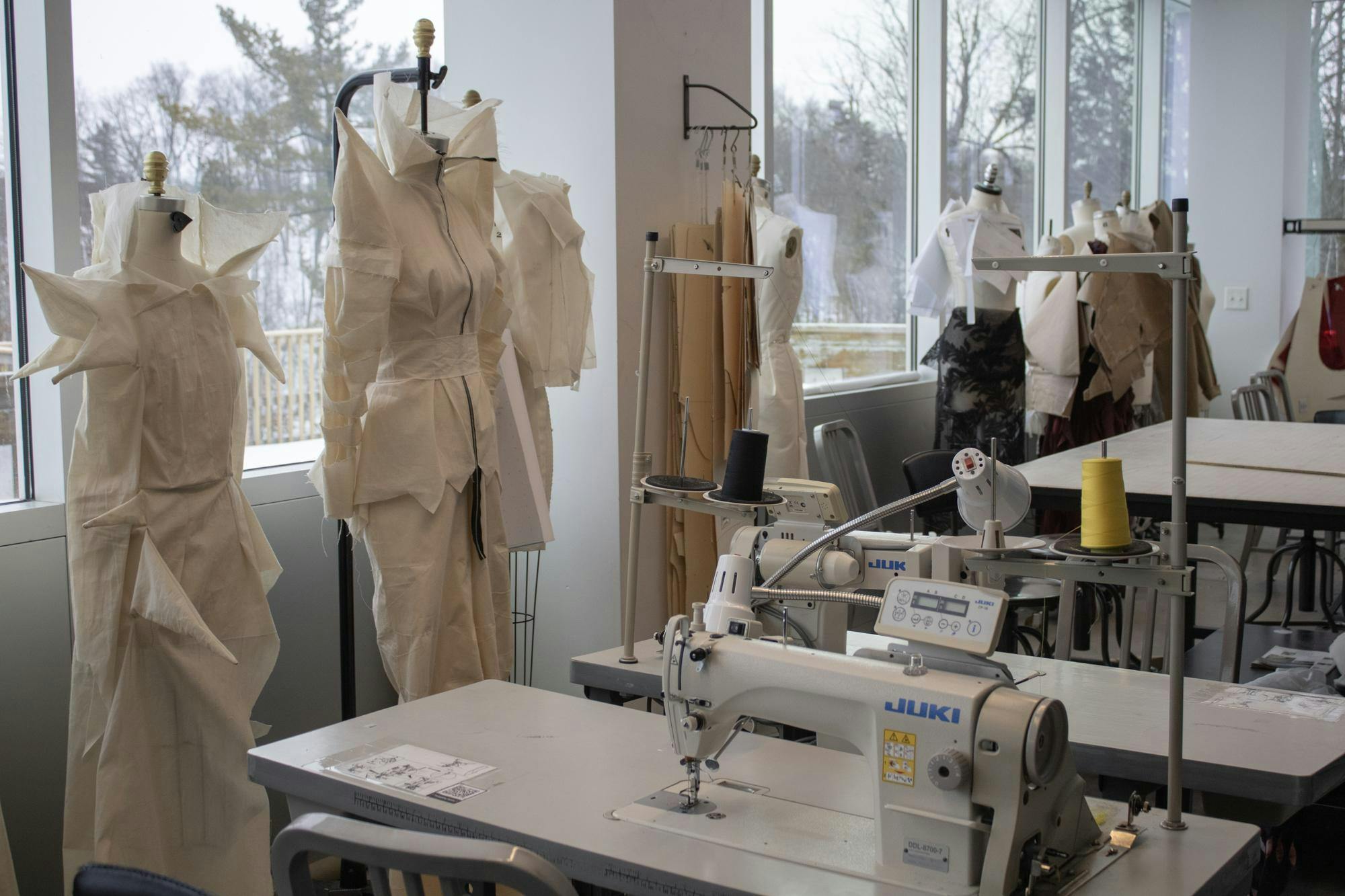
Cornell isn’t something that comes to mind when you think of fashion studies. Compared to fashion-concentrated college programs, like the Fashion Institute of Technology or Parsons School of Design, there is no Garment District or Ithaca Fashion Week.
I interviewed four students majoring in fashion design or fashion design management in the College of Human Ecology: Sophia Kim ’28, Mia Lopez ’27, Sophia Peck ’26 and Liriana Nezaj ’27. These students described why they chose Cornell and what makes Cornell’s fashion community close-knit, technical and human-centered.
Why Cornell?
Cornell is not an obvious choice for studying fashion at first; however, there are various pathways in which people end up with the major they love.
Sophia Peck ’26 entered Cornell initially planning to study economics. It wasn’t until she attended a Cornell Fashion Collective show that she realized fashion could be more than a simple interest. She switched into the College of Human Ecology in her second semester with the wonderful support from the faculty.
Liriana Nezaj ’27 was sure she wanted to study fashion design when applying to college. But rather than attending a fashion and arts school, she wanted to be “surrounded by people who are learning different subjects” than her. This is a key distinction: Cornell provides students the opportunity to study design in a space with economists, engineers and scientists.
Fashion Design vs. Fashion Design Management
Cornell’s fashion-concentrated studies are organized into two interconnected majors: fashion design and fashion design management. Students in fashion design have more advanced studio courses, while those in fashion design management have more STEM and business courses.
Nezaj emphasized her love for learning technical skills in studio classes like pattern-making and knitting as it gives her the time to discover her own style and “create what [she] want[s] to see created.” She also highlighted the faculty support of constructive critiques and operational assistance with larger knitting machines.
On the other hand, Mia Lopez ’27, studying fashion design management, believes her curriculum offers a broad overview of merchandising and management, alongside design and studio courses. Sophia Kim ’28 also enjoyed taking fiber science and fashion history classes, which helped develop a wide range of knowledge and technical skills.
Separating fashion design and fashion design management into two different majors allows for specification and the blending of creativity with technical, analytical and managerial skills, something that makes Cornell distinct from other fashion or design schools.
The Community
Cornell’s fashion department is a close-knit community with relatively fewer students compared to other areas of study. Nezaj mentions that she basically “knows everyone in the major by their names or faces.” With overlapping classes and studio time, many fashion students become familiar with one another.
Peck said she can even identify students majoring in fashion by “the clacking sounds of heeled boots” when she’s in the Atrium. Nezaj humorously added that in her freshman year, she would “ask people [she] spotted wearing a cool outfit if they were in the fashion major.”
Such close relationships within a major are hard to find, especially because collaborations don’t normally arise naturally and success isn’t always communal at Cornell. From late-night sewing in the studio to exams and analytical projects, even the most stressful moments become amazing memories because they are shared. The fashion industry is notorious for being competitive and exclusive, so this sense of community feels radical.
Fashion on Campus
Fashion at Cornell doesn’t only live in one building — it is everywhere. There are so many student organizations on campus, such as The Cornell Fashion Collective. They operate large-scale fashion shows each semester and produce lookbooks — photographs of new designs. They offer a realistic experience of the fashion industry, and the runways are always a hot topic of discussion.
Peck, President of CFC, admits, “Being president isn’t glamorous. There are a lot of people management, logistics and stress, but seeing the runway come together and seeing that tangible creation makes it all worth it.”
There are other groups like the Cornell Fashion Industry Network, Thread Magazine or the Wardrobe, which help build networking opportunities and fashion journalism experiences outside of classes. These organizations bring together creative students interested in fashion, media, business and beyond.
The Future of Fashion Studies
Students highlight Cornell’s fashion program as forward-thinking, particularly in terms of sustainability, fiber science and its technological scale of learning. The variety of courses introduces students to digital tools like 3D design software and AI-assisted mood boards.
Nezaj states that this “technology is amazing and definitely practical,” but she adds that “there’s still something innately human about designing by hand.” As both fashion majors are in the department of Human-Centered Design, their mission lies in “designing solutions to improve the human experience,” ensuring that innovation enhances, not removes, designers’ creative choices and supports the needs of its users.
Students also point out gaps. Although the close-knit community brings a positive, unique energy, some feel there could be more resources and courses to support the program. Students desire more technical skill-based courses, such as more types of pattern-making and drawing classes.
Many also highlighted how challenging it is to get fabric in Ithaca. JOANN Fabric and Crafts, the only place fashion students were able to get fabric, recently closed. Because students need to see the color and texture of the fabrics in person, many students have to drive miles or even go to New York City to acquire the resources necessary for their courses.
Despite these challenges, fashion design and fashion design management students continue to embrace the program’s intensity, intimacy and interdisciplinary approach. They are deeply committed to shaping the future of fashion with both creativity and purpose.
Although Ithaca is not a fashion hub, Cornell offers rigorous training, interdisciplinary learning and a collaborative community. There are logistical challenges, but its emphasis on sustainability and innovation offers something other fashion schools do not. Studying fashion at Cornell is distinct and rewarding.
Ines Hwang is a sophomore in the College of Arts and Sciences. She can be reached at ish7@cornell.edu.


