


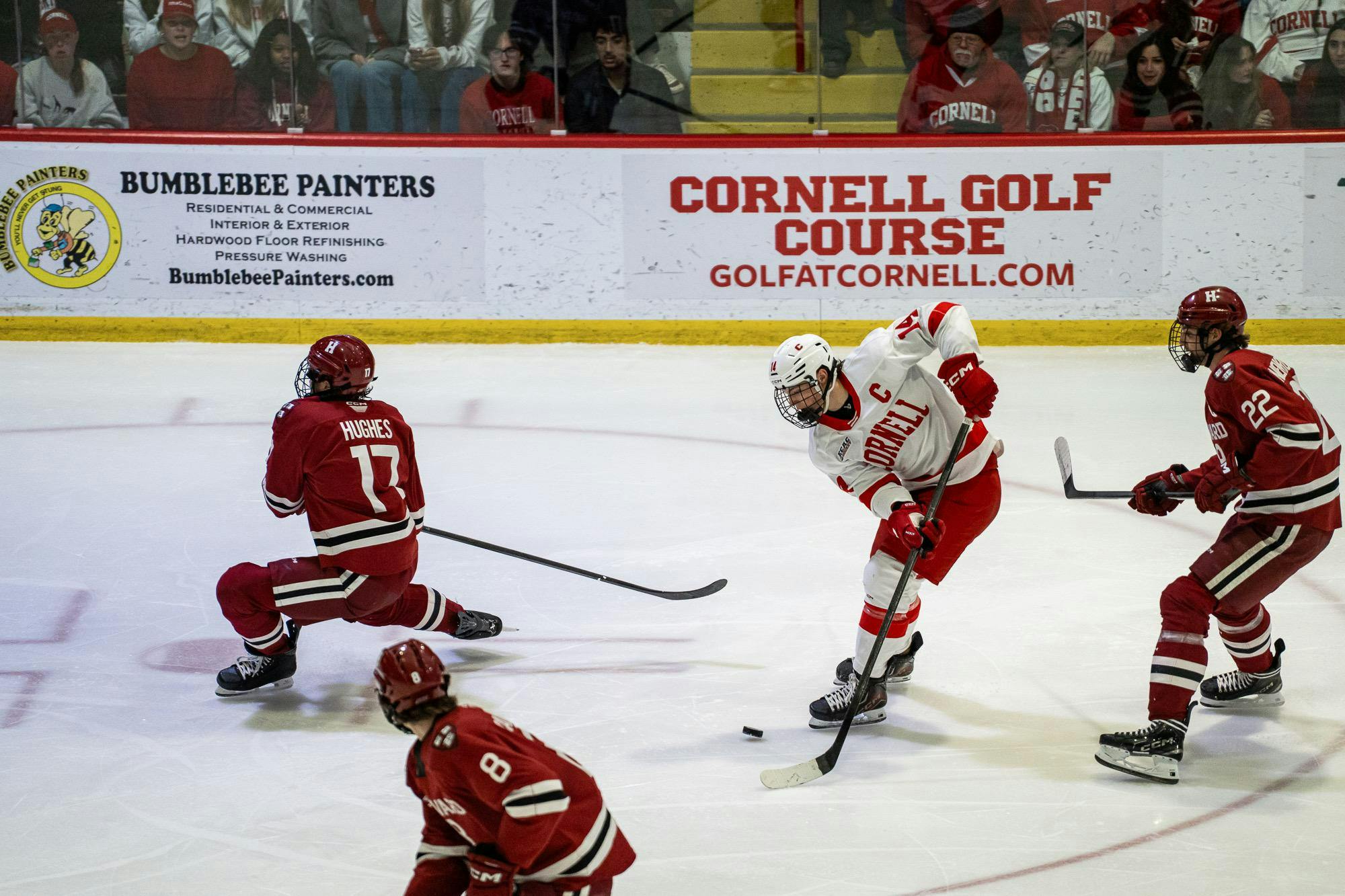
In game one of the ECAC quarterfinals, men’s hockey lost to Harvard in a home playoff meeting for the first time. After giving up the first goal of the game and heading into both the second and third periods in a deficit, the Red couldn’t crack the Crimson’s steady blueline to rally a comeback.
The 3-1 defeat puts Cornell under pressure for the rest of the series, with each game making the difference between a ticket to Lake Placid, New York, to fight for its third consecutive conference title and the disappointment of an ECAC run cut short.
After taking multi-goal victories against Harvard in both games of the regular season (a 3-1 win on Crimson turf on Nov. 1 and 4-1 home rout on Jan. 24), the upset provided a shock to the fired-up Lynah Faithful.
Cournoyer Outdueled in Historic Playoff Debut
Playoff games are often won or lost thanks to streaky goaltending. Arguably, that was the case Friday night.
When freshman goaltender Alexis Cournoyer took the ice on Friday, he became Cornell’s first freshman netminder to start against Harvard in the postseason. He will have to wait at least one more day to become the first freshman to earn a playoff win against Harvard.
While Cournoyer’s performance was solid, it was Harvard’s Ben Charette who had the vast majority of the game’s highlight-reel saves. In a game where Cornell outshot the Crimson 31-22 and owned the lion’s share of grade-A chances, those eye-opening saves proved the difference.
Neither of the goals allowed by Cournoyer would have been textbook saves. The first came after the puck took a funky deflection off the headboard right to a Harvard skater, and the second came on a Crimson two-on-one. Still, both goals could have been prevented. A quicker read of the endboards bounce or more trust in his defenseman on the odd-man rush, and maybe Friday’s end result would have been different.
- Eli Fastiff
Faceoff Prowess Falls Short
The faceoff circle has been Cornell’s dominant battleground throughout the season, with its 55% winning percentage placing the Red at third-best nationally.
On Friday, those possession-stealing draws defined the game’s most decisive moments.
Halfway through the first period, the Red had won just five of 16 attempts. Not only did Cornell miss out on valuable opportunities, but it allowed Harvard significant time in the defensive zone. Five seconds after the Crimson’s 11th faceoff win, a wayward shot by Will Hughes ricocheted off the boards onto the waiting stick of Michael Callow to set up Harvard’s first goal.
After Cornell struggled to gain its footing in the first 20 minutes, the second period told a different story.
Junior forward Jonathan Castagna’s faceoff win in the eighth minute sparked another three-touch goal, sending the puck through junior defenseman George Fegaras, who set sophomore defenseman Luke Ashton up for a one-timer from near the blueline. By the end of the period, the Red was up 24-21 on faceoffs, a comeback driven mainly by junior forward Ryan Walsh.
Heading into the final period, the pressure of a goal deficit manifested in scrappy play in the circle. Cornell took 15 of 20 third-period faceoffs, but the extra possessions failed to put the Red in favorable scoring position.
Walsh ended the night 22-12, tying Cornell’s individual season-high for faceoff wins, while Castagna went 13-5. The efforts of the co-captains ultimately weren’t enough against an airtight Harvard defense.
- Alexis Rogers
Offensive Zone Woes
Cornell had the slight edge over Harvard in shots on goal in the game, 31-22, but the shot attempts swung even further in Cornell’s favor, finishing with a 65-51 margin.
So why couldn’t they get on net?
For one, Harvard was relentless in its defensive zone. The Crimson, playing for its season, was excellent in breaking up passes and forcing many one-and-done opportunities for the Red. Harvard blocked 20 Cornell shots, giving the Red little to work with on offense.
Cornell is not a team that beats other squads with skill, stickhandling and finesse — it finds success in crashing the net and playing a pesky, unrelenting game in all areas of the ice. On Friday night, Cornell struggled to get bodies to the net and, thus, did not get the goals to show for it.
It seemed that urgency was lacking for Cornell, despite being down a goal for the entire third period. The Red was reluctant to shoot the puck, passing up prime scoring opportunities, and even struggling to pass tape-to-tape when it did so.
In order to win two in a row against a chippy Harvard squad, Cornell will need to be smarter in its offensive zone and return to its signature Cornell hockey identity — crashing the net, playing physical along the boards and pouncing on rebounds.
- Jane McNally
Second Goal Kills Comeback
During the regular season, Cornell posted a 4-1 record when its opponents scored first at Lynah Rink. All four of those comeback wins came when the Red shut out its opponent after allowing the initial score. For roughly 20 minutes after Harvard’s first period strike, that trend had a chance of continuing. Ashton’s equalizer sent a wave of energy through Cornell, and a fifth home come-from-behind victory seemed in reach.
Then, shorthand, the Crimson struck back. Once that second goal was scored, the numbers shifted in Harvard’s favor. With the loss, Cornell moved to 1-6-1 when trailing entering the third period.
- Eli Fastiff


