When the bare branches above begin to shed a whirlwind of snowflakes onto the ground below, many Cornellians prepare to brave the harsh winter winds of a false spring, feeling the breeze in their The North Face coats (and also in their hearts). College students across universities would agree that cold winters bring an inexplicable longing for warmth — the emotional kind. The very first winter breeze triggers a surge in couples holding hands and budding pairs across campus, many of whom seem to materialize out of thin air. It’s a campus-wide phenomenon that none of us can escape.
It had me thinking: How on Earth was everyone meeting their significant others, some as quickly as within the first few weeks of the semester?
I’m sure we have all heard the painfully overused phrase ‘it will happen when you least expect it’ — the most unhelpful piece of advice ever given. In my opinion, luck plays a huge role, along with the willingness to put yourself out there, which college is for. Though I’ve had my fair share of relationship experience, I feel as though dating in college has become more challenging.
‘Situationships,’ ‘the three-month rule,’ ‘red flags’ and the dreaded list goes on. Students agree that the increasingly digital dating scene has taken its toll on modern dating. Social media in particular has undermined serious, committed relationships due to various insecurities they bring about. “I think social media promotes more short-term relationships and hookup culture,” said Bojro Das ’29. Das, a first-year student majoring in information science, was excited to meet new people at the start of his college journey. He added, “It’s easy to meet people. Freshmen are generally very social.” At Cornell, first-years believe that it’s easier to meet others as new students, while sophomores may have a harder time, having already settled into the social scene.
Nonetheless, as both groups begin to tread the college dating scene, the dating crisis affects first-years and sophomores alike. They share a fear that everyone knows each other, making in-person interactions with potential partners more difficult. “I’ve noticed that Cornell is a lot more local than I thought it was. … Everyone’s friends with each other,” Das said. As a student from a big city like Boston, the local atmosphere of upstate New York came as a shock to Das. It feels like if anything goes south, it could trickle into other aspects of your social life, and many prefer not to take the risk.
Other factors discourage these groups of students from approaching people they’re interested in: heavy schoolwork, busy schedules and the nerve-racking possibility of being rejected. Even Cornell’s large campus size is a barrier. Some of my sophomore friends have told me that they wished that Cornell was a smaller campus, as they could meet new people more easily. It’s hard to talk to a new person, let alone the right one, when you’re surrounded by a population of 16,000 undergraduate students.
In addition, consistently cold weather heightens feelings of isolation for students. But the desire to find a special someone remains — whether it be a short-term fling or a long-term partner. These feelings often manifest as a desire for companionship, perhaps from the comfort of a curated, digital profile.
No one really approaches each other anymore — everyone’s tired, cold, afraid and just one swipe away from their next talking stage. So what now?
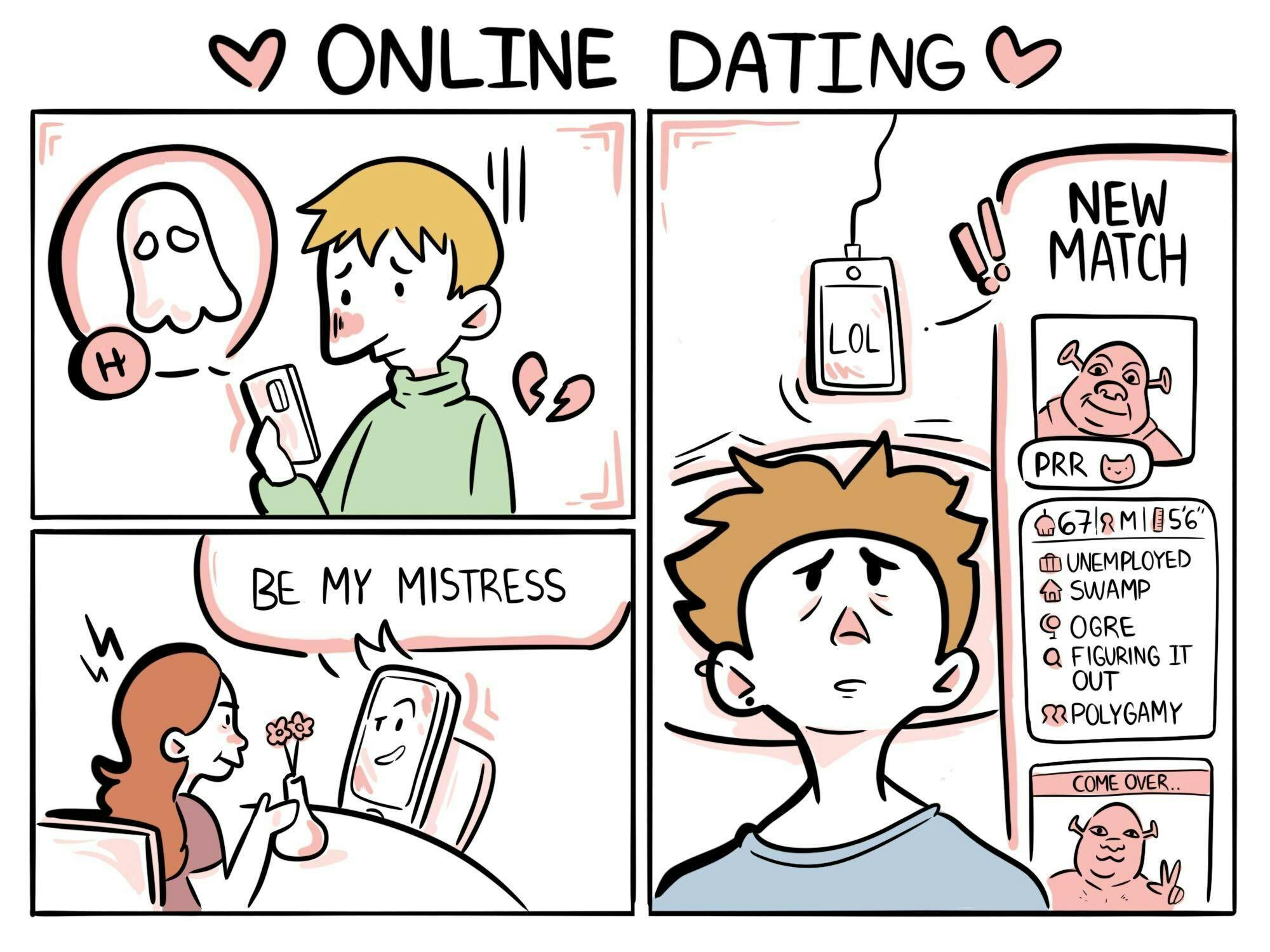
Besides some miracle encounter, there is the third, more sinister option: dating apps. Students can craft their online persona to their liking, presenting themselves however they please. This is appealing mainly because it takes the pressure off of in-person interactions. “I’d expect the dating apps would get a lot of traffic once they launched because people would have a lot of fun with them, regardless of whether people are actually looking for partners on the apps,” Das said.
Online dating has certainly become very common in our ‘screenager’ generation. In hopes of finding ‘the one,’ Hinge, Tinder and even matchmaking systems created by Cornell’s very own students, like Perfect Match, have taken the stage.
Hinge seemed to be the most user-friendly, aesthetically pleasing and accurate option, making it a top choice among college students. But Hinge conversations often hit a dead end after a week or so.
I didn’t think I would ever be interested, but curiosity won me over last year. I tried Hinge, and it’s safe to say that all that came out of it were scary stories to tell my friends. I would agree with the common consensus that it is truly hit or miss, as one can easily forget or be bored of it. Evidently, even the most preferred option fizzles out rather quickly.
UMatch, a well-known matchmaking app on campus, found my account on Instagram at the beginning of the semester, and I wondered if the app would even be useful. Other apps like Harbor, created by Gabriel Castillo ’28, have followed suit, matching Cornell students with each other through a “personality first, looks later approach.”
I never had much luck in the ‘dating department,’ especially on apps. In fact, I think I would have been much better off without them, but they taught me what I was truly looking for: a real, tangible, in-person connection. It’s a feeling that can’t be replicated online.
Overall, dating today is becoming progressively more disconnected and virtual among college students, worrying many of us looking for warmth in the chilly season. It seems that only time will tell what our future prospects for love hold.
Selina Chen is a sophomore in the College of Arts and Sciences. She can be reached at sc3543@cornell.edu.
Selina Chen is a member of the Class of 2028 in the College of Art and Sciences. She is a staff writer for the Lifestyle department and can be reached at sc3543@cornell.edu.