


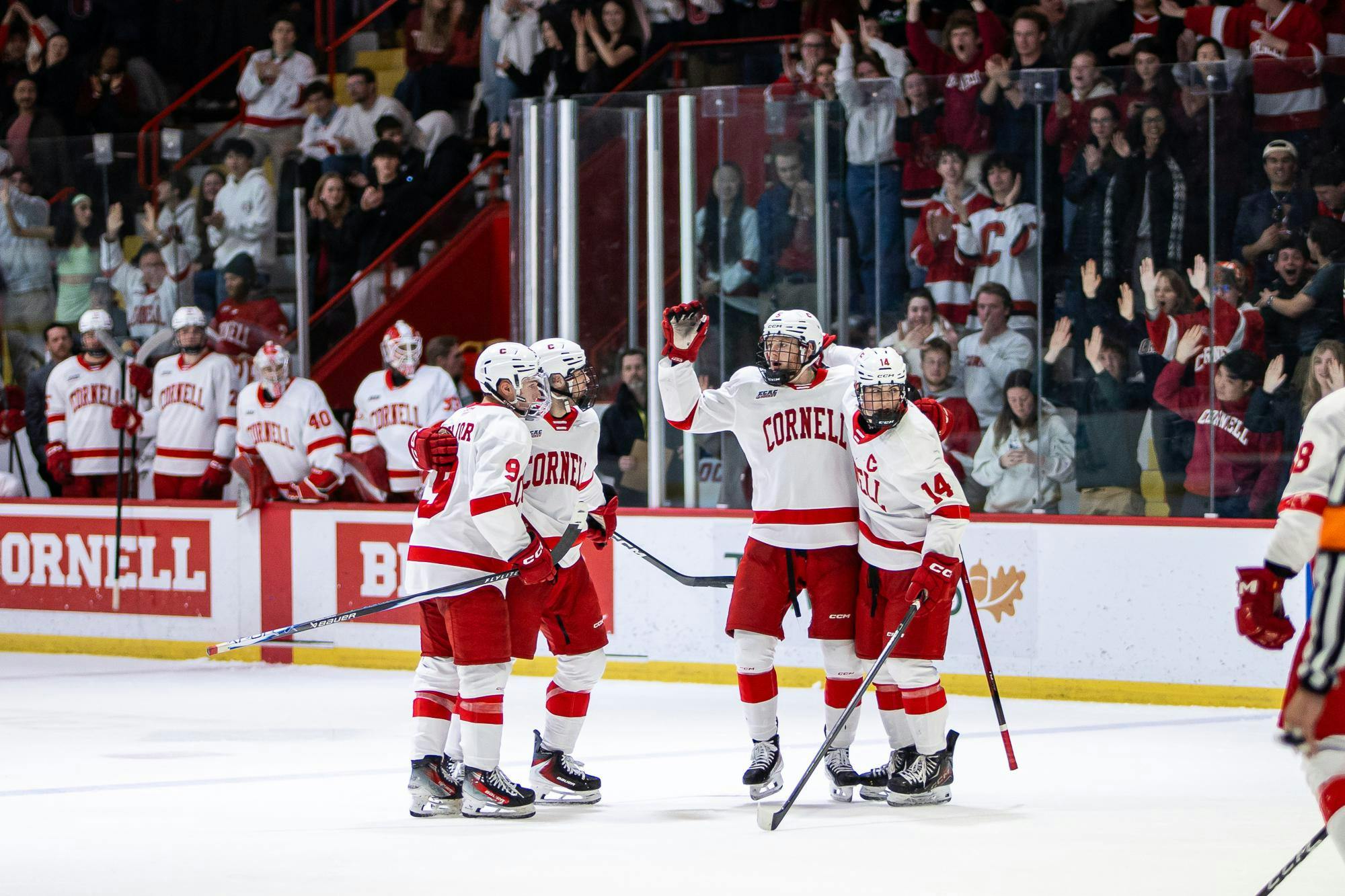
No. 8 men’s hockey will face off against Princeton at 7 p.m. on Friday in the ECAC semifinals at Herb Brooks Arena in Lake Placid, New York.
Here’s how the teams compare. All statistics are courtesy of College Hockey News unless otherwise stated.
The Numbers:
Records: Cornell (22-9-1, 15-6-1 ECAC) Princeton (17-12-3, 11-9-2 ECAC).
Power play percentage: Cornell 24.0% (13th) Princeton 18.6% (39th).
Penalty kill percentage: Cornell 80.9% (34th) Princeton 80.7%(32nd).
Faceoff win percentage: Cornell 55.0% (3rd) Princeton 48.4% (46th).
Goals scored per game on average: Cornell 3.3 (14th) Princeton 3.1 (22nd).
Goals against per game on average: Cornell 1.9 (1st) Princeton 2.7 (21st).
Shots per game: Cornell 29.6 (29th) Princeton 28.6 (38th).
Penalty minutes per game: Cornell 9.0 (41st) Princeton 10.3 (30th).
Series history: Princeton and Cornell share not just two of the oldest arenas in college hockey, but also a rich competitive history. The Red has a large advantage in the series history, 103-55-8, dating back to 1901. In the last 10 matchups, Cornell is 7-2-1.
This season, Cornell was outpaced by the Tigers in a 4-2 loss at Hobey Baker Rink in its last meeting, leaving the season series split after a 2-1 win in Ithaca earlier in the year.
The last time these two met in Lake Placid was in 2018, when Princeton upset Cornell, 4-1, in the ECAC semifinals en route to a Whitelaw Cup — Princeton’s most recent title and one of only three for the Tigers.
Cornell’s last time out: No. 9 Men’s Hockey Punches Ticket to Lake Placid With Gutsy Game Three Win Over Harvard
Final score: Cornell 5, Harvard 2
Cornell defeated the Crimson in front of a rowdy crowd, avoiding a major upset in the ECAC tournament — the same tournament that saw top-seeded Quinnipiac fall at home in two straight games to six-seeded Clarkson.
The Red improved throughout the weekend after a surprising loss on Friday. The 5-2 victory was a team effort, with each goal coming from a different player. Cornell also allowed just one power-play goal in the decisive win.
Princeton’s last time out: Princeton’s path to Lake Placid was less stressful. After a strong run down the stretch to secure home ice and a first-round bye as the No. 4 seed, the Tigers faced No. 5 Union in the quarterfinals and handled the Garnet Chargers convincingly, winning 5-2 on back-to-back nights. Princeton showcased a potent offense throughout the weekend and finished off a 14-win slate on home ice.
Scouting the Tigers: Kai Daniells paces the offense in a breakout junior season for the forward. Daniells contributed four points in Princeton’s victorious efforts in the ECAC quarterfinals, including a hat trick in the deciding game. Daniells is a dangerous scorer with a knack for scoring in bunches; he had four separate multi-goal affairs this season, including a record-setting five-goal night against St. Lawrence. While Daniells leads the Tigers in goals, David Jacobs is the player feeding him the puck. Jacobs leads the team with 26 assists — eight ahead of the next best, Daniells. Jacobs doesn’t just contribute in the offensive zone; the senior forward is also excellent on defense, being recognized as a finalist for ECAC Defensive Forward of the Year alongside Cornell junior forward Jonathan Castagna.
In net, junior Arthur Smith has been a solid starter, posting a .913% save percentage and 2.42 goals against average. Smith, like the Red’s freshman goaltender Alexis Cournoyer, is 6 feet, 4 inches tall and uses his frame and positioning to see through chaos and limit second-chance opportunities.
Princeton is coached by former Cornell associate head coach Ben Syer. Syer has revitalized Princeton in his second year with the program, leading the Tigers to their first winning record since the 2017-2018 season — notably, the last time the Tigers took the Whitelaw Cup. The ECAC Coach of the Year finalisthas brought knowledge and experience to New Jersey, implementing a tenacious style of play and mentality that can overwhelm opponents. Being 23rd in NPI rankings, Princeton is on the outside looking in on the NCAA Tournament and will need the automatic bid from winning the ECAC championship to extend its season.
Tyler Goldberg is a member of the Class of 2028 in the College of Agriculture and Life Sciences. He is a Sun Senior Writer and can be reached at tgoldberg@cornellsun.com.


