

Lebanon, I write this love letter to you —
They have battered you, but they will never break you.
To the villages along the South, who have long faced bombardment, you will never fall. To those forced to flee in the earliest hours of the night, there is no disgrace in your survival. You will return to the land of love, and we will always find our way. This is the story of resilience that has damned our history for almost a hundred years.
Lebanon, how must it feel to watch smoke dance across your once-clear sky?
Flower of the unfortunate, they have mistaken the bloom of the mushroom cloud for beauty, the stammer of soldiers’ boots for music. How do they tune out the children’s screams? Do the hollowed-out ruins make for good acoustics? What a cruel staccato.
They say they will level Dahiyeh like they did Khan Younis. They’ve bombed a girls’ school, highways, hospitals. My grandparents drove hours to Beirut to hide in a hotel, and they’ve bombed hotels too.
And when we raise the flag, what do you think it is that they see? Is it the grimace of the man who hoists it, the wind that drags upon it like nails clawing at its fabric, the tears of the mother, the child, the refugee? Do you think they see such things at all?
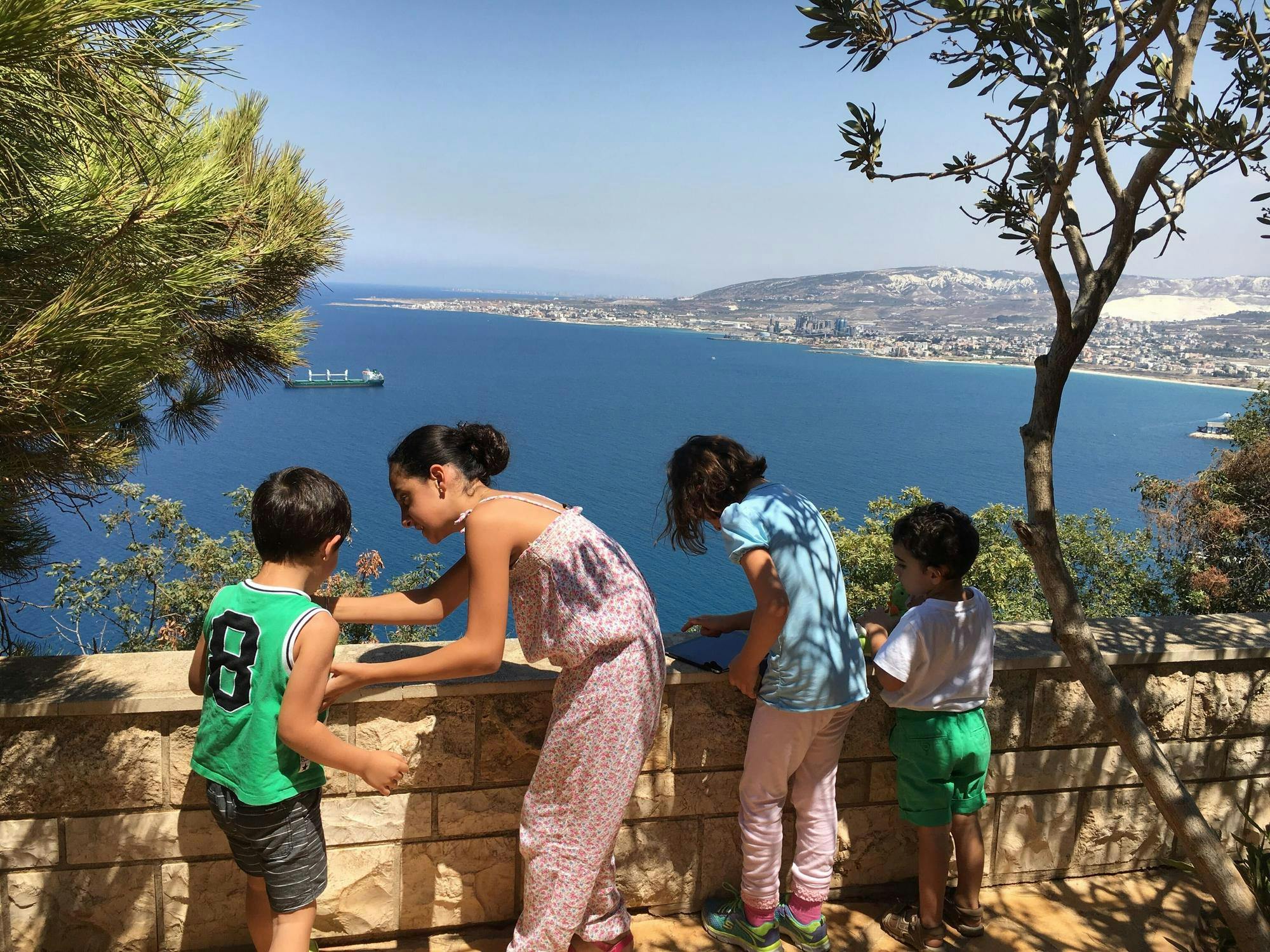
We used to ‘pspsps’ the cats that scurried down our streets. We used to climb trees and eat ice cream and set fireworks in my cousin’s backyard. I played soccer with my neighbors in a twice bombed Beirut parking lot. I wouldn’t have known if they hadn’t shown me the pictures. Do they know too that we used to link arms and skip down those streets? That we woke to birdsong, jumped down stone walls like it was death or life? Do they know too that we are human?
Children splash at each other. As the Mediterranean glistens, another rocket shoots to the sky. What did they sign on this one, I wonder. They try to write us our eulogies, but the truth is clear: They cannot take from us a land so etched in our bones that the rubble breathes fire.
How do I hold all this admiration and despair? What an easy task that is. True to my name, I have never suffered like you. I am soft and American, an imposter here and there.
Lebanon, I paint my nails red for you. Red for the blood, red for the sacrifice. Red as a reminder that you cannot ignore suffering behind a morning coffee and a red Canvas circle and internship applications. We scroll on our phones, we write cover letters and talk about AI startups. We call it normal.
Our distance has become more than a convenient excuse. What are we to do about the drones and warplanes we’ve never seen with our own eyes? It is easier to treat devastation like background noise, to say that it is all out of our control while entire families are forced from their homes.
But inaction is never neutral; it is permission. Our voices are our strongest weapon, yet the silence of this campus is deafening.
Lebanon, my first love, my last regret. I have betrayed you. I cannot save you with anything but a pen, and I doubt that’s enough. I would go back if I could and I would lie on the sidewalk and listen to your Phoenician heart and I would hear the ground rock and I would try to gouge myself in all of your steadfast beauty, something they have tried too many times to take away. They will never learn that such a feat is impossible.
This is not farewell, because there is no such thing. The rain will erase the blood, smoke will become a mist, but the smell will remain, and the grief. The shattered glass windows of our Beirut apartment will be built again, the cedar tree will heal, beyond the summer and the winter.
Lebanon, I am done praying.
Lebanon, we will meet again.
Rageen ya hawa.
The Sun is interested in publishing a broad and diverse set of content from the Cornell and greater Ithaca community. We want to hear what you have to say about this topic or any of our pieces. Here are some guidelines on how to submit. And here’s our email: opinion-editor@cornellsun.com.
Leah Badawi '27 is an Opinion Columnist and a Government and English student in the College of Arts & Sciences. She also serves as the Co-Editor-in-Chief of Rainy Day Literary Magazine. Her fortnightly column Leah Down The Law reflects on politics, history, and broader culture in an attempt to tell stories that are often left between the lines. She can be reached at lbadawi@cornellsun.com.


