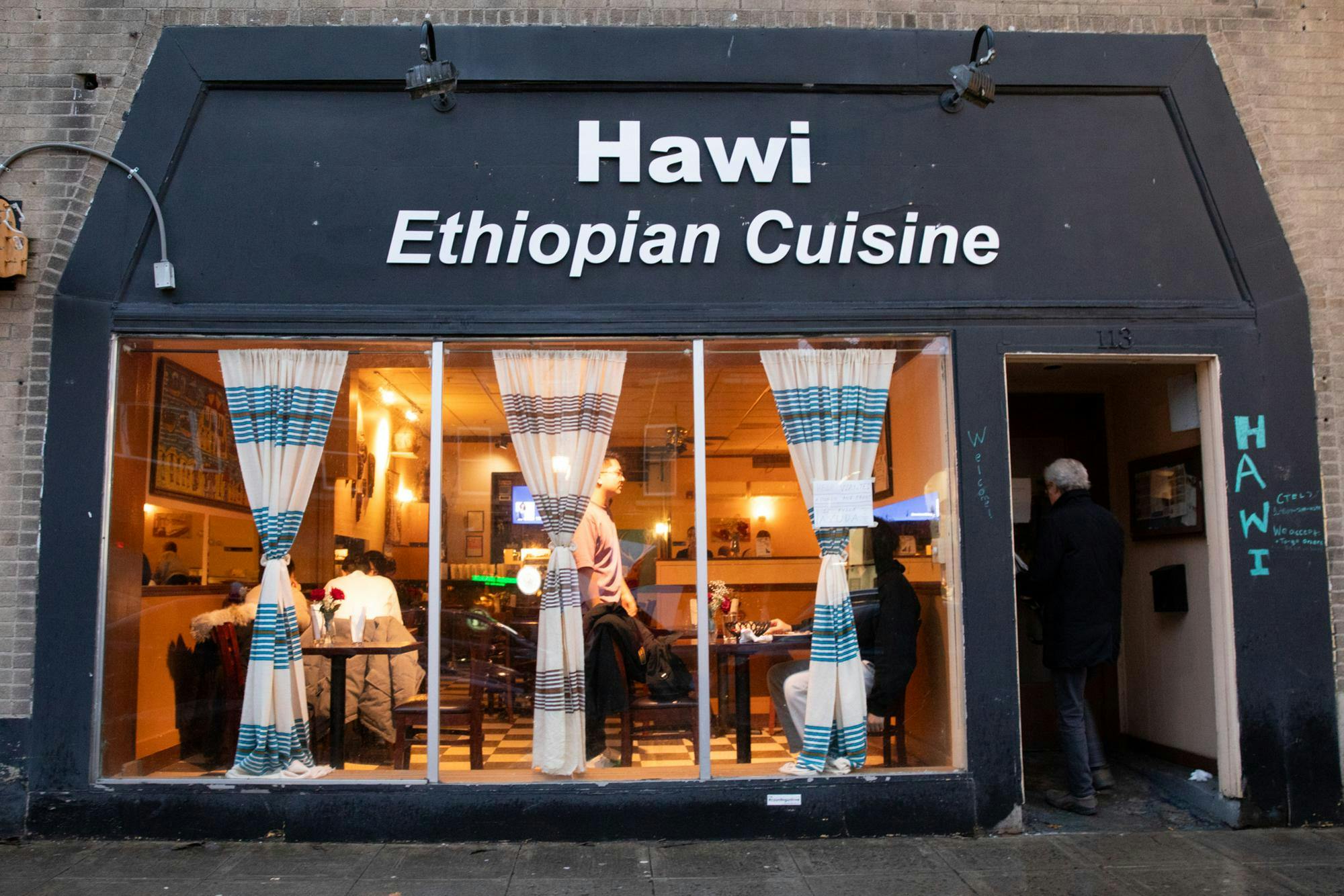
At the start of the semester, out of the blue, my friend asked to get dinner. While I expected him to suggest a standard Collegetown spot like Collegetown Bagels, Xi’an Street Food or Pokelava, he instead recommended a restaurant, unlike any eatery offered in Ithaca: Hawi. Located in Ithaca Commons, Hawi serves traditional Ethiopian dishes. I was shocked when my friend told me that there was an Ethiopian restaurant in the area, and as I had never heard of Hawi before, we immediately went for dinner the next day.
Opened in 2015, Hawi is the only restaurant in Ithaca to serve Ethiopian food and is known around the area for its warm and comfortable atmosphere. When I entered the restaurant, I was immediately greeted with a warm aroma of chili and cumin and laughter from large groups sharing trays of food. As we waited to get seated, I stared at the colorful foods on everyone’s plates, and I immediately knew I was in for a delicious meal.
Traditionally, Ethiopian food is meant to be eaten with your hands. Every dish is served with a layer of injera, fermented flatbread, at the bottom of the dish, which is meant to be eaten along with the various meat and vegetable curries placed on top of it. While eating, you are supposed to break a piece of injera and eat it with the accompanying dishes. These dishes are large and are meant to be shared.
The menu includes various appetizers and drinks, but the true star of the restaurant is the plates they offer. Hawi serves various meat combo meals — Chicken, Beef and Lamb — where you can order a platter of two meats and three veggies. Hawi also offers veggie combos for vegetarians and vegans. These combos start at $23 for one person, though you can order a platter for up to four people to share for $76. Hawi has five meat options and seven veggie options. They also list five more “traditional” dishes that they recommend customers get on their second visit, as these dishes are more of an “acquired taste.”
My friend and I had never had Ethiopian food before this visit, so we asked our server for suggestions. He recommended we get the “Special Combo,” listed under the traditional dishes section. This dish comes with Kifto, Derek Tibs, Doro Wat, the choice of two veggie dishes and injera. They serve the dish in a mesob, a traditional basket made for storing injera. We had no clue what any of the dishes would taste like, but based on the aromatic smell of the restaurant, my friend and I knew that this meal would be amazing.
When the dish arrived, I immediately dug in, ripping a piece of injera to try the Derek Tibs. Derek Tibs is a beef dish, where beef strips are marinated in wine and sauteed with onions and jalapeños. Needless to say, I loved this dish. Smoky, rich and savory, it was unlike anything I’ve ever tried before, and the firm, juicy beef blended to create a great texture in my mouth. Paired with the sour injera, as the bread is fermented, the dish was bursting with flavor. I really enjoyed eating this dish with Ayib, Ethiopian cottage cheese, which was sprinkled throughout the mesob.
Next, I tried the Kifto. Kifto is a raw minced beef infused with butter and spices, and is known as a celebration dish for holidays and special occasions. I have to say, I had never tried raw meat before this dish, so trying Kifto was a new experience for me. I wasn’t a big fan of the texture, which I think is because I wasn’t a fan of the soft, raw meat. The flavor is the combination of rich butter and chili spice, which I liked, but I didn’t enjoy how it didn’t really have a chew. Though I was able to eat it with injera, which provided a more solid bite.
The last meat dish I tried was Doro Wat: chicken drumsticks with egg in a tomato-butter sauce. The chicken was unbelievably tender, and I loved how creamy and aromatic the sauce was. I’m a huge fan of chicken, and I found that this was one of the best chicken dishes I’ve had in Ithaca. Though I steered clear of the hard-boiled eggs (as I’m not a huge egg fan), according to my friend, the egg soaked up all the sauce, making it unbelievably creamy and savory.
The two veggie dishes we got were variations of lentil stew. In my opinion, these dishes weren’t the stars of the show, but I found that when accompanied with a meat dish and injera, the stews added a hearty bite. Of course, even when eaten by themselves, these veggie dishes were delicious.
Overall, my visit to Hawi was one of my most memorable dining experiences in Ithaca so far. From the atmosphere to its vibrant flavors, every part of the meal felt like an introduction to rich, authentic Ethiopian culinary traditions. Hawi reminded me how exciting it can be to explore new cuisines right in your own town, and I look forward to sharing conversations over a plate of delicious food with my friends at Hawi in the coming weeks.
Sanika Saraf is a sophomore in the School of Industrial and Labor Relations. She can be reached at ss4353@cornell.edu.

Sanika Saraf is a member of the Class of 2028 in the School of Industrial and Labor Relations. She is an assistant lifestyle editor on the 144th Editorial Board and can be reached at sanikas@cornellsun.com.