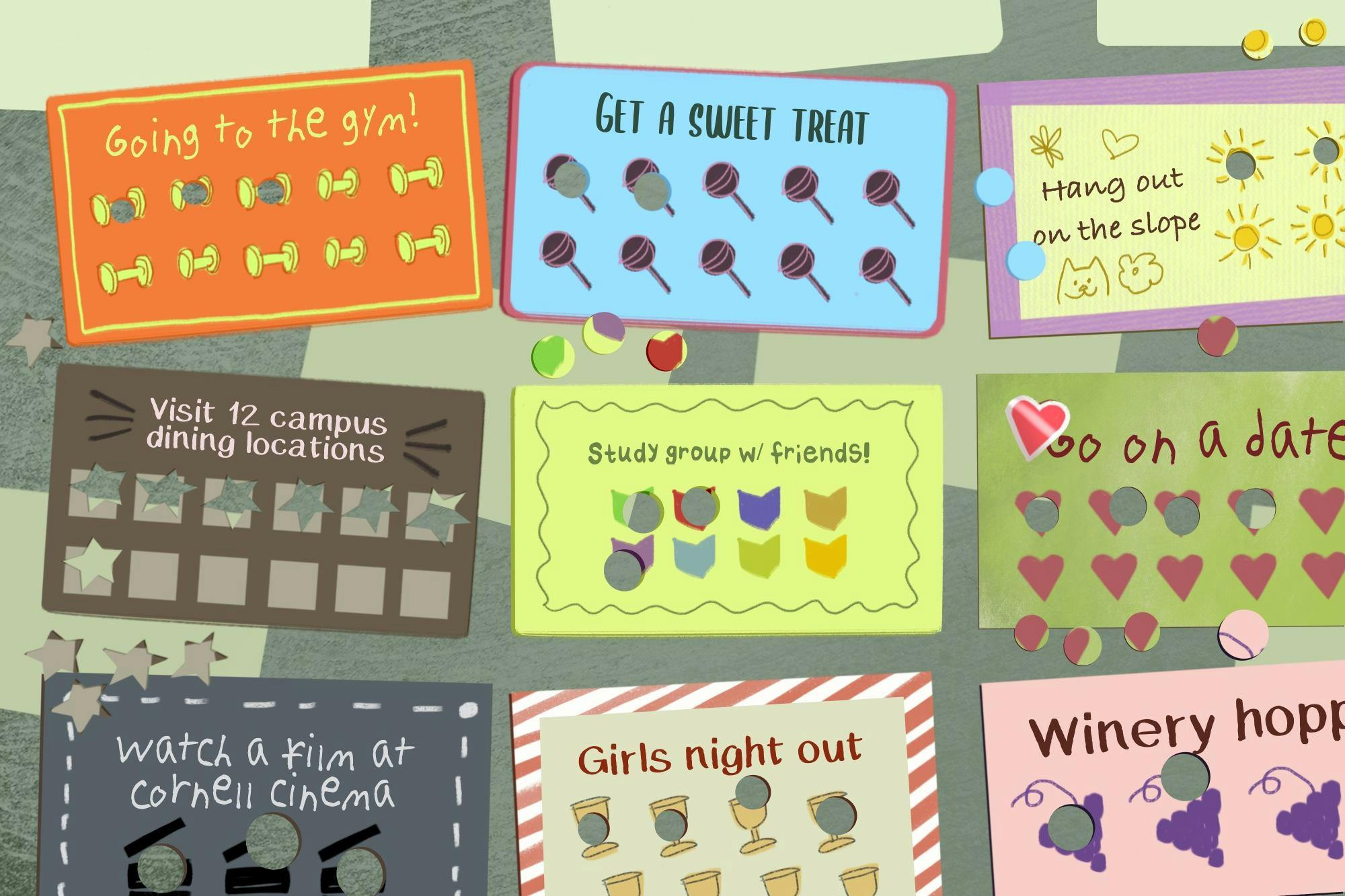
By no means am I an arts and crafts person. I quit crocheting when I was 10 because I could never figure out how to loop the yarn properly without tears forming. However, what began as a creative and accessible twist on the annual attempt to follow through on New Year’s resolutions — the kind we all swear we’ll commit to before conveniently forgetting them a week (maybe two) into January — has turned into a rewarding, low-pressure way to stay motivated. The DIY trend, known as “Punch Card Goals,” transforms personal goals into a tangible, friend-bonding experience that makes accountability feel fun, rather than tantalizing. And who am I not to partake in a free-of-charge trend?
These Pinterest-esque punch cards are exactly what they sound like: a simple, quick craft that turns any goal — no matter how small — into something you can physically track. All you need is a notecard, a hole punch, and some writing utensils (the more vibrant, the better). At the top of the card, write your goal. Below it, draw a set of small icons to represent progress: circles, stars, or any tiny symbols tied to your goal, spaced neatly across the card. Each time you complete the task, you punch a hole through one icon. The card slowly fills with punched-out marks, making your progress visible. At the bottom, write your reward — a trip to College Town Bagels, a movie night, whatever truly motivates you — as a reminder of what you are working toward. Once every icon is punched through, the card is complete, and the reward is yours.
I am far too guilty of ‘treating myself’ after doing nothing more than ‘doomscrolling’ for a few hours and maybe glancing at the first paragraph of my assigned reading. This system has forced me to confront my not-so-productive habits. The day before classes began this spring semester, my friends and I found ourselves talking about our shared desire to become more disciplined, academically-focused scholars. While the intention was genuine, we all knew good intentions alone wouldn’t carry us through the semester. That night, we hosted a small “Punch Party” where we pulled out a stack of untouched, dust-covered index cards and colored pencils and set goals for ourselves — on our own timelines, with our own rules.
I decided to use my punch cards not only to support my academic goals but also to prioritize self-care during a semester that lacks both sunlight and serotonin. On one index card, I drew music notes, added eight soon-to-be-hole-punched circles and wrote a simple but meaningful personal goal: “Practice guitar weekly (at least twice).” At the end, I chose a reward — a much-needed Trader Joe’s trip. The structure made the goal feel manageable, while the reward gave me something tangible (and delicious) to look forward to.
My friends came up with ideas of their own: studying consistently throughout the week, starting their gym grind, budgeting weekly Big Red Bucks or finally getting around to watching films from ignored Letterboxd watchlists. Whether academic or personal, the punch cards offer a creative way to commit to goals and track progress without pressure or perfectionism.
Rose Yardeni ’29 centered her punch card around journaling, pairing it with a DoorDash reward. She admitted the prize itself felt a bit silly — nothing revolutionary — but said the process remained meaningful. She explained, “I like to write, and journaling has been an important habit in my life,” noting how the rush of a new semester can make it easy to forget simple outlets that once brought comfort. She also made a punch card as a gift for her boyfriend, focused on trying new restaurants together. This demonstrates how the activity can become just as much about connection as completion.
During the process of making her cards, Yardeni said, “It felt almost like a keepsake more than an actual reminder.” She found value in the experience itself, explaining that “having to think of a goal to put on it reminded me of the activities I enjoy and sometimes forsake.” She also emphasized that making punch cards with friends made the activity more engaging by fostering an exchange of ideas. The card became less about rigid productivity and more about collective motivation and mental well-being.
Ultimately, these punch cards prove that motivation doesn’t have to be complicated. When goals are simple, visual and shared with friends, following through becomes less daunting and far more rewarding. Sometimes, the simplest and best resolutions are the ones that actually stick. Who knows, maybe now is finally my time to pick up that long-lost talent for crocheting.
Savannah Sandhaus is a first-year in the College of Arts and Sciences. She can be reached at sjs482@cornell.edu.
Savannah Sandhaus is a member of the Class of 2029 in the College of Arts and Sciences. She is a staff writer for the Lifestyle department and can be reached at ssandhaus@cornellsun.com.