


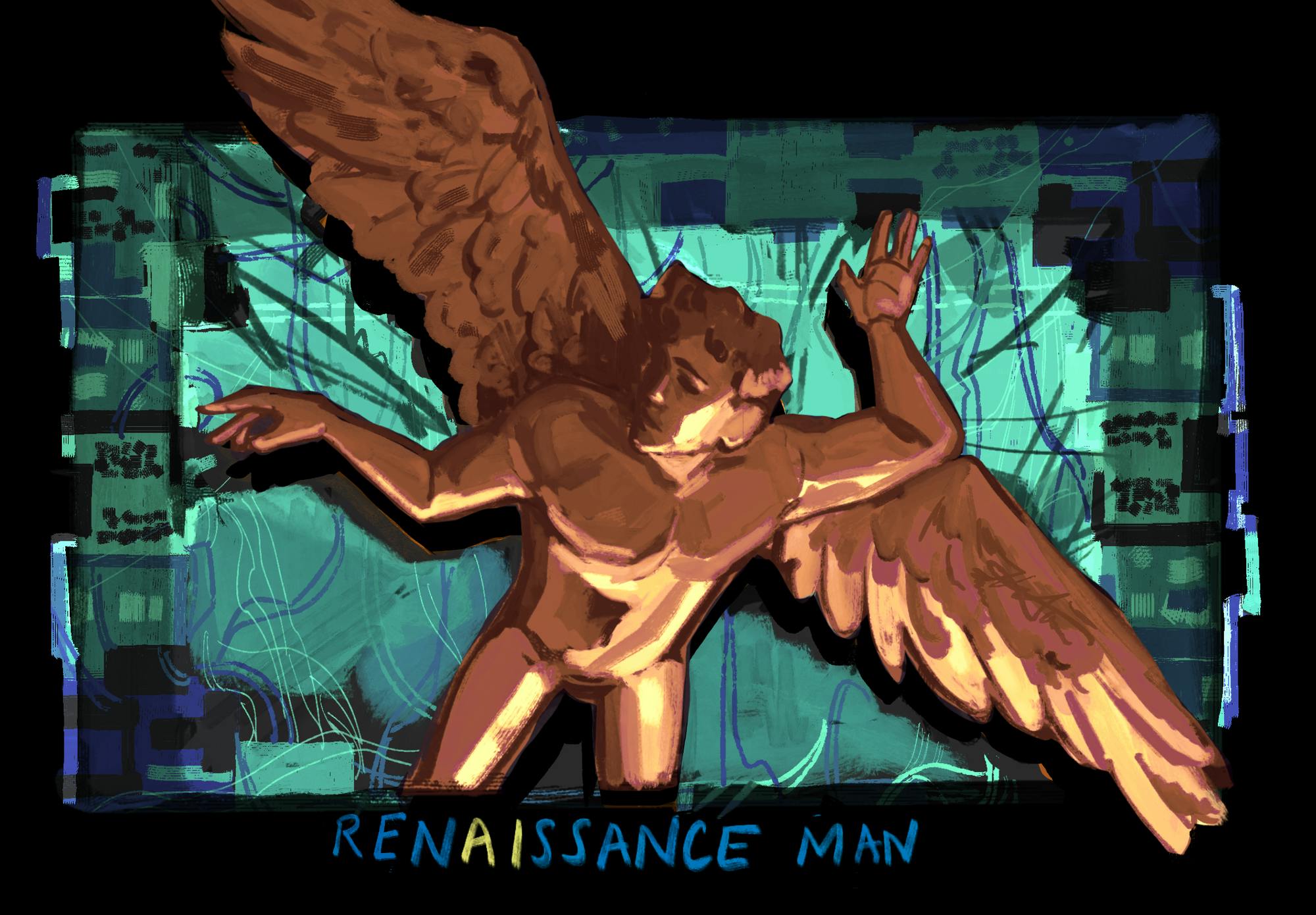
If someone studied the nature of existence, and I asked you to guess their major, what would you assume? Physics or theology? What about someone who studies logic — are they a mathematician or a philosopher? If I told you I was a designer, would you assume me to be a student in the College of Architecture, Art and Planning or the College of Engineering? We killed the polymath, and we did it with course catalogs. Somewhere between the trivium and the computer science major, between Aristotle and the specialized Ph.D., we decided that human knowledge was too vast for any single mind. We were wrong.
Why do we assume these must be different people? When did we decide that understanding belonged solely to one campus building? Once upon a time, the greatest minds refused to recognize these boundaries. They were polymaths.
Hypatia of Alexandria didn't partition her understanding of the cosmos from that of human thought. The same mind that improved the astrolabe — calculating the positions of stars with unprecedented precision — also taught Neoplatonic philosophy. She saw the universe as both a mathematical problem and a spiritual question, and she was right to see it that way.
When Hypatia built her instruments, she wasn't just advancing astronomy. She was asking what it meant for humans to measure the heavens, to impose order on vast chaos — to find our place in an infinite cosmos in a religiously divided academic capitol. Her mathematics served her philosophy. Her philosophy deepened her science. To her, these weren't separate disciplines requiring separate degrees from separate schools; they were facets of the same inquiry.
We wouldn't know how to educate Hypatia today. We'd force her to choose. Pick a lane. Declare a major. Stay in your department. She'd refuse, and we'd be poorer for it.
Leonardo da Vinci. You may know him as the man who painted the Mona Lisa. He also studied hydrology, mapped human anatomy and engineered weapons of war. But these weren't hobbies he pursued in his spare time between art commissions. His art was his engineering. His engineering was his art.
Artists used to dream of flight; they would follow their imagination to the farthest reaches of possibility. Birds, bats and kites would draw visual inspiration into sketchbooks that became blueprints. Da Vinci didn't separate observation from creation. The same eye that painted sfumato — the revolutionary technique of soft shadows — dissected cadavers to understand how muscles moved beneath skin. The same hand that drew the Vitruvian Man sketched flying machines by studying bird anatomy in obsessive detail. His ornithopter didn't emerge from equations. It emerged from watching. From beauty. From the artistic understanding that form and function are inseparable, that to truly see something is to understand how it works. He didn’t need advanced calculus or fluid mechanics to scheme what many great engineers would later innovate from.
We have grown accustomed to artists who panic at the sight of an equation and engineers who outsource their sketches to rendering software. We've convinced ourselves that the person who dreams cannot be the person who builds. Da Vinci would find this baffling. So would the Wright Brothers, who owned a bicycle shop and studied buzzards before they conquered the sky.
The professionalization of academia in the 1800s demanded specialization. The word ‘scientist’ wasn't even coined until 1834. By 1905, universities were formalizing the division: general education, then a major. We created departments and housed them in separate buildings. The physicist stopped talking to the poet. The biologist forgot the ethicist existed.
In the last 20 years, Cornell’s humanities enrollment has plummeted while engineering’s soared. We started measuring education in return on investment. The market spoke. The universities listened.
We've lost the scientists who can write and explain their work to the public that funds it. We've lost the humanists who can critique AI while also understanding the algorithms that govern it. We've lost the ethical frameworks that once constrained innovation because when you study only chemistry, you can convince yourself that Agent Orange is just a herbicide.
Most tragically, we are losing the breakthroughs that happen at intersections. The ones that require seeing what a biologist and a computer scientist might create together. What a historian and a physicist might discover in conversation.
This isn't about nostalgia or some hyperclassical fixation. The problems we face — climate change, artificial intelligence, bioethics — don't respect our arbitrary academic boundaries. They require solutions that span disciplines, minds like Hypatia's that can hold multiple frameworks simultaneously, vision like da Vinci's that would refuse to separate art from science.
The greatest minds didn't excel across fields. They excelled because they refused to recognize fields at all. Once upon a time, we knew this. Perhaps it's time we remembered.
The Sun is interested in publishing a broad and diverse set of content from the Cornell and greater Ithaca community. We want to hear what you have to say about this topic or any of our pieces. Here are some guidelines on how to submit. And here’s our email: opinion-editor@cornellsun.com.

Zak Kheder '26 is an Opinion Columnist studying Electrical & Computer Engineering in the College of Engineering. RenAIssance Man explores questions of intellectualism and what it means to be a student in the age of information and technology. He can be reached at zkheder@cornellsun.com.


