


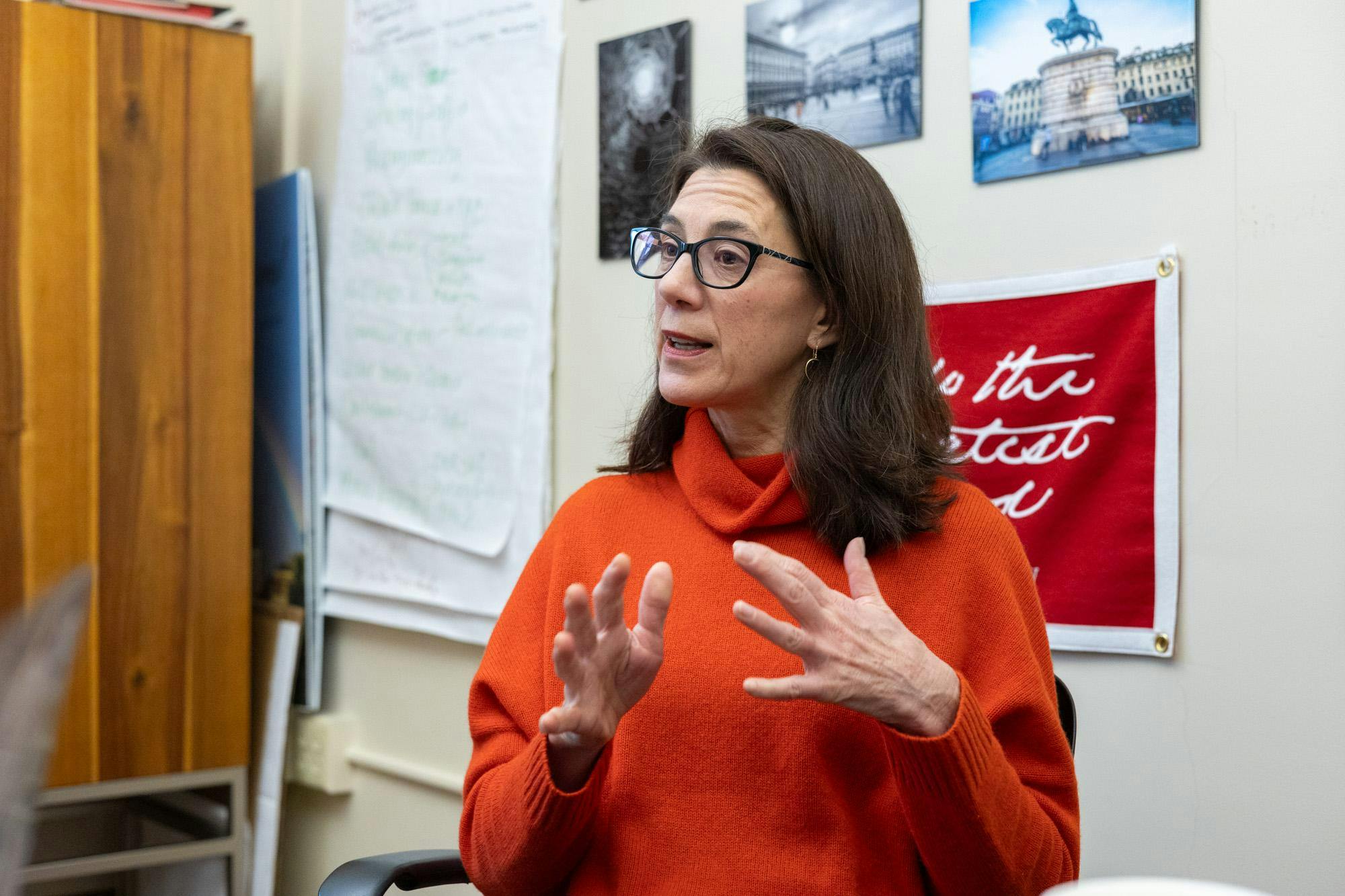
Over the course of a 30-minute interview with The Sun, Wendy Wolford, vice provost of international affairs, spoke about Cornell’s Nov. 7 settlement deal with the Trump Administration and why Foreign Gift and Contract reporting was emphasized in the agreement. In 2019, the University fell under Department of Education investigation for failing to disclose gifts and contracts from Qatar and China, though Wolford said the University is not currently facing any federal inquiries over the matter.
Wolford also spoke on two developments that have or could impact international Cornellians. Speaking on H1-B visas, Wolford said that the University is still waiting for the final ruling on the legality of the Trump Administration’s Sept. 19 decision to require a payment of $100,000 to sponsor H-1B applicants. Additionally, Wolford explained that the University submitted public comment on how the Department of Homeland Security’s Aug. 28 decision to change the duration status of F1 and J1 visas is “both unnecessary and harmful to our student population.”
Below is the full transcript of The Sun’s interview with Wolford, which has been lightly edited for clarity.
H-1B Visas
The Sun: Speaking on international issues and things that affect our international community, I want to jump right in and start with H-1B visas. On Sept. 19, President Trump signed an order that required employe[r]s to pay $100,000 to sponsor new H-1B petitions and created restrictions on the entry of H-1B workers into the United States. On Oct. 20, U.S. Citizenship and Immigration Service provided additional guidance on the fee. Now, according to the data from U.S. Citizenship and Immigration Services from 2009 to 2024, Cornell University has sponsored an average of roughly 120 new approved H-1B visas per year. 2023 and 2024 were the highest at 178 and 205 approved visas, respectively.
With this in mind, will the University pay the price to sustain the same number of H-1B workers? If not, what are the new numbers expected to be?
Wendy Wolford: We are still waiting on the final ruling. The initial proclamation from President Trump was very unclear, and we all scrambled to try to understand what the actual impact was. The new guidance from USCIS is helpful, but it's still not regulation that we're totally clear on. It isn't clear that it's going to stick. It is currently, of course, being fought by a few different lawsuits, one put forward by the AAU, the American Association of Universities, and the U.S. Chamber of Commerce, arguing that it is outside the authority of the President to impose this fee. So, we're waiting to see what happens. We have sent in a statement about the value of our H-1Bs and the importance of those individuals to the University community. We've had a couple of webinars on international issues you might have seen in the last semester, so the last few months. The H-1B question is probably one of the more urgent questions, also duration of status, which for students, is a huge issue.
The University won't take a set position on the payment of the fee, in the sense that, if it is legally required, of course it will be paid, but we won't say there's a new policy on bringing H-1Bs in or not, or who pays the fee. That will still be the responsibility of the hiring units. So, chairs, deans, they'll decide whether or not they're going to pay that fee. I will say the clarification in subsequent weeks by the [Trump] administration that people who are in the country and applying for a change of status or applying for H-1B will not be subject to the fee was actually a huge update, or clarification. So, only those who are outside the country at the time of application would be subject to a one time fee. It's still a significant amount of money, but it is a lot different than anybody applying [for the fee] and every year, which was the initial understanding.
The Sun: The question on a lot of people's minds [is], if this order does become law will Cornell pay the money? Looking into the future, would Cornell be in a position to do that, to sustain the [same] number of [H1-B] workers?
Wendy Wolford: It's a really good question, but my point is that it isn't Cornell writ large that pays the money. It would be a startup package for a faculty member. It would be a research unit funded by federal grants that would say: for our synchrotron, we feel this person is necessary, and so we're going to pay the fee. So, Cornell as a whole won't have a policy and doesn't pay, as a rule, for individuals in that way. Are there individuals who, if we are required to pay a fee, who will have the fee paid for them? I imagine so.
The Sun: You mentioned that there are some ongoing lawsuits about the fee increase. During the first Trump administration, Cornell actually joined some lawsuits about H-1B visa restrictions put in place in 2020. Is Cornell intending to join any lawsuits against the federal government now? If not, what steps is Cornell taking as a university to respond to the fee increase.
Wendy Wolford: Our professional association, the AAU, American Association of Universities, is and was the unit that went forward with the lawsuit. So, we are represented in that lawsuit, and we put in a statement for it, arguing that our H-1Bs are incredibly important and that the fee would be difficult. The University itself, as far as I know, and this can always change, doesn't have plans to join a lawsuit, but we feel like we're represented.
Student Visa Revocations and SEVIS Terminations
The Sun: Last year, at least 17 current and former students had their SEVIS immigration records terminated and then later restored. At the time, the University stated on its dashboard that this action is temporary while the Department of Homeland Security creates a new system to review student records. During this past fall 2025 semester, have there been any SEVIS record terminations? If so, how many students have faced SEVIS record termination?
Wendy Wolford: There have not, as far as I know, and I would normally know. I'm just saying there's something that could have happened, but it is very unlikely. As far as I know, there have been no SEVIS record terminations. There are two different things, visa revocations and SEVIS terminations and people often conflate them. In terms of visa revocations, we have seen two of those, which isn't all that unusual. You would sometimes have a visa be revoked for reasons that were outside our control, or even the student’s, but there is a more fraught landscape for immigration than there has been previously.
The Sun: Could you give any more context about what those two visa revocations were, what their situation was, why they were targeted?
Wendy Wolford: No, a lot of that is personal details. I will say that [Proclamation 10043] does mean that there is extra investigation of international student visas for reasons of what is referred to as undue foreign influence — the concern that national security is imperiled if we don't investigate the backgrounds closely of our international students, staff and faculty.
The Sun: In an article published on Oct. 7, when asked about how Cornell is assisting its international students with the new policies, you [Wendy Wolford] explained in an email statement that Cornell International Services has “extended flexibility in deferrals” of admission and has also launched a global semester program for new students unable to schedule a visa appointment prior to the start of the academic year. You explained further that students “could start their Cornell degree with one of our top three partners abroad” through this program. Could you describe that program? Which partner schools is Cornell partnering with and how many students are using this program?
Wendy Wolford: I can. No students are using the program. I don't think I said our top three, because I'm very conscious of the fact that we have many good partners. I think I said three of our top partners. The partners were The University of Edinburgh, Yonsei University in Seoul and Hong Kong University of Science and Technology, three long standing and good partners. We reached out to them in the summer because we really had no idea what the visa landscape was going to look like for our students, and we were afraid that they wouldn't get appointments until after the semester started. They might feel like they could chance it, but who knows whether they'll get to campus on time. The social media vetting was a new thing, and students were very worried that that would take an extended amount of time.
Just to try to provide one more option for students, we leaned into a program that we also built during COVID, which allowed students to stay on a partner campus. During COVID it was a bit different because all classes were remote here in the fall of 2020, and so they could be on an international campus at another university and take classes from Cornell. That was a slightly different program. In this case, we reached out to our partners and said, “Could you host up to 50 Cornell students if they needed it on your campus,” and it would be for probably new students, because the continuing students have a visa that covers their entire stay, so we were really worried about the new students.
In the end, getting visas was less of the concern that we thought it might be. People got their visas. There were some deferrals. Those are decided on by the admitting units, not by international services, but there were some deferrals. Cornell actually increased its international student population by 1 percent in terms of the incoming group compared to the prior year. We have 4 percent fewer international graduate students, but we have fewer new graduate students in general on campus this year. We actually didn't suffer the same fate, the 15 percent drop in international students, that was seen across the country or that a lot of other institutions did. I don't know what will happen next year, but I do think that there's a real concern and a justifiable concern among international students that coming to the U.S. might not offer the security or job prospects that it once did.
[Editor's note: The decrease in overall international college student enrollment nationwide was 1 percent while the decrease in first-year enrollment was 17 percent, according to The New York Times.]
The Sun: You spoke about how you were looking particularly at incoming students as a population that might face troubles with their visa and might have to use that study away program. Student enrollment data, though, for this year, states that there are 43 first-year students studying off of Ithaca's campus. What is the reason for this development? What's the context behind those numbers? And is it not that program?
Wendy Wolford: It’s not that program. We have a super cool program in D.C., Cornell in Washington, that the Brooks School of Public Policy started recently. So, you have the option there of … a DC start.
The Sun: That explains those 43 first year students?
Wendy Wolford: I don't know the exact numbers who are in that program and if it explains all of them. I am not sure what would explain the others.
DHS Duration of Status Policy
The Sun: The Department of Homeland Security proposed a rule on Aug. 28 that would end the long standing duration status policy for F1 and J1 international students and scholars, potentially reshaping how Cornell's international community maintains their legal stay in the United States. This proposed rule would replace the current duration of status policy with a defined period of stay of exclusively four years or less. This is important because many graduate level degree programs take place over the course of four years or more. Public comment on this rule ended on Sept. 29. Have you received any updates on the government's positioning towards this?
Wendy Wolford: No. Cornell, we submitted, I think it was nine pages in our public comment. It's available on the website, I think they're still available, detailing the ways in which this was both unnecessary and harmful to our student population. It's not just our graduate students, it's our undergraduates, too. We worry about change of major being subject to additional scrutiny. We have two five-year degrees, so architecture would potentially be impacted. It's a disappointing turn of events in terms of immigration for undergraduate students or all of our students, undergraduate and graduate. USCIS has got tens of thousands of comments. The practice is that they have to go through and answer all of those comments. They can put them into buckets. If there are 40,000 that say one thing, they can answer that. They don't have to answer all 40,000 individually, but they are supposed to answer all of the comments that come in. There are also legal challenges to that change to a fixed term. We don't have any further updates on it. We've tried to provide with these webinars, that has been a series that we started this semester for the international community, to give updates and explain some of the implications of these proclamations or rulings. We just had one on Nov. 19. We just don’t have any … more information.
The Sun: Do you have any idea of how many students it would potentially affect if it went into practice?
Wendy Wolford: It would impact everybody. We have almost 7,000 international students on campus, 6,900 and something. It would impact everybody in the sense that, even if you came in for a four-year degree and you were given a visa that covered that, if you changed your major, like I said, or you changed institution, or you changed college, there could be implications. Everybody would have to reassess their immigration status because of this change.
Cornell’s Deal with the Trump Administration, Foreign Gift Reporting and ‘Terrorist Financing’
The Sun: I want to turn to Cornell's recent settlement deal with the federal government. Inside that settlement deal, a section deals specifically with the University's compliance with Section 117 of the Higher Education Act of 1965. This section regulates foreign gift and contract reporting obligations. Obviously, language within a settlement deal like that is important. Could you give context about why this is included and why this was a necessary inclusion?
Wendy Wolford: It's a regulation that we have to obey no matter what. So, in a sense, including it is no more than stating that we have to do our legal obligation or work of reporting the sources of money that come in on campus. Section 117 has been the subject of increased scrutiny since the first Trump administration, but even before that. It's not a Republican administration policy. It really is an all-of-government [policy], it has been both Republican and Democrats. It's about reporting, disclosure of where your funding comes from. We have put in place, over the last decade, very strong mechanisms to just understand, document and report where funding comes into the University. It has to be reported both to the Department of Education and also for tax purposes. We're just already very sensitive to that.
The Sun: I've heard many people turn their heads at this particular language in the settlement deal. There's a paragraph in there that says “Cornell will, as needed, engage experts on laws and regulations regarding sanctions enforcement, anti-money laundering, and prevention of terrorist financing (including laws and regulations applicable to sanctioned countries and individuals).” Has Cornell in any way taken money or finances that could be construed by the federal government as terrorist financing?
Wendy Wolford: That's unfortunately out of my purview to be able to answer. I can't speak for what the government could construe as terrorist financing, so I'll leave that to the legal team. But that isn't to suggest that I have any particular stance on it, just that I don't know. It's a changing landscape all the time, and I will say with the shooting of the National Guard officer by an Afghan national, the [Trump] administration's move to review all of the refugee and asylum petitions that were granted in the last five years has hugely negative implications for Cornell students, some staff too, who have had refugee status or asylum or green cards. That idea that we would hold an entire population accountable for the actions of this one is deeply disturbing. It's disturbing to our students, in particular from Afghanistan.
The Sun: To focus back on Section 117, you noted that this is an ongoing focus of the federal government. In 2019, the Department of Education alleged that Cornell University had failed to disclose foreign gifts and contracts from Qatar and from China. This according to a report by the Associated Press.
Now, quoting from the settlement, it said that “Therefore, in addition to obtaining records and employee interviews [under 34 C.F.R. § 668.24] in furtherance of any investigation about the sufficiency of Cornell's Section 117 reporting, Cornell acknowledges that the Secretary of Education is authorized under 20 U.S.C. § I 097a to require by subpoena the production of information, documents, reports, answers, records, accounts, papers, and other documentary evidence pertaining to participation in any program under Title IV of the Higher Education Act.” The particular language of “in furtherance of any investigation” stands out to me. I know that Cornell was investigated in 2019. Is there any current investigation by either the Department of Education or another federal agency into Cornell and its relation to foreign gifts and contracts?
Wendy Wolford: As far as I know, there's no current investigation, but it is standing policy and law that we have to disclose, and that has become more aggressively vetted in recent years, understandably due to concern that there is money coming in from overseas that might be influencing our research. We at Cornell are very confident that that isn't the case. We're very certain and it is just a matter of documenting where the money comes in. There was an issue with Qatar because of the [Weill Cornell Medicine — Qatar] Medical School and so the Medical School receipts were being properly submitted to the tax office and all of the paperwork was done, but there was a miscommunication in terms of reporting to the Department of Education. So, it's just a matter of cleaning up the disclosure and making sure that we have a very strong set of systems and trainings on campus so that we know where all of the funding is coming from and we're able to report it. This is something that every university has to do, and it's written in the statement just because there's been increasing attention to it, and the government is increasingly insistent and concerned, and rightly so. We have all of the information. So, it’s just about stating that that's required.
The Sun: Have there been other countries that have been particularly highlighted or targeted by this aggressive vetting?
Wendy Wolford: Not really a particular country. I mean, certainly, Qatar came up in relation to Cornell because of the medical school and the amount of money going back and forth due to the medical school. China is a focus of concern for the administration. With export controls, Iran is a high importance for the government and for the University because of the sanctions, because that's a comprehensively sanctioned country. North Korea also. So we have graduate students from Iran, and we're just reporting and careful in terms of complying with export controls.
The Sun: Is it only because of graduate students from those countries, or is there also any foreign contracts?
Wendy Wolford: We do also make sure that those are run through our legal office, our Global Operations Contracting Office. There are so many rules about working abroad, paying people, contracting goods and services. Those rules are partly our own, and then also the foreign governments. So, we have an office that helps us to deal with that. For example, if you are taking classes remotely and sitting physically in another country, there's a possibility that if there are a certain number of students doing that, those students will have to pay a tax on the tuition dollars coming to this country. So, there's just a lot to keep track of.
Cornell-China Relations
The Sun: My last question focuses on China. Recently, several Cornell administrators went to China for an annual summit or at least a somewhat regular one. Could you speak about the importance of that trip and why you as well attended that trip to China? What is the importance of that and of Cornell's relationship with China?
Wendy Wolford: So, Cornell has been engaged with Chinese students and institutions for 120 years. We've had international students in our University, matriculated since our first doors were open, since our first class. We have been partnering with institutions in China since the Nanking Rice Project in the early 1920s. Our dorm, the Hu Shih dormitory, is named after somebody who led the literacy movement in China in the early 1900s. We have statespeople, engineers, agriculturalists, poets who have been educated here at Cornell and [are] highly influential in China. So, we maintain relations with institutions and also now we have many thousands of alumni who are throughout the country and in different positions, some of those private sectors, some of those educational, some of those, political.
So, the Cornell China Forum was started in 2019 as a way to both showcase educational innovations here at Cornell, faculty doing work in different areas, and also then to make connections to academic partners, and alumni in China by having panels that were combinations of those different groups, and talking about, this year, it was healthy aging, what's the research, what are the different cultural norms around aging, sustainable agriculture, a little bit more broadly, sustainability was a theme, and then AI and education. So, how are we thinking about educating leaders, given the changes wrought by education? It has been really important to maintain the University as a bridge between these two superpowers, between China and the United States, and to do so primarily through academic work and through our alumni. So, Martin Tang, who just named and endowed the new engineering building in the engineering quad for students to have experiential opportunities with their engineering work, gave the closing comments at the forum and really just talked about the importance of that connection.
I think the main thing I would want you to know is just how important international students, staff and faculty are to the University. We can talk about the impact of duration of status, we can talk about H-1Bs, but it all only matters because that population is incredibly important. They're important because they bring some of the best talent and the diversity of experiences and perspectives to the University. So, if you're going to fight for something, fight for the value, the importance of the international community.
The other thing I would say is the [Trump] administration has recently ended a series of programs that have been dedicated since the end of the Second World War to increasing understanding in this country about international affairs, people, politics. So, that's the National Resource Centers that funded our area studies program. So, Latin American and Caribbean Studies, Southeast Asia Program, the South Asia Program, those have been around, those grants in that program since the late 1950s, early 1960s. Those have ended, meaning that there is less focus and capacity on understanding how people live and what they think and what they're doing in places outside the United States, and that's a huge loss. I feel like sometimes there's a rush to solve and fix or intervene without this incredibly important component of understanding. How do we understand the way that people live and think?
Clarification, Dec. 10, 11:30 p.m.: An editor's note has been updated to highlight that The New York Times reported that a decrease in overall international college enrollment nationwide was 1 percent, while the decrease in first-year enrollment was 17 percent.

Coral Platt is a member of the Class of 2029 in the College of Arts and Sciences. She is a news editor for the 144th Editorial Board and can be reached at cplatt@cornellsun.com.

Caroline McHugh is a member of the Class of 2029 in the College of Agriculture and Life Sciences. She is a staff writer for the news department and can be reached at cjm444@cornell.edu.
Benjamin Leynse is a member of the Class of 2027 in the College of Arts and Sciences. He is a multimedia editor for the 144th Editorial Board and was a news editor for the 143rd Editorial Board. He can be reached at bleynse@cornellsun.com.


