


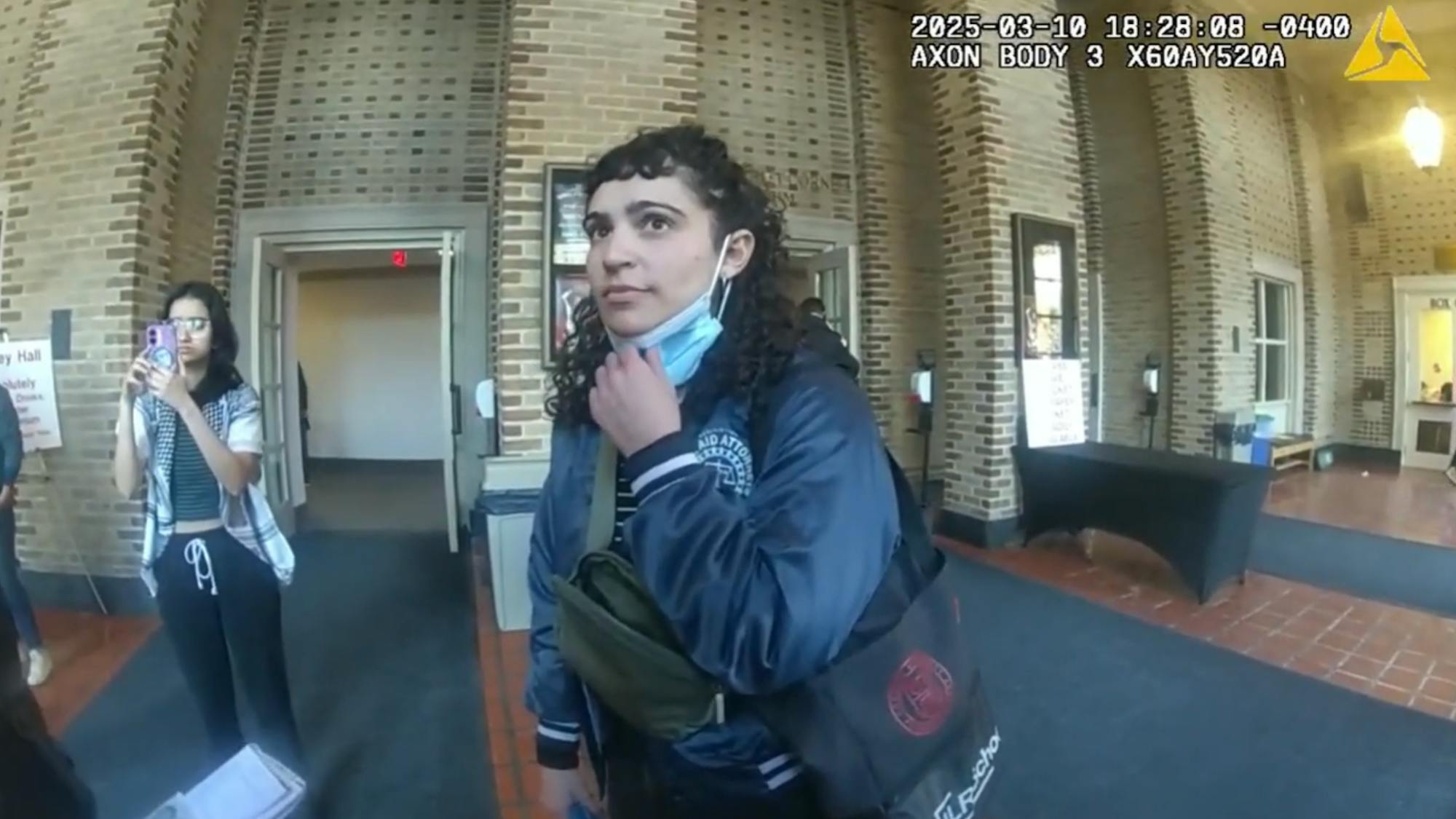
Dina Ginzburg, a second-year graduate student in the School of Industrial and Labor Relations, was found “not responsible” by a hearing panel for three alleged Student Code of Conduct violations, nearly 11 months after the Office of Student Conduct and Community Standards launched an investigation centered on her “disruption” at the Pathways to Peace event.
Ginzburg’s hearing took place on Feb. 6, almost 11 months after Pathways to Peace, a panel discussion held by the University in Bailey Hall on March 10, 2025, to discuss politics and conflict in the Middle East, including “potential paths forward for the people of Israel and Palestine,” according to its event page. Ginzburg was accused of “disrupt[ing] the event by yelling or chanting,” according to the formal OSCCS complaint, obtained by The Sun.
A Sun investigation independently verified that Ginzburg's case included a temporary suspension, inaccuracies in reports and an 11-month investigation, according to Cornell University Police Department body camera footage, emails between Ginzburg and OSCCS and documents related to Ginzburg’s case, all obtained by The Sun.
“I think the entire process hasn't been due process,” Ginzburg told The Sun. She added that she felt the investigator acted biasedly when denying her requests to add evidence into the investigative record.
Ginzburg was one of 17 people arrested or detained for demonstrating at the event, nine of whom were Cornell students.
When The Sun requested a comment from the University in March, asking about several of Ginzburg’s comments on what she described as a lack of due process and accountability, a University spokesperson wrote that “The university diligently follows all standards of due process laid out by the Student Code of Conduct and Procedures.”
In a separate exchange on Feb. 13, prior to the hearing panel’s decision, The Sun requested a comment from the University about the reasons for Ginzburg’s temporary suspension, comment on Ginzburg’s sentiment about a lack of due process, discrepancies in the initial police report and formal complaint, the length of the investigation and the process for determining evidence relevance and limiting bias.
A University spokesperson replied that the Family Educational Rights and Privacy Act “protects the records of individual students and bars institutions from discussing specific conduct cases.”
The spokesperson added that, “The Office of Student Conduct and Community Standards moves through investigations as efficiently as possible without compromising thoroughness. The length of an investigation depends on different factors, including but not limited to, the complexity of a case and the amount of information to be gathered.”
“Tzipi Livni, You’re a Chillul Hashem”
Ginzburg’s demonstration at the event was in response to one of the Pathways to Peace panelists: Tzipi Livni, former Israeli vice prime minister and foreign minister. The other speakers at the event included moderator Ryan Crocker, former U.S. ambassador to Afghanistan, Iraq, Pakistan, Syria, Kuwait and Lebanon; panelist Daniel B. Shapiro, former U.S. ambassador to Israel; and panelist Salam Fayyad, former prime minister of the Palestinian Authority.
Livni has been the subject of war crime allegations filed in a British court, before the Belgian federal prosecutor's office and with the Attorney General’s Office in Switzerland. The proceedings regard her role as the foreign minister and vice prime minister during “Operation Cast Lead,” an Israeli military offensive in Gaza from December 2008 to January 2009 that killed 1,417 people — an estimated 83% of whom were civilians, according to The Guardian.
Approximately 25 minutes into the event, Ginzburg stood up from the audience and shouted “Tzipi Livni, you’re a chillul hashem and Israel is the biggest chillul hashem in all of history.” Her shout lasted approximately six seconds, according to CUPD body camera footage obtained by The Sun.
“Chillul hashem” is a Hebrew phrase that refers to an action by a Jew that is a “desecration of God’s name,” Ginzburg told OSCCS officials in an investigative interview on May 29, 2025; the transcript of the interview was obtained by The Sun.
“The idea behind it is that as Jews, as representatives of God, as representatives of Judaism, we have a responsibility to hold ourselves to a high moral standard,” Ginzburg said in the investigative interview.
When Ginzburg shouted, Livni, who was speaking at the time, paused briefly, repeated the word she was saying and continued speaking after Ginzburg finished. Ginzburg then silently walked out of the auditorium on her own, according to the investigative report and body camera footage taken by police officers at the event.
Ginzburg’s demonstration followed two warnings announced at the event by President Michael Kotlikoff against demonstrations that could “prevent a speaker's ability to be heard or the right of others to listen and see,” according to the final investigative report on Ginzburg’s OSCCS case, which was obtained by The Sun.
Kotlikoff’s second warning specified that “disruptive individuals would be removed from the venue should they continue to interrupt the speakers,” according to the final investigative report.
Following her demonstration and exit from the auditorium, Ginzburg told The Sun that she was stopped by a CUPD officer. When asked for her identification, Ginzburg asked the officer if she was being detained but did not receive a clear response, Ginzburg added. Eventually, another police officer approached and informed her that she was being arrested for disorderly conduct.
An initial police report was filed by CUPD officer Kyle Sandy on March 11, 2025, one day after the event, and was obtained by The Sun.
“As Expeditiously as Possible”
Nine days after the event, on March 19, 2025, Ginzburg received a formal complaint from the OSCCS, initiated by Lieutenant Scott Grantz of the CUPD on behalf of the University, and obtained by The Sun. The complaint accused Ginzburg of disorderly conduct, disruption of University activities and failure to comply with the lawful directive of a University official.
Both the initial police report and the formal complaint contained statements contradicted by CUPD body camera footage, which The Sun obtained.
In the incident report, Sandy wrote that Ginzburg’s shouting “occurred for approximately 20 seconds.” However, CUPD body camera footage shows that Ginzburg shouted for approximately six seconds.
The formal complaint stated that Ginzburg “further disrupted the event by continuing to yell or chant as [she] left the auditorium” and “was removed” from the event. However, the footage shows that she left the auditorium silently and without police escort.
On the same day that the formal OSCCS complaint was filed, Ginzburg received another correspondence from OSCCS with notice that she would be subject to a “temporary suspension.” This suspension was issued before the formal investigation was launched and prohibited her from being on campus for purposes other than attending class, working in an on-campus position or using Cornell dining or health services, according to the interim action obtained by The Sun.
Temporary suspensions “may be imposed only when available less restrictive measures are reasonably deemed insufficient to protect the Complainant or the University community,” according to Section 8(a) of the Student Code of Conduct Procedures.
If Ginzburg had to failed to comply with the suspension or “engage[d] in, facilitate[d], participate[d] or assist[ed]” in violations of the Student Code of Conduct, it would have “prompt[ed] an immediate evaluation of whether the restrictions in place are sufficient to protect the university community and could result in a more restrictive interim measures being imposed,” according to the interim action.
There are six factors which, “among others,” are considered in the University’s decision to temporarily suspend a student, including if the respondent is a repeat offender, used a weapon or force or if there is a risk of further interpersonal misconduct, retaliatory acts or harm to health and safety in the Cornell community, according to the procedures.
“None of these things apply to me,” Ginzburg told The Sun, referring to the six factors.
Seven weeks after the formal complaint and temporary suspension order, OSCCS lifted Ginzburg’s suspension on May 9, 2025. An investigative interview between Ginzburg and OSCCS then took place on May 29, 2025.
Section 18(b) of the Student Code of Conduct Procedures states that investigations should be completed “as expeditiously as possible, commensurate with [their] complexity.”
Nearly three months after the investigative interview, on Aug. 21, Ginzburg received another email from OSCCS: an offer to pursue an “alternate resolution,” which presents the option to resolve the issue without a hearing, through “mediation or restorative processes.” This option was also mentioned in the May 9, 2025 email.
Ginzburg refused the alternate resolution in August; in an email to Gordinier regarding a draft of the investigative record, she stated that she refused to “seek an alternate resolution and admit guilt.”
Ginzburg told The Sun that she received no further communication from OSCCS until she emailed the office on Dec. 15 to “follow up on the status of the investigation,” nearly four months later.
“The Whole Thing is a Sham”
Eleni Gordinier, OSCCS assistant director and the OSCCS co-investigator assigned to Ginzburg’s case, along with Kwan Wallace, an OSCCS assistant director who is no longer employed by Cornell, responded to Ginzburg’s email on Dec. 16, stating that the investigation was complete and would be followed by a commenting period and the hearing, according to an email chain between Ginzburg, Gordinier and Wallace, obtained by The Sun.
During the commenting period, which lasted until Jan. 20, Ginzburg and Grantz had the opportunity to review the investigative record and comment on factual inaccuracies, as well as request redactions, additional meetings with the investigators, further investigation or “inclusion of content deemed irrelevant or duplicative by the investigator,” according to an email sent by Gordinier to both Ginzburg and Grantz.
Section 18(d) of the Student Code of Conduct Procedures states that in an OSCCS investigation, “the investigator has the discretion to determine the relevance of any requested materials” that would go on the investigative record. Only evidence submitted to the investigative record would be used to determine Ginzburg’s responsibility in the hearing.
Ginzburg sent an email to Gordinier on Dec. 17, where she requested the addition of evidence to the investigative record, as obtained by The Sun. Several pieces of evidence were denied by Gordinier on the basis of relevance, including documents regarding her disorderly order charge and emails between her and OSCCS regarding her temporary suspension, an option for an alternate resolution and her follow-up email on the investigation from Dec. 15.
Gordinier accepted the following evidence into the record: a September Sun article covering the Pathways to Peace event arrests and detainments, as well as additional footage of Ginzburg’s arrest, taken by a bystander.
Ginzburg asserted that the evidence denied by Gordinier was relevant to the investigation, both in an email to Gordinier during the commenting period and in an interview with The Sun.
In the email to Gordinier, Ginzburg wrote that Gordinier’s “questionable and inconsistent judgement of what is relevant to the specific allegations in the formal complaint suggests that this investigation has been conducted in a way that is extremely biased towards the complainant.”
Ginzburg also expressed frustration, both in an email to Gordinier and to The Sun, at the fact that an opinion piece published in The Sun, written by Nicole Schanker about Pathways to Peace, was included in the investigative record.
“Nicole Schanker's op-ed and interview mention nothing about me or the specific allegations in the formal complaint and yet you have decided that they are more relevant to the formal complaint than, for example, the emails between OSCCS and I about my specific case,” Ginzburg wrote in her email to Gordinier, which The Sun obtained.
Another piece of evidence denied by Gordinier was a September Sun article covering a statement made by Kristin Hopkins, chief administrator for the Office of the President and Provost, which was recorded by police body camera footage. In the footage, Hopkins said, “Mike … was just hoping the number would be more than eight,” in a discussion regarding the number of detainments at the Pathways to Peace event.
In a later interview with The Sun, Kotlikoff said “I assume that the Mike reference was to me,” adding that it referred to the fact that they were trying to ensure everyone who violated University policy was identified.
Matthew Chaffinch, a second-year graduate student in the ILR School, who served as Ginzburg’s Weingarten representative at the hearing, spoke on the relevance of the excluded article in an interview with The Sun.
“I think that's pretty clearly relevant to Dina [Ginzburg] being arrested or being detained, the fact that they were, self admittedly, trying to increase the numbers of people detained, and Dina [Ginzburg] was one of those people,” Chaffinch said. “That's, for me, a pretty big, glaring example of something that just compromises the entire integrity of this as representing anything like due process or basic fairness.”
In an investigative process regarding a unionized worker, Weingarten representatives serve to advise and assist the respondent, according to the National Labor Relations Board.
“In this particular hearing, I think [my role] was largely allowing Dina [Ginzburg] to articulate her answers and make her case,” Chaffinch said. “I think overall there were a few interruptions, which is where I felt like I was stepping in the most.”’
Ginzburg expressed frustration with the entire investigation, including the assembly of the hearing panel.
“The same person [Christina Liang] who appointed the investigator was the same person who punished me without due process, the same person who appointed Karen [Vicks] to be the hearing panel chair and the same person who appointed every single person on the hearing panel,” Ginzburg wrote in an email statement to The Sun. “The whole thing is a sham.”
Gordinier and Wallace were appointed to the case by Liang, according to an email from Wallace to Ginzburg, obtained by The Sun. Section 2(d) of the Student Code of Conduct Procedures states that the hearing panel chair, currently Vicks, is to be appointed by OSCCS director Liang.
Sections 2(c) and 2(f) of the Code state the hearing panel is to be composed of five people: three students, one faculty and one nonfaculty employee who are all randomly-selected members of the Hearing and Review Board.
The Hearing and Review Board is composed of students, faculty members and nonfaculty employees nominated by University Assembly, Faculty Senate, Student Assembly, Graduate and Professional Student Assembly and Employee Assembly. Nominees for the board are then appointed by Liang “[i]n consultation with those committees,” according to the Student Code of Conduct Procedures.
“Judge, Jury and Executioner”
Ginzburg’s hearing panel took place on Feb. 6 and included Ginzburg, Chaffinch, Ginzburg’s staff advisor Kate Bronfenbrenner, Hearing Panel Chair Vicks, OSCCS Office Coordinator Vinnie Clementine and the five panelists randomly selected for the investigation, according to the hearing decision. The panel was open to the Cornell community per Ginzburg’s request.
Throughout the hearing, there were multiple instances where Vicks interjected when Ginzburg brought up her experience with the investigative process, claiming it was not part of the final report and therefore not relevant to the case. In return, Chaffinch responded claiming due process allows her to speak on such matters, leading to back-and-forth exchanges that ultimately allowed Ginzburg to continue her point.
Ginzburg told The Sun that she believes she did not receive due process both during the panel hearing and throughout the entire investigation.
“Cornell admin and OSCCS Director Christina Liang, [are] all judge, jury and executioner,” Ginzburg said.
Chaffinch also expressed concern regarding due process within the case, in an interview with The Sun.
“I think that the structure of the entire investigation and hearing — where Cornell was very easily able to influence a lot of things in their favor, most notably the evidence — fatally compromised due process in it,” Chaffinch said.
In addition to her concerns over what she described as a temporary suspension without trial, Ginzburg expressed concern that neither the CUPD officers who arrested her nor Liang, who issued the formal complaint from OSCCS, attended the hearing.
“The complainant didn't show up [to the hearing], and my side wasn't able to cross examine them and the hearing panel couldn't ask them any questions,” Ginzburg said. “[The complainant] also didn't provide an opening statement [or] closing statement.”
“I Want Him to Apologize”
Ginzburg received the findings of the hearing panel on Feb. 20, two weeks after the hearing took place.
She was found to be not responsible for all three claims, in a unanimous decision regarding the claims of disruption of University activities and failure to comply, and a 2-2 decision regarding the claim of disorderly conduct. In an OSCCS hearing, a majority vote is required to determine responsibility, according to the findings.
“The Hearing Panel concluded that although the Respondent’s yelling was inappropriate and rude in public forum, her conduct did not rise to the level of a Code violation or materially interfere with the event, as the event ultimately proceeded to conclusion,” the panelists wrote in their findings, obtained by The Sun.
While five people were selected for the panel, one panelist, Dena Bauman J.D. ’91, director of externships and pro bono scholars program and lecturer of law, recused herself from the investigation, according to the findings.
The morning of the hearing, Ginzburg was made aware of a LinkedIn post made by Bauman about an Academic Engagement Network trip to Israel that occurred from Nov. 2 to Nov. 6. In the post, Bauman wrote, “I am so excited to take next steps here to counter the vicious anti-Israel narrative that is so prevalent on university campuses.”
In her closing statement at the panel hearing, Ginzburg raised concerns about Bauman’s LinkedIn post. Ginzburg told The Sun that she believes her comments about Bauman’s post during the hearing played a part in her recusal.
“This [recusal] is especially significant because the votes on some of my charges were 2-2, which means that the outcome of my case would have been decided by Dena Bauman if I hadn’t happened to have seen her LinkedIn,” Ginzburg wrote in an email to The Sun.
Following the release of the hearing panel’s decision, both the complainant and respondent have an opportunity to appeal the decision as outlined in Section 21 of the Student Code of Conduct Procedures.
While the formal investigation concluded when the hearing panel decided Ginzburg was not responsible, she told The Sun that she hopes to see accountability taken by those involved in the investigation process.
“I do still want apologies from Christina Liang [and] from Eleni Gordinier, and I want Kotlikoff to admit that he was the ‘Mike’ that his assistant was referencing in that body cam footage. I want him to apologize for trying to get his own students arrested over nothing,” Ginzburg said. “There's still a lot of accountability to be taken by Cornell and CUPD.”
Ginzburg added in an email statement to The Sun that she also wanted an apology from CUPD for “all the wrongful arrests that happened.”
Ginzburg also hopes that her investigation leads to changes in the Student Code of Conduct process.
“We all know that the process is not working and that it's not doing what it's ostensibly supposed to be doing. I'm hoping that by making this hearing public, it creates more movement towards the goal of ultimately reforming the Student Code,” Ginzburg said.
Bauman, Gordinier and Liang did not respond to The Sun’s request for comment. Bronfenbrenner, Vicks and hearing panelists Hank Guo and Anthony Condo declined to respond to The Sun’s request for comment.
Everett Chambala ’27 contributed reporting.

Coral Platt is a member of the Class of 2029 in the College of Arts and Sciences. She is a news editor for the 144th Editorial Board and can be reached at cplatt@cornellsun.com.


