


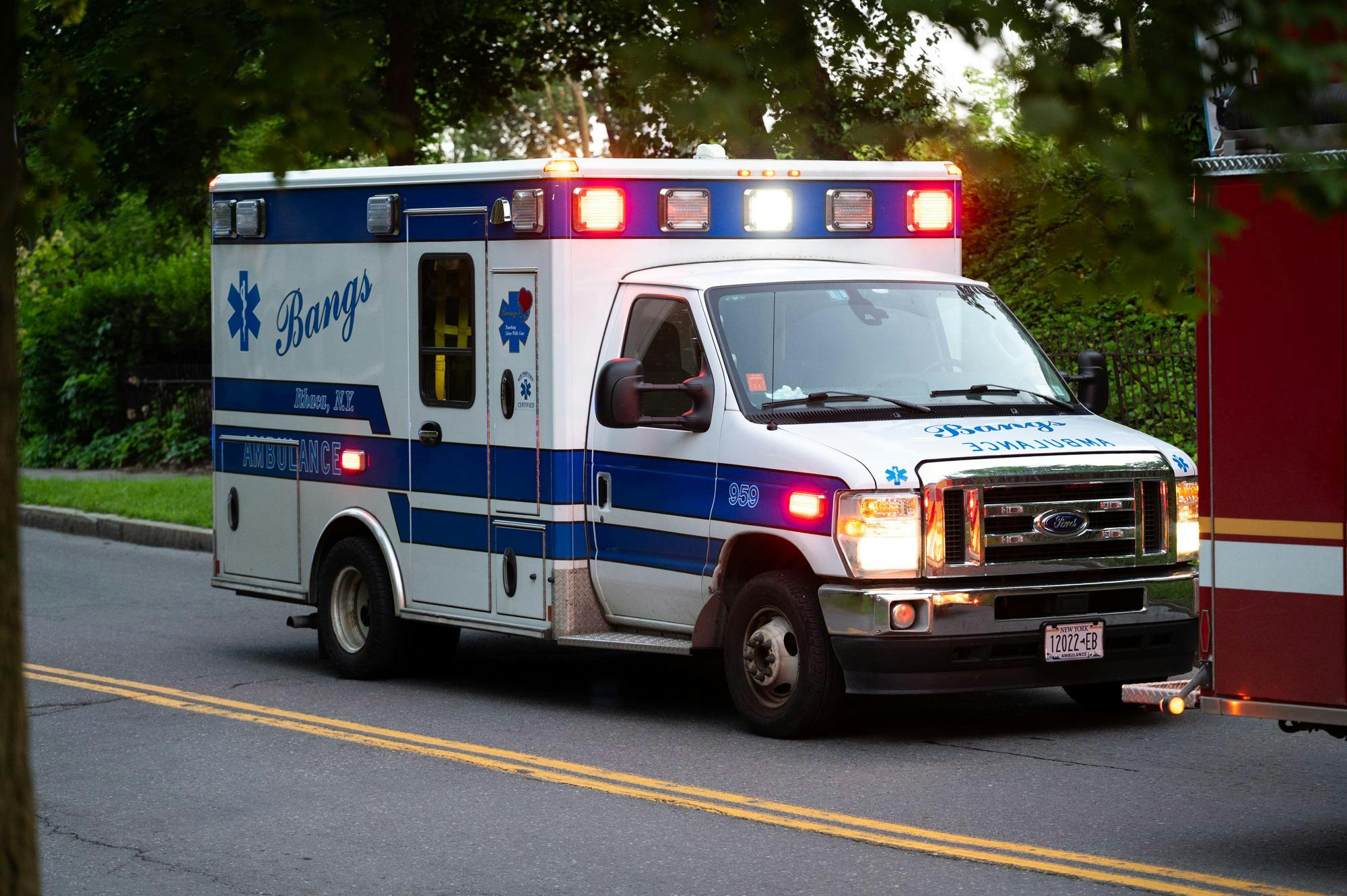
Tompkins County’s emergency medical services system has been struggling to fill gaps in care due to rising response times, limited ambulance capacity and staffing shortages, according to Prof. Dan Lamb, public policy, who is also the Deputy Supervisor of the Town of Dryden.
Tompkins County relies on a decentralized EMS structure to cover the entire 475 square mile county which dispatches a mix of light rescue providers such as local fire departments and ambulance agencies. There are only four ambulance agencies open to servicing all of Tompkins County: Bangs Ambulance, Dryden Ambulance, Groton Fire and Ambulance and Trumansburg EMS.
According to Lamb, “the core problem with the EMS system is simple — we don’t have a system.”
This fragmented system leaves gaps in care. Light rescue responders can stabilize a patient, but cannot transport them, according to Lamb, causing the members of the county to have to wait for one of the four transport-capable ambulance agencies in crucial times of emergency.
“We live in dangerous times in terms of our emergency response capabilities,” Lamb said. “Where you live in this county and where the emergency occurs will determine how effective your EMS response is going to be.”
Bangs Ambulance is a private provider that carries the majority of calls for Ithaca. Due to staffing shortages and limited resources, explained Common Council Alderperson Clyde Lederman ’26 (D-Fifth Ward), they often have to rely on mutual aid from neighboring towns, according to Lamb.
“The system is disjointed,” said Lederman. “Bangs can’t always cover the capacity we need, and other departments like Dryden or Trumansburg end up picking up the slack.”
Lamb explained how this reliance on mutual aid creates inequities. Rural municipalities such as Dryden and Trumansburg are funded by town taxpayers, yet their ambulances are providing emergency care for the entire county, a system he says is “unsustainable, inequitable, ineffective and inefficient.”
“Dryden spends roughly $1.2 million per year on ambulance services, despite only 40 percent of its calls occurring outside the town,” according to Lamb
Tompkins County’s EMS costs have risen nearly 80 percent from 2016 to 2022, according to a Cornell Institute for Public Affairs study. The study additionally found that response times have shown “alarming” trends as volunteer agencies, which were once the backbone of rural EMS, have shut down because of burnout, stricter training requirements and failing recruitment.
A March 2024 New York State Comptroller Report found a 17.5 percent drop in volunteer EMS staffing statewide from 2019 to 2022.
“We’re losing the volunteers,” Lamb said. “The next generation of people who come to help us is shrinking. If we don’t fix that pipeline, we will have an even bigger crisis.”
This loss of volunteers is already having detrimental effects, as seen in 2015, when Slaterville Ambulance, who served Tompkins County, was forced to close due to a lack of volunteer interest after 57 years of service, shifting more pressure to the four remaining agencies.
Fewer emergency medical technicians available means fewer ambulances in service. 2022 data from Tompkins County Dispatch collected by the CIPA study shows that it takes 12 minutes and 48 seconds on average for a Tompkins County resident to receive emergency medical attention after calling 911, as compared to the national average response time of 4 minutes. So far, in 2025, the county had 114 incidents in which a rescue was not available and 34 occasions when crews waited more than 10 minutes on scene for a transport ambulance, according to County emergency staff.
For the past decade, Lamb has worked with the Tompkins County Council of Governments to push for EMS reform. He said the county has only recently begun to understand the scale of the problem.
“Many county legislators assumed Bangs would take care of everything,” Lamb said. “But now they’re learning that we have gaps where you might have to wait half an hour for an ambulance. Or one may never arrive.”
A 2025 CGR Tompkins County EMS Evaluation outlines a county-wide, publicly funded EMS model which would add standardized training, staff and centralized coordination.
Lamb calls this evaluation the “first roadmap” for the EMS crisis in Tompkins, saying, “We finally have a plan. Now we need the investment.”
Lederman echoed the sentiment, emphasizing the urgent need for county-run EMS.
“If the county ran EMS, it would cover gaps more consistently, both in rural areas and when demand spikes,” Lederman said. “That would go a long way.”
According to a November website poll conducted by the Ithaca Times 71.1 percent of respondents said that Tompkins County should assist more with providing ambulance services.
The Tompkins County Council of Governments passed a resolution in April urging New York Gov. Kathy Hochul (D-N.Y.) to pass Senate Bill S7501A, which would require each county in New York to develop a comprehensive EMS plan.
For a more immediate solution, Tompkins County Council of Governments passed a resolution on July 24, 2025 to expand the current Rapid Medical Response Program to provide 24/7 EMS reinforcement, “decreasing the average response time by approximately half, enabling quicker medical care when minutes matter and relieving the need for ambulance response when transport is not needed.”
Additionally, the County launched a Community Outreach Worker Program in February 2024, which aims to reduce non-emergency EMS calls by addressing mental-health and substance-related crises before they escalate.
The RMR program and the Community Outreach Worker Program would be able to help most “omega” or “alpha” calls, which are low-priority, non-life-threatening calls. These calls are often the cases that slip through the cracks. 2022 data from the Tompkins County Council of Governments: Emergency Response and Planning Subcommittee shows that “omega” or “alpha” calls are the most frequent in Tompkins County, but are also the most neglected, as ambulance agencies choose to take more high-priority cases.
“I hope incoming county legislators continue this work and move Tompkins County into a new chapter of EMS services,” Lamb said. “We’ve got to make the investment if we want life in this community to be safe and secure. How we fund EMS is a sign of how we invest in our own communities.”
Correction, Feb. 5, 2:45 p.m.: This article has been updated to correct when the CGR Tompkins County EMS Evaluation was conducted and that the Tompkins County Council of Governments passed a resolution to expand the current Rapid Medical Response Program.

Valencia Massaro is a member of the Class of 2029 in the School of Industrial and Labor Relations. She is a senior writer for the news department and can be reached at vmassaro@cornellsun.com.


