Finding a place at Cornell within the widely advertised array of student organizations always involves one part planning, one part research skill and one part pure luck. As a freshman, I was extremely fortunate that a bit of luck came my way in the form of an orientation week concert by a combined Cornell Glee Club, Chorus and Chorale ensembles. With classes looming within the next few days, I thought the afternoon event would be just a nice way to relax before things jumped into academic high gear, but one amazing performance, a few conversations and a club leaflet later, I’d signed up for the three groups’ joint audition.
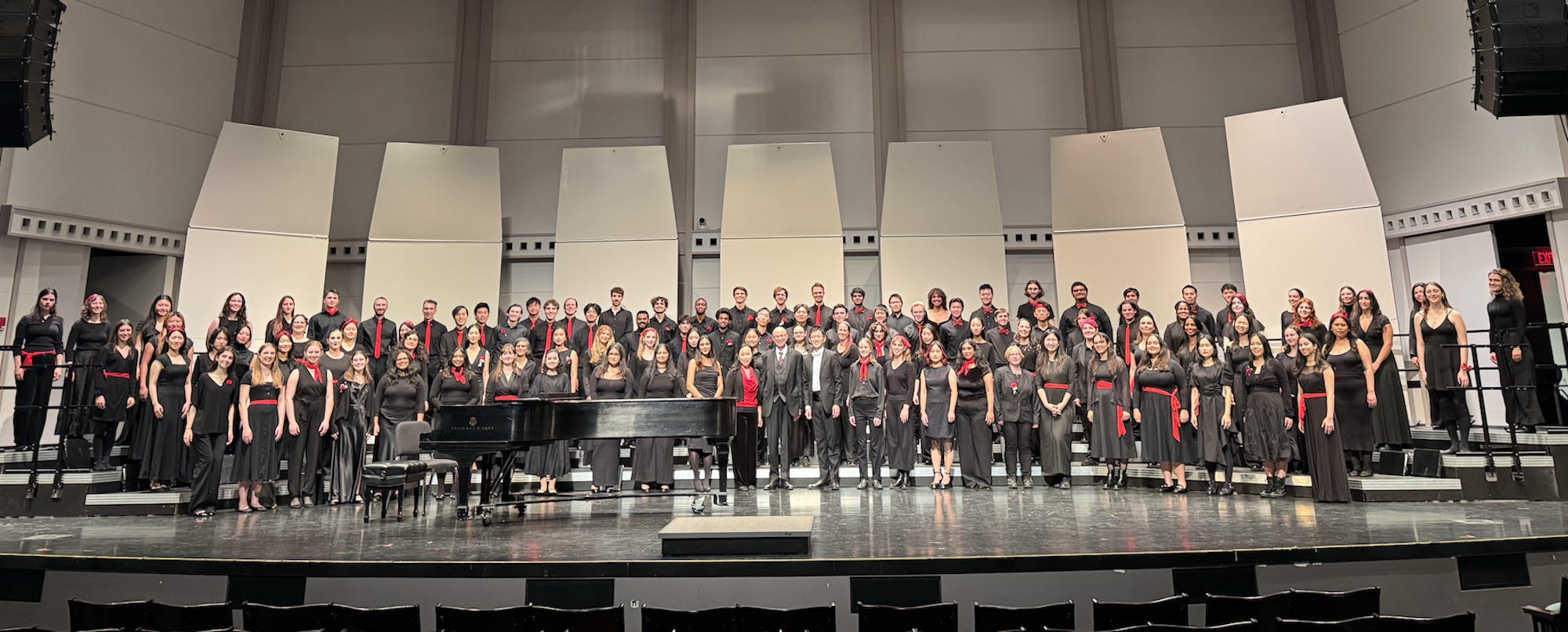
After an audition packed with stumbles and wracked with nerves, I was thrilled to receive an email telling me I’d gotten into the Chorale and, about a week later, I walked into my first rehearsal. In that first rehearsal, I was astonished to discover that the Chorale boasted 120 members despite being a student organization that was officially only two years old. This membership number grew even more impressive when I heard its source: the occupancy limit of Lincoln Hall’s largest available room, also known as the Chorale’s rehearsal space. Within the span of two years as a student organization, the Chorale has drawn enough interest to have its membership capped by physical constraints.
Intrigued by this impressive expansion, I approached Chorale Director, Dr. Yen-Hsiang Nieh, and President Pranav Shankar ’26 to discover how the organization had accomplished such a feat. One of the first things they clarified was that the Chorale actually has a legacy stretching back over half a century which makes its story not one of creation, but of resurrection.
The Chorale currently attributes its founding to Director Thomas A. Sokol, who, in the 1970s, formed a group of singers from students, faculty, staff and people from all across the Ithaca community. Echoing Cornell’s philosophy of “any person, any study,” the Chorale continues this tradition, even as a student organization, to this day. In fact, along with faculty and staff, the Chorale hosts students who are undertaking a wide variety of majors across every one of Cornell’s colleges.
Following the hit that live performing arts took from COVID, the Chorale hit a slump that left it for dead. Nieh recalled that in 2023, he arrived at Cornell to find the Chorale with dwindling membership and completely lacking funds. By reaching out to the 2023 Chorale’s few members, Nieh gathered an executive team and, from there, reinvented and revived the Chorale as a student organization. Shaknar explained that the logo, the constitution, the website, the Instagram and the Chorale’s archives were all either overhauled or created from scratch by the first or subsequent E-Boards.
Nieh, originally from Taiwan, personally sought to expand the Chorale’s musical repertoire by featuring music from across the globe, particularly Asia as his personal expertise, and from diverse genres. Nieh said that when making musical selections for the concerts every semester he tries to include at least five different languages, so as to make the Chorale a conduit through which a diverse host of voices can be heard.
And throughout all of this, the Chorale grew even beyond Cornell’s campus. Whether it was performing alongside a visiting Taiwanese choir, going on the Chorale’s first ever international tour or, most recently, hosting highly decorated guest conductor Dr. Jo-Michael Scheibe and having the concert broadcast around the world, every semester has meant something new for the organization and its members.
But despite this amazing expansion, the Chorale maintains space in its schedule for a wide variety of interest and skill levels. The standard rehearsals are only once a week in a casual, though still structured, environment. Those wishing to double check their parts have the option to attend additional rehearsals where specific groups focus on their unique harmonies. Beyond this, Nieh offers weekly office hours as well as solo opportunities for those looking to really refine their signing technique. And for those locked-in to academics, the Chorale actually doubles as a one academic credit course in addition to being a student organization.
While perhaps not as flashy as Cornell’s many acapella groups, the Chorale is a low-stakes community where anyone, especially those of us who just hum along to our favorite tunes, can learn to become better musicians. I hope you’ll keep your eye out for the Chorale’s upcoming auditions early next semester or attend the free end-of-year concert and take a chance on this organization that speaks to the fact that we don’t have to make something we love into our career to pursue it. But also, more importantly, I hope you’ll hear the harmony of this expansive, inclusive community celebrating the world through song.
Wyatt Tamamoto is a freshman in the College of Arts and Sciences. He can be reached at wkt22@cornell.edu.
Wyatt Tamamoto is a member of the Class of 2029 in the College of Arts and Sciences. He is a staff writer for the Arts & Culture department and can be reached at wkt22@cornell.edu.