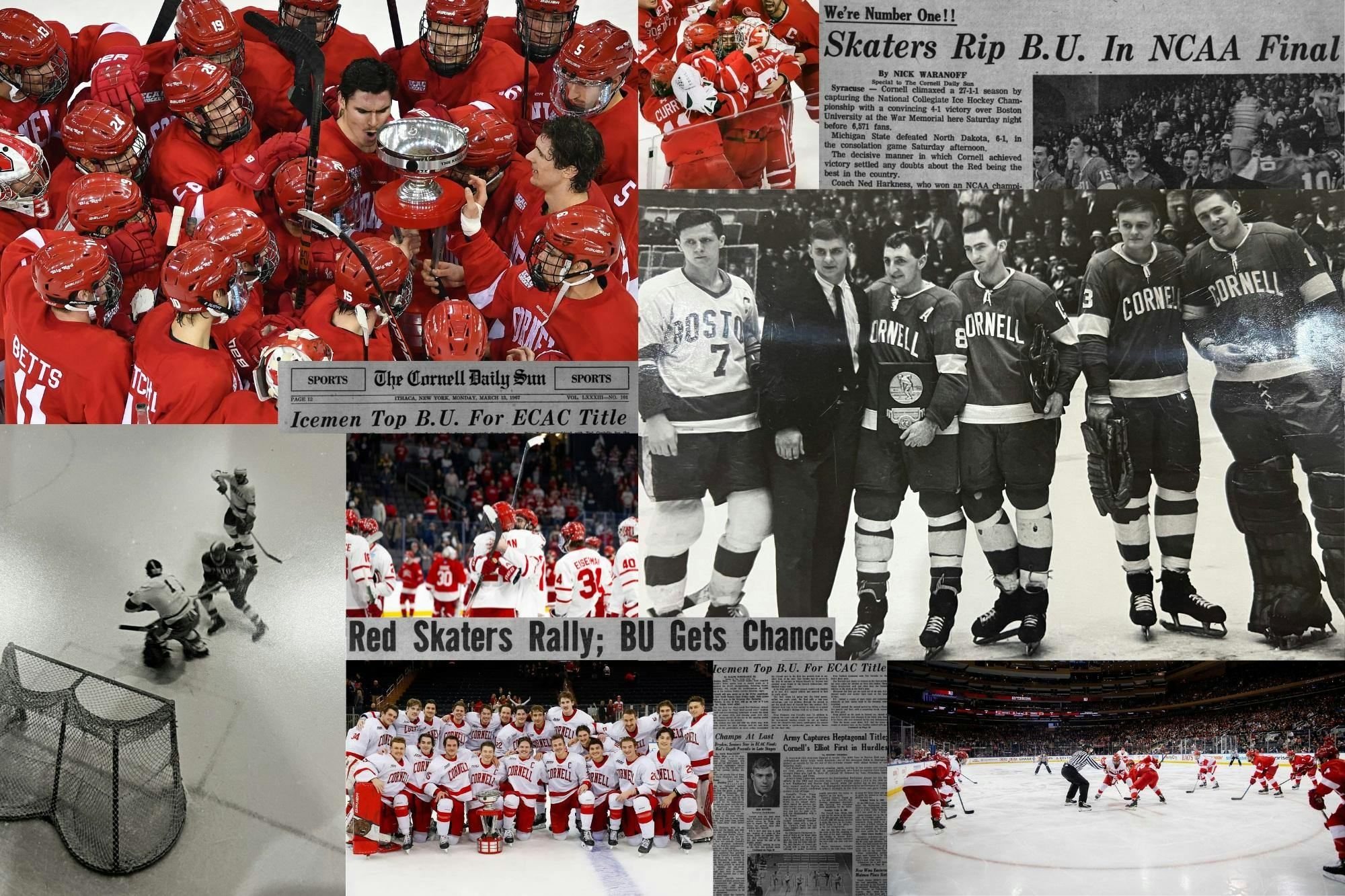
Brought together over a microphone in 2007, two iconic college hockey figures — Jack Kelley, longtime Boston University men’s hockey coach, and Ned Harkness, legendary Cornell men’s hockey and men’s lacrosse coach — began to bicker.
There was one question to be answered: who was the best Eastern college hockey team?
Only one way to figure it out — Boston University, 11-1 at the time, and Cornell, 11-0 — would clash on the historic Boston Arena ice. The two coaches, both of whom won multiple national championships with their squads, would meet in the championship game of the Boston Arena Christmas Tournament.
Surely, that game would decide who the powerhouse Eastern team was, the fitting opponent to pin up against the monstrous Michigan State or Notre Dame of the West.
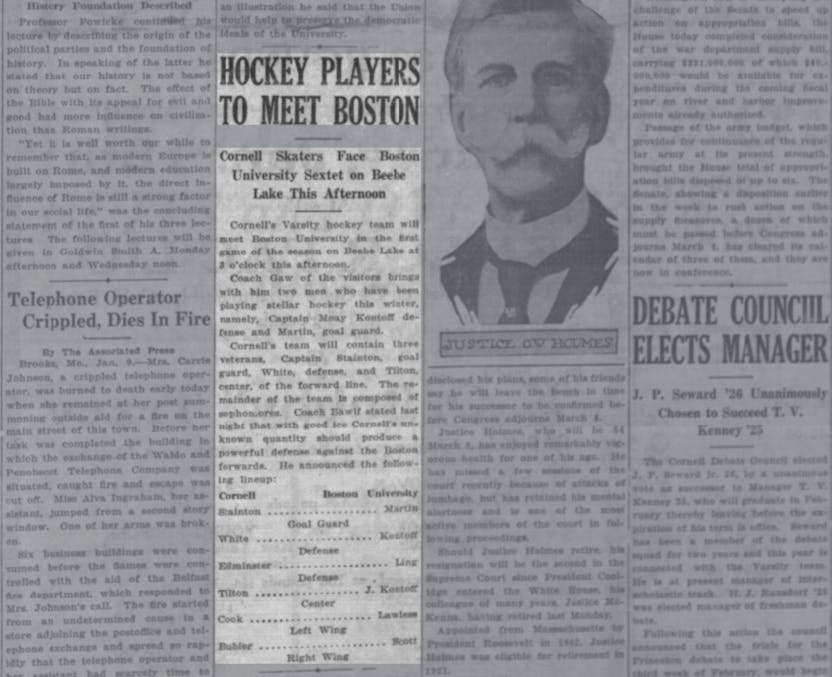
The kicker? The game that had ought to answer that question had happened almost 40 years earlier, on Dec. 30, 1966.
For both coaches, that question — who the best eastern hockey team was — still remained unanswered. It was 2007, and Kelley and Harkness were still asking it.
“The two of them were still arguing about it 40 years later, like grumpy old men,” said veteran sports broadcaster and longtime voice of Boston University men’s hockey, Bernie Corbett.
“‘I wanted to keep playing,’” Kelley said.
“‘What do you mean you wanted to keep playing? You stopped the game!’” Harkness retorted.
“‘What are you talking about?’”
That 1966 game was tied 3-3 after regulation, so overtime would be needed to settle the score. And when neither team could beat the opposing netminder — it was Ken Dryden ’69 between the pipes for the Red — an unorthodox second overtime would be played, and that would be that.
Once two overtimes passed, Boston Arena emptied. The Terriers would even out at 11-1-1, and Cornell a 11-0-1 record. A 3-3 tie would be officially etched in the scorebooks.
Evidently, there was lingering confusion on whether or not both coaches agreed to settle on a tie — even 40 years later.
“Screaming at each other — they're like, 80-something years old — about a game that was played 40 years ago,” Corbett, who had invited both Kelley and Harkness onto his podcast, and unknowingly rekindled an age-old dispute, said. “It was tremendous entertainment, and two great competitors that were the head of the two programs.
“That is the beginning, the signature moment, of the rivalry.”
To the casual fan, the Lynah Faithful’s “Screw BU, [SCHOOL] too!” chant might not make much sense. A shadow has been cast on what was once an inevitable and indisputable rivalry between two teams that regularly dueled for national championships.
The two squads no longer duke for ECAC Hockey titles — the Terriers have been a proud member of the Hockey East conference since its inception in 1984 — but that doesn’t rewrite the irrefutable history of two college hockey blue bloods.
Beneath the dust and haze — a consequence of recency bias — that rivalry remains, burning just as red hot as it always has.
“You know the chant,” said current head coach Casey Jones ’90.
Cornell and BU will take the ice once again for their 10th clash at Madison Square Garden as part of the biennial Red Hot Hockey contest on Saturday. The rivalry — split almost cleanly down the middle, with Cornell having the slight 27-23-3 edge — ignited with “The Game” of Eastern college hockey, as printed in The Sun on Jan. 5, 1967, but has authored much more than just wins and losses.
"I thought we played excellently and that we should have won," Harkness told his team after those two overtimes. "You bet your life we still think we're No. 1.”
Early Red Dominance
The Red and the Terriers met for a pair of matchups on Beebe Lake in Ithaca in 1925 and 1926, but almost 40 years would pass before the two foes would meet again — this time, in the ECAC Tournament, on March 11, 1966.
This was months before the double overtime debacle at Boston Arena, but was the first win for Cornell in what would become an 11-game unbeaten streak against the Terriers. Cornell downed BU, 8-1.
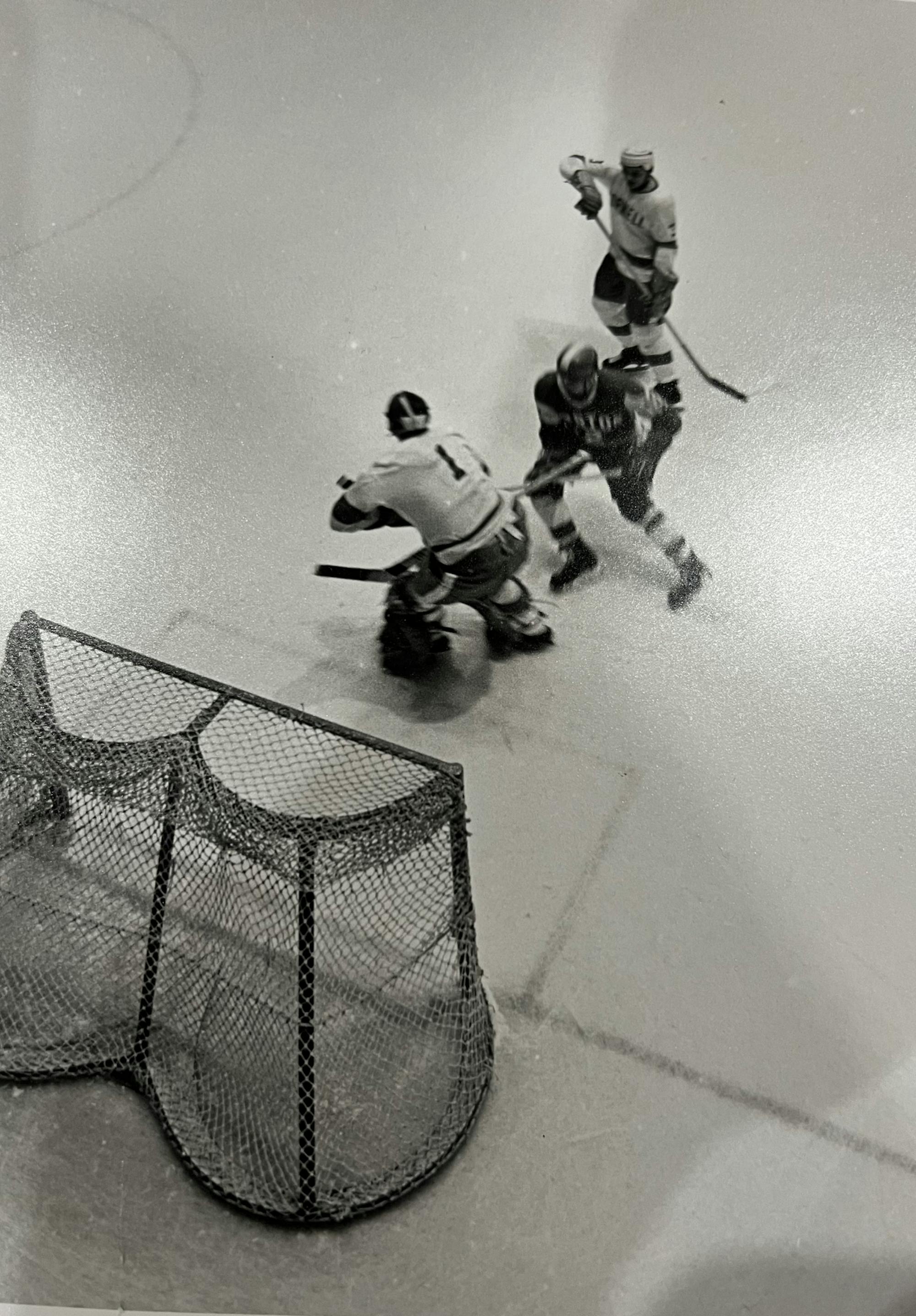
However, that was before an important figure in the Cornell-BU rivalry even took the ice — Dryden. They didn’t keep track of shots on goal and saves diligently back in the 1960s, but each time the 6’4” behemoth took the ice against the Terriers, he won. After all, Dryden lost just four games throughout his three years at Cornell.
Then came the notorious Boston Arena Christmas Tournament championship, which stands as Dryden’s only tie as a Cornellian. But that was the only blemish on Dryden’s resume when it came to the Terriers, as the legendary netminder would go on to win his next (and final) six games against BU.
“Everybody’s like, who's this, 6’4”, enormous goaltender guarding the Cornell net that you couldn't get a puck by?” Corbett said.
Later in that 1966-1967 season, Cornell and BU met — once again — in the ECAC tournament. This time, at the old Boston Garden, Dryden led his team to a conference title, upending BU, 4-3.
And just one week later, the Red beat the Terriers, 4-1, to clinch its first-ever national championship. After that game, Kelley called Dryden “the best college goalie [he’s] ever seen.” The sentiment was well-backed — Dryden stopped 71 of the 72 shots he faced in two NCAA Tournament games.
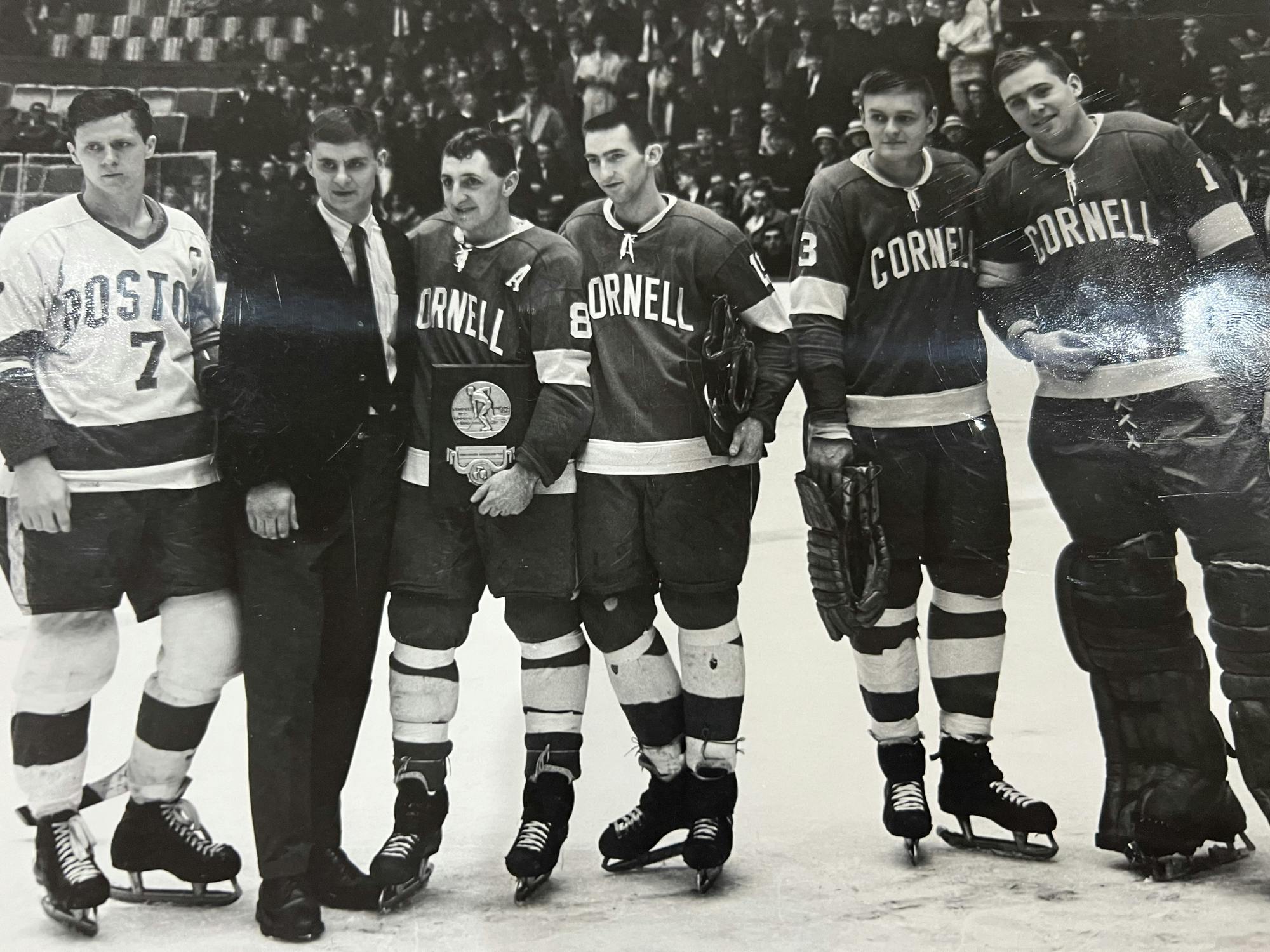
As the sun dawned on new seasons, Dryden’s domination of the Terriers was a constant — he won Cornell two more ECAC championships in 1968 and 1969. Dryden was named the MVP of both those tournaments.
And even after Dryden graduated with his degree in 1969, there was no immediate end to the Red’s torturing of the Terriers.
“First, we can't get by Dryden,” Corbett said, “but then the goalie that came in after him, Brian Cropper [’71], he leads Cornell to an undefeated season.”
It’s true — Cropper went 29-0-0 en route to the first (and only) undefeated season in college hockey resulting in a national championship. Though he didn’t beat BU in the title game like Dryden had three years prior, two of Cornell’s victories came at the expense of the Terriers.
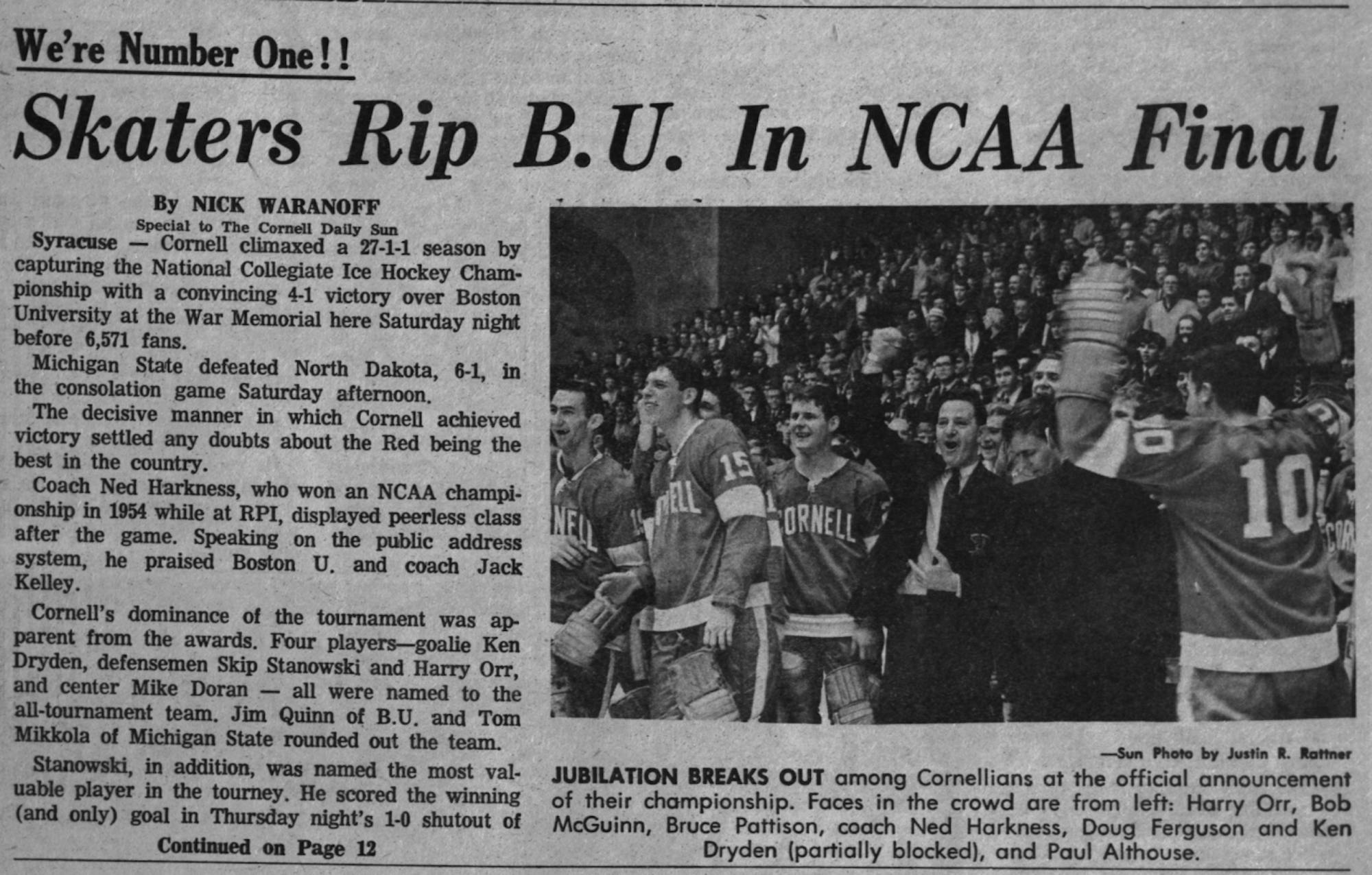
In all, from 1966-1972, Cornell went a stellar 13-1-1 against BU, including an 11-game unbeaten streak between 1966-1971.
The tide turned after that. The Terriers won their first ECAC Tournament title on March 11, 1972, beating Cornell by a 4-1 score. One week later, BU won a national title — clinching it with a 4-0 win over Cornell.
“You want to talk about a rivalry, you want to talk about high-stakes games in a basically a five-year period,” Corbett said. “BU and Cornell [were] just on a completely different level.”
A Game of Tattletale
Though on-ice antics were enough to boil the tensions between BU and Cornell, an instance of sore losing, perhaps, pitted the two foes even further against one another.
A Cornell-BU game on Dec. 13, 1972, is listed as a 9-0 Cornell victory.
That’s not exactly how it went — BU’s Dick Decloe had a hat trick in what was a 9-0 Terrier victory at Lynah Rink.
But soon after BU trounced the Red on its home ice — the Terriers’ first-ever win at Lynah — Cornell’s athletic director at the time, Jon T. Anderson, filed a complaint to the ECAC, arguing that Decloe was ineligible to play college hockey.
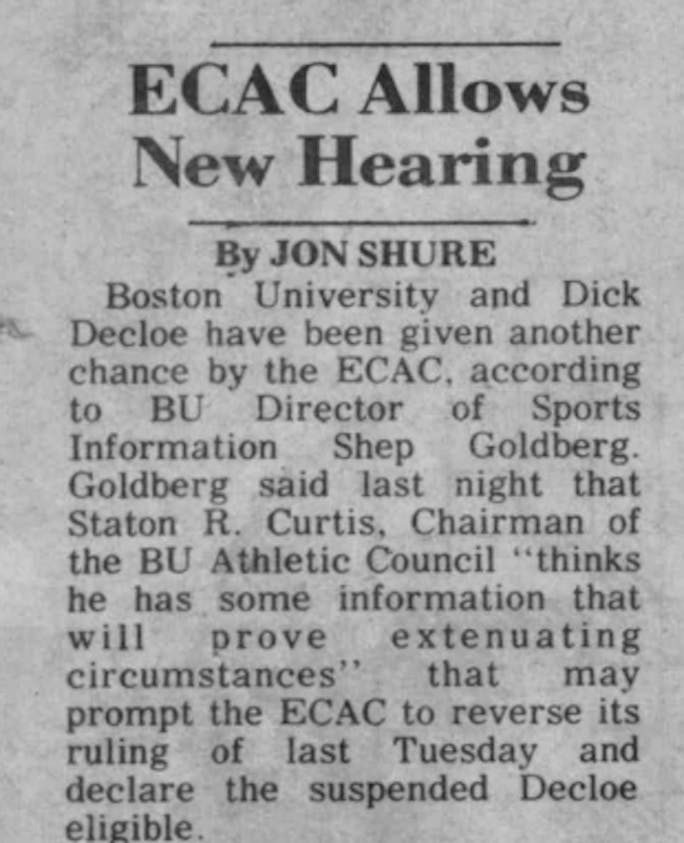
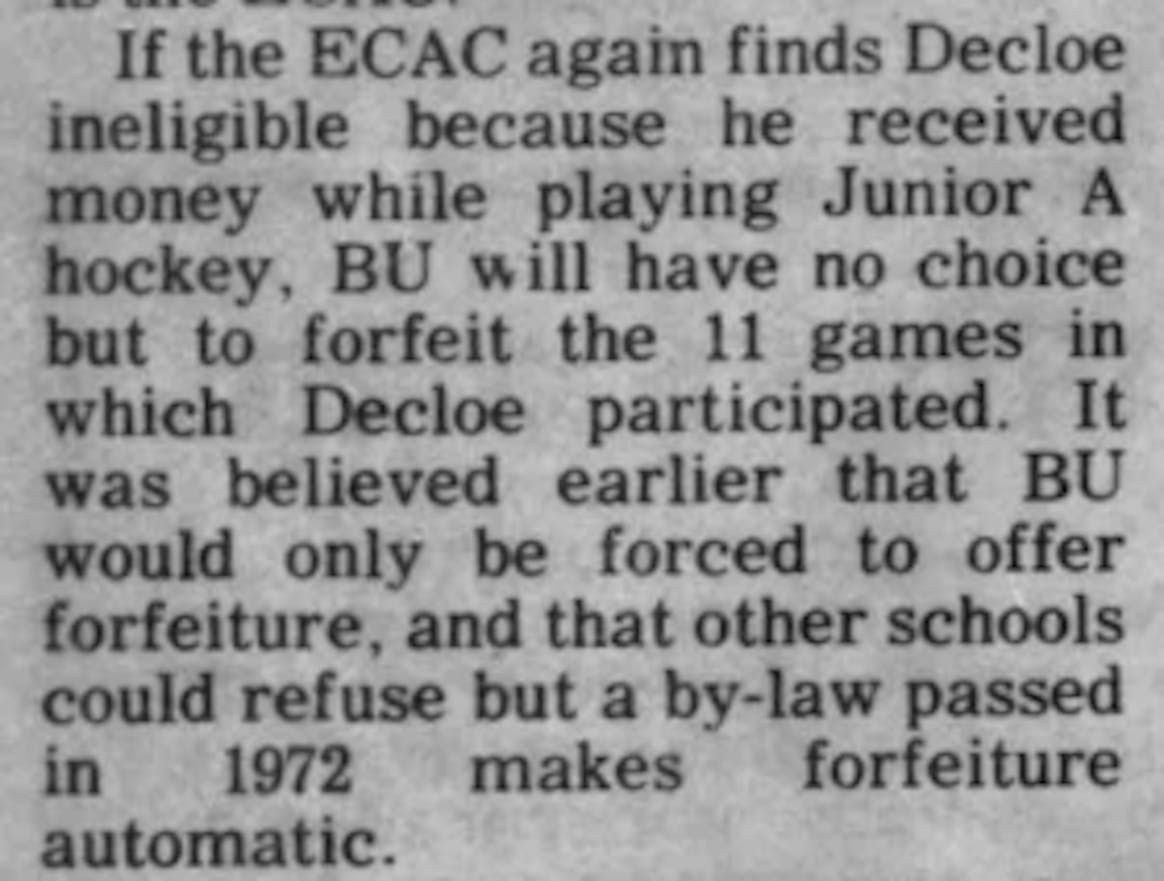
Within a month’s time, BU’s record — which was, at the time, 11-2-0 — was scrubbed down to a dreary 0-13-0. The verdict: Decloe was ineligible, and therefore BU must forfeit all games Decloe skated in.
Hence the 9-0 Cornell win.
Decloe’s case was multifaceted — before his time at BU, Decloe played Junior A hockey for the London Knights of the Ontario Hockey League. NCAA amateurism rules prohibited any player receiving compensation for playing from gaining collegiate eligibility, and that is exactly what had happened to Decloe — without him even knowing.
The Knights had paid Decloe’s high school a non-resident tax of $189.33, none of which ever made it back to the player himself. But the eligibility rule, established by the NCAA in 1972, gave Cornell its pleading case.
The Red knew what it was like to have a player ruled ineligible — a player on its 1971-1972 freshman team, Peter Titanic, was barred from playing a season prior due to previous status as a Junior A player.
“If Decloe was eligible to play last season and for several games this season,” Anderson said, “why wasn't Titanic?”
The rumored reason for Cornell’s punctuality with its complaint, however, is what fuels the feud to this day. Decloe, as a matter of fact, was recruited heavily by Cornell. Had he committed to the Red, Anderson could have turned a blind eye to potential NCAA rules violations. But with Decloe snuffing Cornell for its biggest rival, coupled with an embarrassing loss at home, the Red robbed BU big time.
“The bad blood between BU and Cornell just went to a whole different level,” Corbett said. “To a real point of hatred.”
“There's a lot of built-up angst. It just makes it meaningful. It trickles down,” Jones said. “Our guys are fully aware that over the years, there's been something there.
“And that they knocked us out of the tournament last year.”
Red Hot Reignition
Much like the origins of the Cornell-BU rivalry, there has been no shortage of high-stakes games between the two squads in the 21st century.
“Red Hot Hockey” was conceived in 2007, and the two teams have met biennially at Madison Square Garden in New York City ever since. All but three of the 10 meetings have been decided by just one goal.
But it goes even further than that — the two rivals rarely meet in the regular season anymore, ever since Boston University left the ECAC for Hockey East in the 1980s. That doesn’t mean they don’t meet away from Madison Square Garden.
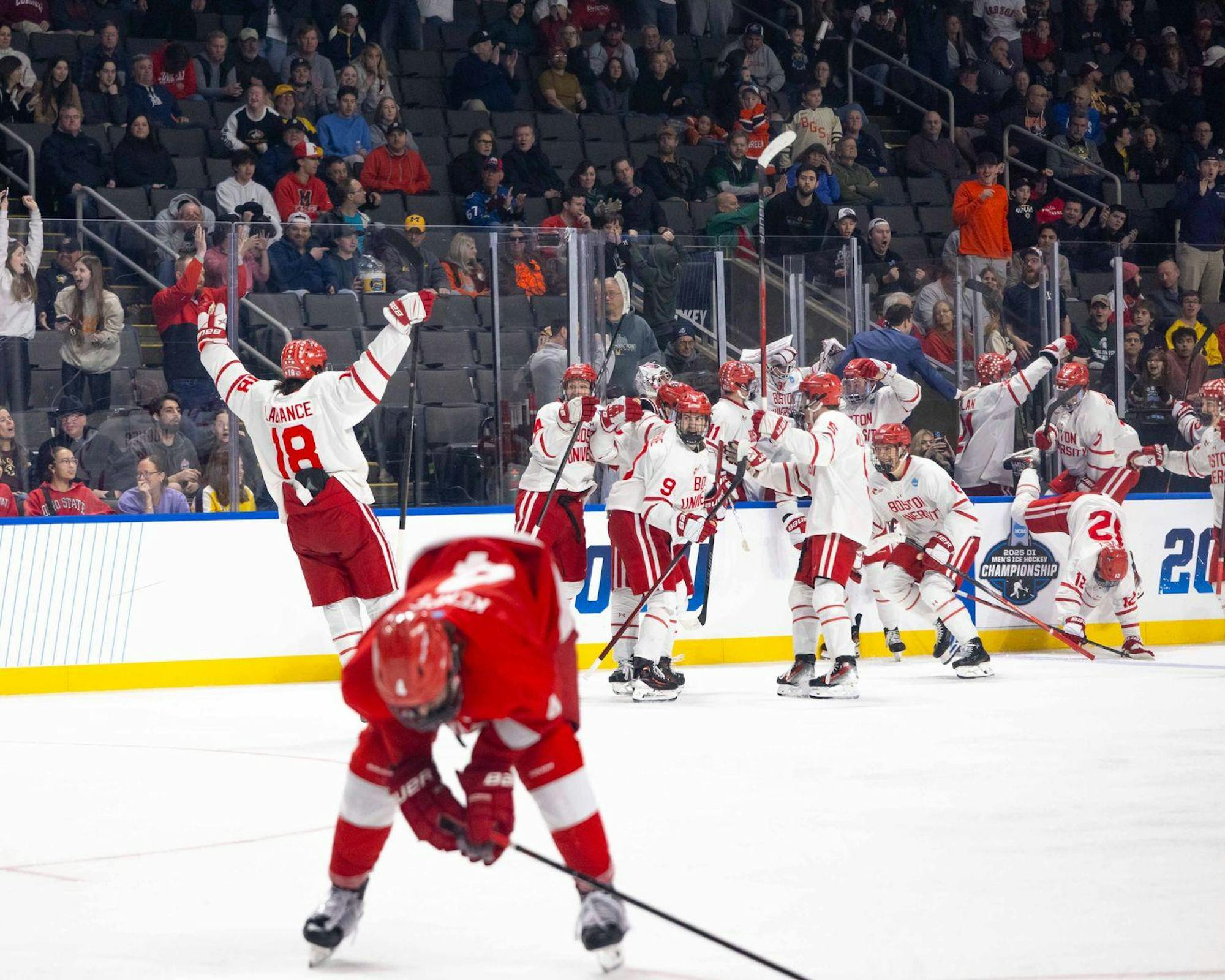
Cornell and BU have met three times in the NCAA Tournament since 2018, including twice in the last three seasons. In all three, the Terriers have emerged victorious.
“They're always there at the end of the year. We expect them there at the end of the year,” Jones said.
In 2018, the stage was Worcester, Massachusetts, in the NCAA regional semifinal. Cornell scored first, but three unanswered goals by BU — including the equalizer just 36 seconds after the Red’s opening tally — capped the 3-1 victory for the Terriers, which ultimately fell two days later in the regional final.
Then, in 2023, it was Manchester, New Hampshire — NCAA regional final. Cornell was nearly shut out by BU — a goal by Dalton Bancroft ’26 late in the third period halved the lead — but the Terriers held on for a Frozen Four berth in Jay Pandolfo’s first season at the helm.
Two years later, 60 minutes was not enough time to settle the NCAA regional final in Toledo, Ohio. Cornell equalized the game, 2-2, late in the third, but an overtime hail-mary shot ended the Red’s season short of a Frozen Four for the third year in a row.
Two of those three? Losses to BU.
“It just hurts,” said former head coach Mike Schafer ’86 postgame, after he saw his coaching career end on March 29, 2025.
In the same way the early years of BU and Cornell brewed bad blood, the games of the 21st century have done just that and more, rekindling one of the most historic rivalries in all of college hockey.
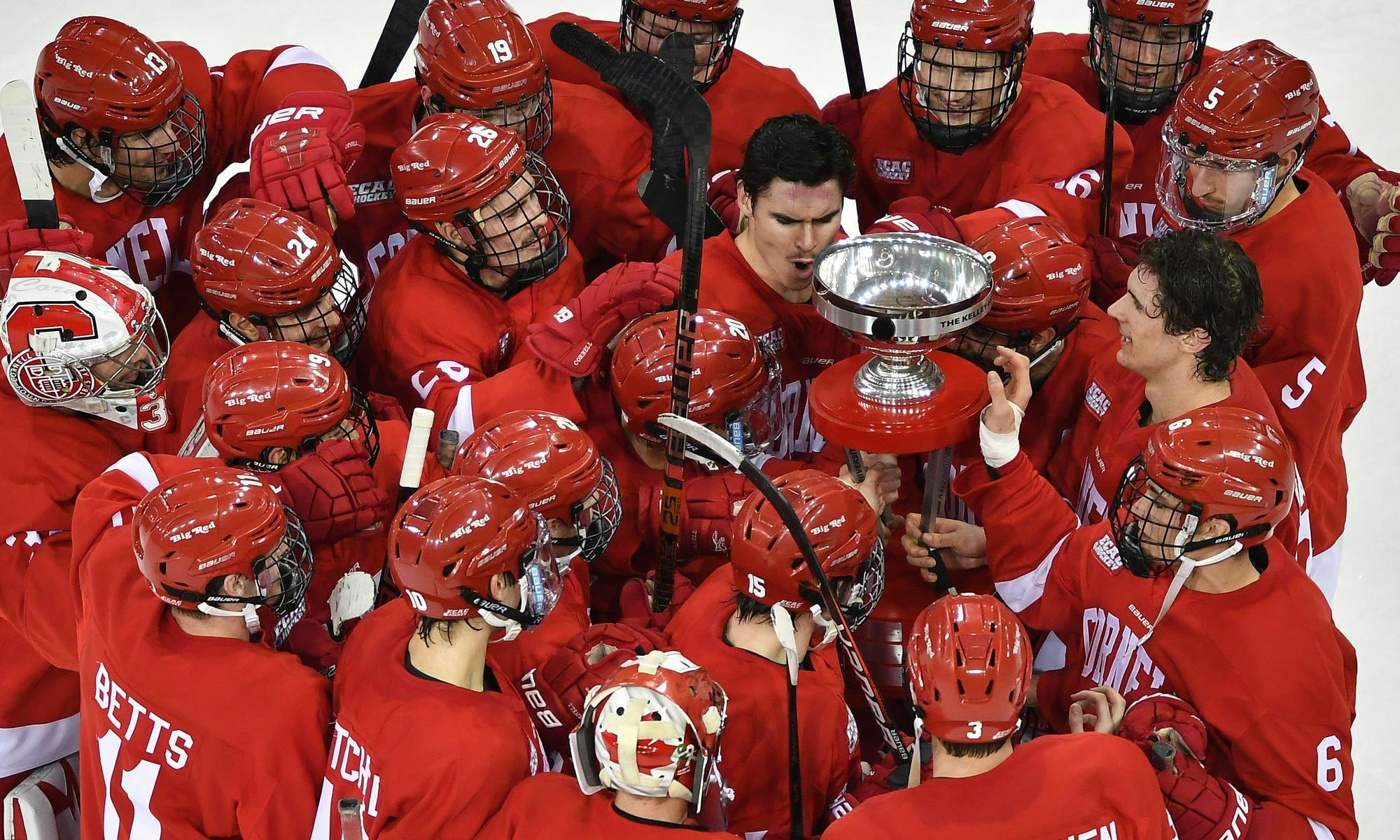
And on Saturday, the two teams will have the opportunity to play for a trophy — the Kelley-Harkness Cup, named after the two legendary coaches, and introduced to the rivalry in 2013.
Though both of those coaches have since passed, there’s still a question to be answered: who is the best Eastern team in college hockey?
It might not be Cornell or BU, this year. But the Red has held the trophy since its 2023 win, and has no intentions of surrendering it to its longtime foes.
“You look through all the years, it's the legacy, right? You come to these programs for the tradition,” Jones said. “These coaches … that's what makes these programs special, and these nights special: you're celebrating some of the history of the programs.
“And, you know, trophies up or grabs. So you only have a certain number of times in the season to win one, right? Something’s on the line. It's fun to play for that.”
Jane McNally is a senior editor on the 143rd editorial board and was the sports editor on the 142nd editorial board. She is a member of the Class of 2026 in the College of Agriculture and Life Sciences. You can follow her on X @JaneMcNally_ and reach her at jmcnally@cornellsun.com.