I’ve always found that one of the quietest and sharpest ironies of campus life is how confidently we treat exhaustion as evidence of achievement. You hear it everywhere at this point in the semester — the late-night chatter about all-nighters, the implicit competition over who has slept the least, the casual way we turn near-burnout into proof of our commitment. Fatigue becomes our most trusted currency, the clearest sign that we are truly trying. And yet, as Thanksgiving break approaches, I want to offer a different path — an observation I wish someone had given me years ago: rest is not a luxury or a sign of weakness. It is a form of study itself.
I don’t mean this metaphorically. The science is stark. Only about 11 percent of American college students sleep well, and 40 percent feel well-rested only two days per week. In other words, most of us are running on a collective deficit. That is not a moral failing; it is a culture — one of achievement defined by depletion, of peer pressure so subtle we barely register its weight. And academia — competitive, selective, relentlessly self-justifying — does not help. Many students (and faculty) believe, more or less quietly, that having made it here means constantly proving they deserve to stay.
Just the other day, a student told me, half-joking, that rest felt like cheating. They said they’d sleep once finals were over, once applications were done, once life was less chaotic. I understand the impulse. I’ve spent enough years in college and academia to know that the pressure to be constantly productive never disappears. It simply changes shape.
And yet — and this is the part I learned much later than I should have — slowing down is itself a skill. (Also, I am simply getting more tired as I age, which turns out to be an unexpectedly persuasive teacher.) But truly: slowing down can be learned. We should perhaps teach it just as deliberately as thesis statements or analytical methods. Rest is not absence but preparation. It’s the quiet work of allowing new knowledge to take root.
The data is unequivocal. A major study using wearable tracking found that better sleep quality, longer duration, and greater consistency were strongly associated with higher academic performance — and sleep measures accounted for nearly 25 percent of the variance in students’ grades. And it wasn’t just the night before a test that mattered. It was the pattern long beforehand — the accumulated rhythm of rest. In short: sleep habits, not cramming, make a measurable difference.
Neuroscientists go even further. Sleep isn’t passive downtime; it is active cognitive work. Research shows that sleep plays a critical role in the formation and storage of long-term memories, and growing evidence suggests that the brain literally replays the day’s learning during sleep — like a craftsman smoothing the edges of fresh timber.
In other words, we learn best not while we are frantically consuming information, but after — when we pause, when we sleep, when we walk, when we look out the window with no particular purpose. What feels like “doing nothing” is often the moment when learning finally settles into coherence.
The upcoming Thanksgiving break is the perfect moment to practice that discipline of rest. Not because it’s a “real” break — breaks never are; life and obligations follow us home — but because it invites us to notice the world moving at a different pace. To step outside the daily rhythm and remember that the mind, like the body, cannot run on adrenaline (and caffeine) alone.
I say this as someone who had to learn this lesson the hard way. I am a lifelong night owl. In college, I wrote my best essays in the quiet hours, sitting beneath the glow of a 19th-century Haussmann streetlamp outside my window in Paris — a soft amber light that makes the whole boulevard feel as if it’s humming. Back then, I also mistook late nights for depth, and fatigue for (true) dedication.
Nowadays, after finishing lecture notes, writing, and grading, I find myself in the kitchen washing dishes long after I should be asleep. And in those small, unremarkable moments — hands in warm water, apartment quiet, the day finally loosening its grip — something shifts. Thoughts settle; threads reconnect. Sometimes an idea that eluded me for hours or even days becomes clear. Not because I pushed harder, but because I stopped pushing at all. Rest is not the opposite of effort.
Rest is the space that makes effort meaningful.
So, as you head into the break, I hope you give yourself permission to slow down — not as surrender, but as part of the work. Let your mind breathe. Let your body breathe. The hardest part of learning is rarely the content itself. More often, it’s allowing ourselves the quiet in which learning can unfold. I’m wishing you a restorative break — one that reminds you that rest, too, is part of the basics.
The Cornell Daily Sun is interested in publishing a broad and diverse set of content from the Cornell and greater Ithaca community. We want to hear what you have to say about this topic or any of our pieces. Here are some guidelines on how to submit. And here’s our email: associate-editor@cornellsun.com.
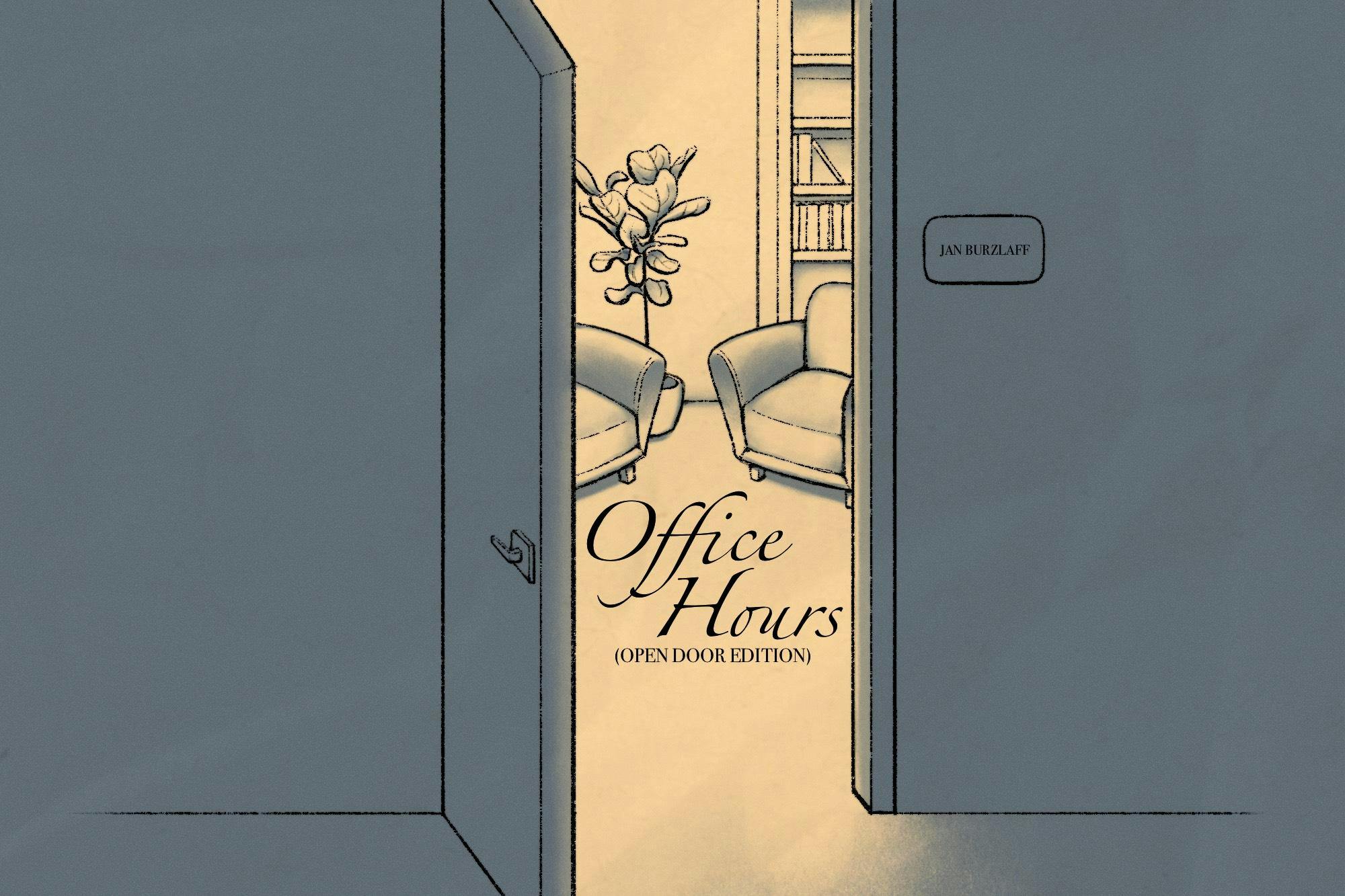
Jan Burzlaff is an Opinion Columnist and a Postdoctoral Associate in the Program for Jewish Studies. Office Hours (Open Door Edition) is his weekly dispatch to the Cornell community — an associate's reflections on teaching, learning and the small moments that make a campus feel human. Readers can submit thoughts and questions anonymously through the Tip Sheet here. He can also be reached at profjburzlaff@cornellsun.com.