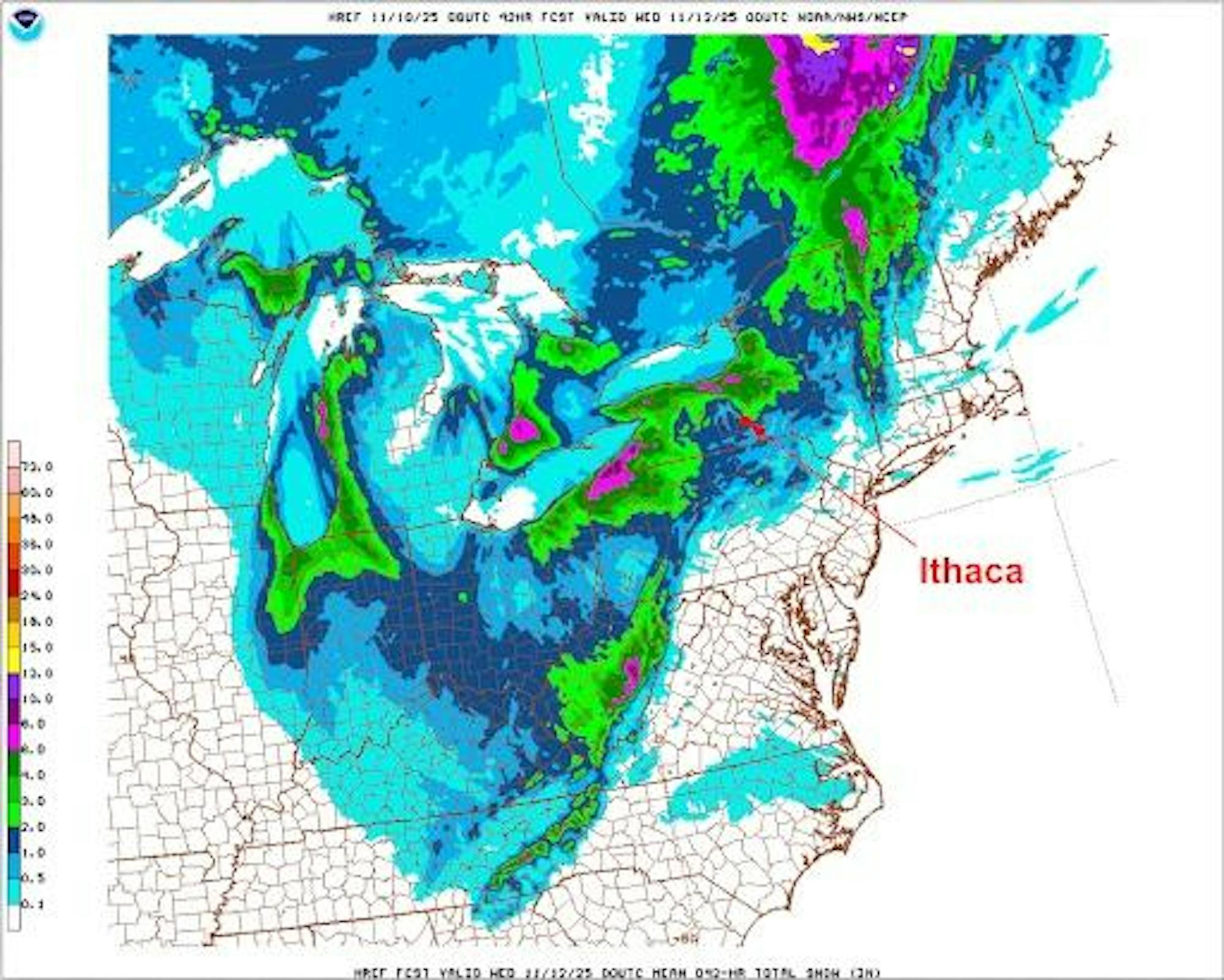
This morning, Ithaca woke up to its first snowfall of the year, a sight many of us surely can’t believe. You might be asking yourself: “Wait, if winter starts in six weeks, why are we seeing snow already?”
While the shock of freezing temperatures and wind-whipped snow may seem premature, this time of the year is normal for many towns in Upstate New York to experience a first snowfall. Ithaca saw its first snow showers on Nov. 21 in 2024, and although 2025 is almost two weeks earlier, it aligns with the historical average of Nov. 25 as the first day of measurable snowfall.
With that in mind, the Cornell community should brace for another two days of winter-like weather. On Monday night, temperatures will plummet to as low as 24 degrees Fahrenheit, and winds from the west at eight to 10 mph will certainly make it feel colder. While snow accumulation is expected to be less than half an inch this evening, Tuesday will bring a mix of snow and rain showers throughout the day as temperatures hover around the upper 30s. A moderate breeze with winds from the west at 10 to 21 mph, with gusts up to 32 mph, will contribute a wind chill that makes layers a must for everyone. Heading into the remainder of the week, snow showers will taper off after Wednesday as temperatures climb above freezing, but expect soggy conditions to linger until the weekend.
This plunge into winter weather is brief, but nonetheless, it is important to be smart and prepared when heading outdoors. Walkways and roads may potentially be slick, and with temperatures dipping to near or below freezing, remaining snow may freeze into ice overnight and present additional hazards to those commuting around campus.
Students, faculty and staff should layer appropriately, prioritizing a wind-resistant outer shell over insulating layers. A warm hat and effective gloves are helpful for blocking the wind's chilling effect, as is wearing a jacket with a hood to shield your face from wind-blown snow. For those using public transportation, buses will likely be full most of the time from people wanting to avoid the snow, and schedules may experience minor delays. Allow extra travel time for bus rides, and if walking, choose well-maintained and clear walkways, even if it adds a few minutes to your route.
The first day of measurable snowfall is the first time snow accumulation reaches 0.1 inches or more, also known as measurable snow. Most regions in the Northeast experience a few instances of flurries, or light snow that falls and immediately melts on contact with the ground. Since these events produce extremely little to no snow accumulation on the ground, they do not count as the date of first measurable snowfall.
But now, a powerful low-pressure system tracking eastward has pulled a surge of cold air directly from Eastern Canada across the Great Lakes. As this frigid mass encounters residual moisture over the Great Lakes, the precipitation cascades into snow, a textbook example of how Ithaca transitions from autumn to winter.
For those accustomed to milder climates, the rapid shift in Ithaca weather can seem jarring. However, the climate here, especially this time of year, is heavily influenced by proximity to the Great Lakes and far distance from the Catskill and Adirondack Mountains.
Across the U.S., cold weather patterns typically originate in Canada and sweep across the continent from west to east due to prevailing winds. These low-pressure weather systems drop the required cold air, but the crucial ingredient for heavy snow often comes from our immediate proximity to Lake Ontario. When a low-pressure system flows over the still-warm lake waters, it initiates Lake Effect Snow.
While today’s event is a moderate large-scale snow event, the groundwork is being laid for more intense snowstorms later in the season as lake temperatures remain high. Ithaca’s far distance from nearby mountains also helps with making its climate more variable than a place like Denver, where it’s dry during the winter.
While this initial system is textbook November for Ithaca, the remainder of the fall will be set by the ongoing battle between cold air from Canada and Great Lakes moisture. As the Great Lakes continue to moderate Ithaca’s climate, frequent, intense snow events will become more regular as we head into the rest of the fall semester. Expect fluctuations: a few days of slightly warmer, drier weather, only to be followed by the next strong cold front pushing down from the north. This pattern of climatological variability defines the classic winter weather at Cornell we all know and love.