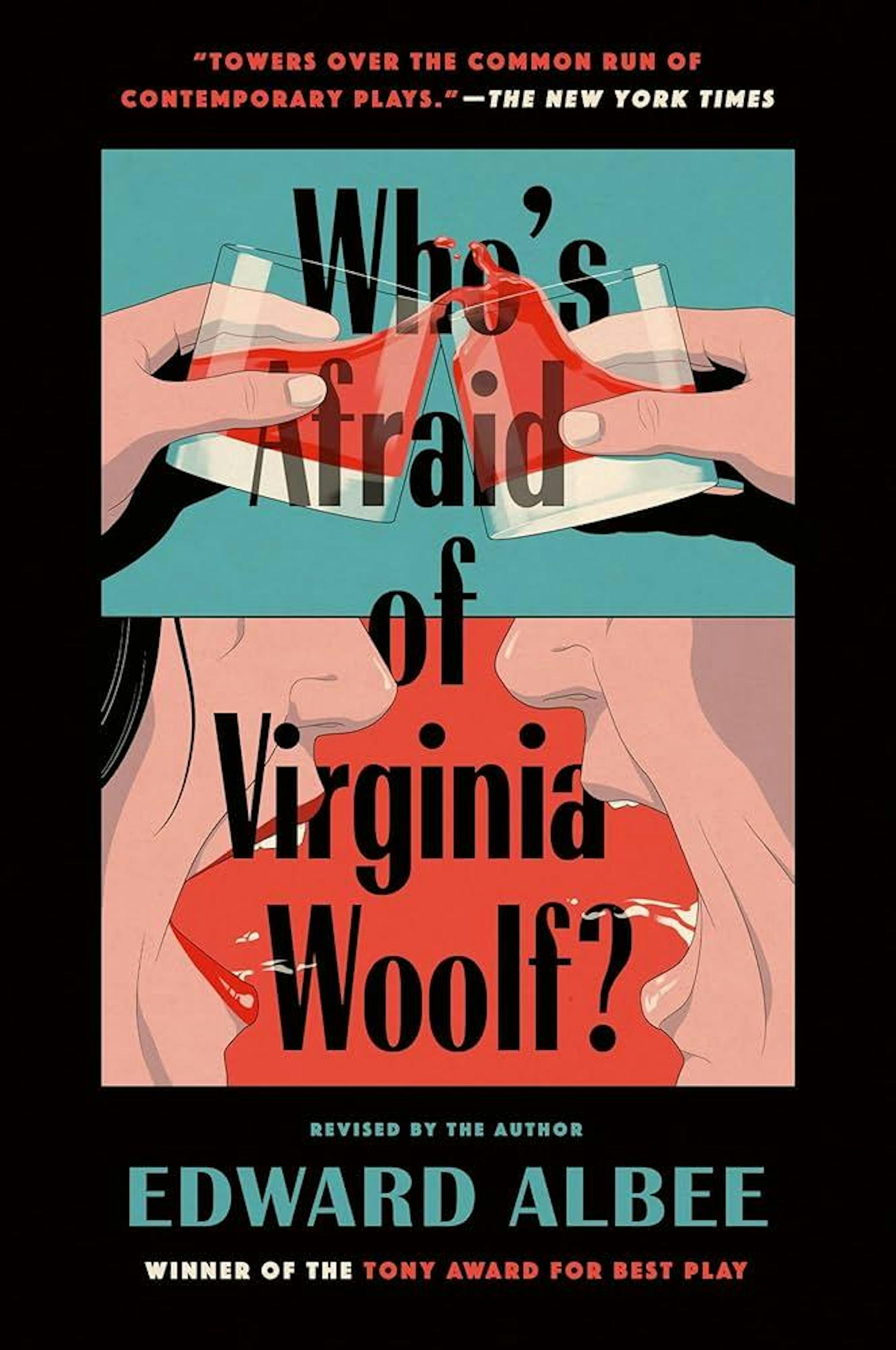
To what extent do we create euphemistic narratives to escape our inner dissonance? How far will our minds stretch to contrive a self-image that doesn’t make us cringe? “Who’s afraid of the big bad wolf? … Who’s afraid of living life without false illusions?” asks Edward Albee. Cog Dog’s production of Who’s Afraid of Virginia Woolf? premiered Nov. 22 in a converted Cornell Cinema for its one and only showing, digging into the grist of these themes.
Originally published in 1962, Albee’s (long) three-act play is a canonical landmark in the history of American theater. In it, George, a cynical sharp-witted history professor, engages in psychological warfare with his wife Martha, the daughter of the president of the college. As the middle-aged couple entertains the new arrival to the biology department, Nick, and his wife Honey at their house over a long night, their marriage is strained (to put it lightly). Over the course of the play, the initial seed of discontent snowballs into revulsion and insanity as past sins are dragged out, couples cheat and the illusions they live under are killed.
I appreciated the faithfulness of the production to the source material. Each actor embodied their archetype in a way that felt drawn upon prior interpretations, yet possessed of its own life and vigor. I talked to the cast and crew stationed in a conference-style room in Willard Straight Hall during a rehearsal break.
On portraying George, Aaditya Bahl ’27 explained that the core he gripped onto was his “playfulness.” At various points, to the effect of many laughs, he laid back on the couch kicking his foot at Nick to the rhythm of his speech or popped behind him facing the audience to bray in his ear, cultivating the gestures of the condescending academic in inventive ways not necessarily found in the script. Josh Martin ’26 landed his performance of Nick as a squarely polite, staunch kind of man, at times a few steps behind Martha and George. And although she had the fewest lines, Lucy Jones’ ’26 performance portraying Honey might’ve packed the biggest punch per pound. “I read the character description; it said dumb, ugly. … I thought it was hilarious. … I loved playing it.” Adopting a similar midwestern accent to Sandy Dennis, her desperate, bubbly positivity was so hopelessly incongruous to the biting jabs being dealt by George and company that it felt like every line got a laugh.
The greatest illusion in the play is that of “the son,” and it’s probably the most interesting mystery as well. After Martha “breaks a rule” by mentioning him, he surfaces intermittently in reference, until at the end George declares he has “killed him;” and that he couldn’t have really existed at all to begin with. Caroline Murphy ’28, who plays Martha, expanded, “this shared delusion is the only way we’re able to tolerate each other,” and Bahl, “There’s this trope of you stay in the marriage for the child. So when the son dies, it’s like the marriage is dead.” As an allegory (George and Martha like George and Martha Washington), one interpretation of the son is that of the American dream, a clinging-to of the good moments in a marriage and a hope. The son — “blonde-haired and blue-eyed,” — is picket fences, the nuclear family and home cooked meals; this fugazi ’50s American idyll. It’s the death of a kind of blind, simple, hearty optimism in the turnover from one generation to the next, entering the modern age. While Murphy lay supine on the floor, seeped in nostalgia as she described him, all of this subtext came out through her fragile voice.
The production also encountered difficulties, as you may discern from its location. Risley Theater has been shut down from hosting the student productions it normally would. This has been a challenge for student productions this semester as they struggled to find a venue. David Gilmour, stage manager, elucidated that thankfully they were able to book Cornell Cinema on 25live and were grateful for the help moving furniture and props into the space by staff. The set design — bookshelves packed with antiques, a Cleopatra easter egg vinyl record and bohemian-esque furniture — brought the audience into the world. Yet it is regrettable that the University and PMA department weren’t able to accommodate the displacement more effectively, relegating the production to only one public performance.
Cog Dog’s troupe, headed here by Kaelyn Sandifer ’26 and Jillian Walker ’27, successfully dug into everything that makes this play a classic, bringing out its substance with nuance. Its themes of disillusionment with utopic America feel as resonant as ever.
Tommy Welch is a senior in the College of Arts and Sciences. He can be reached at tsw62@cornell.edu.
Tommy Welch is a member of the Class of 2026 in the College of Arts and Sciences. He is a staff writer for the Arts & Culture department and can be reached at twelch@cornellsun.com.