

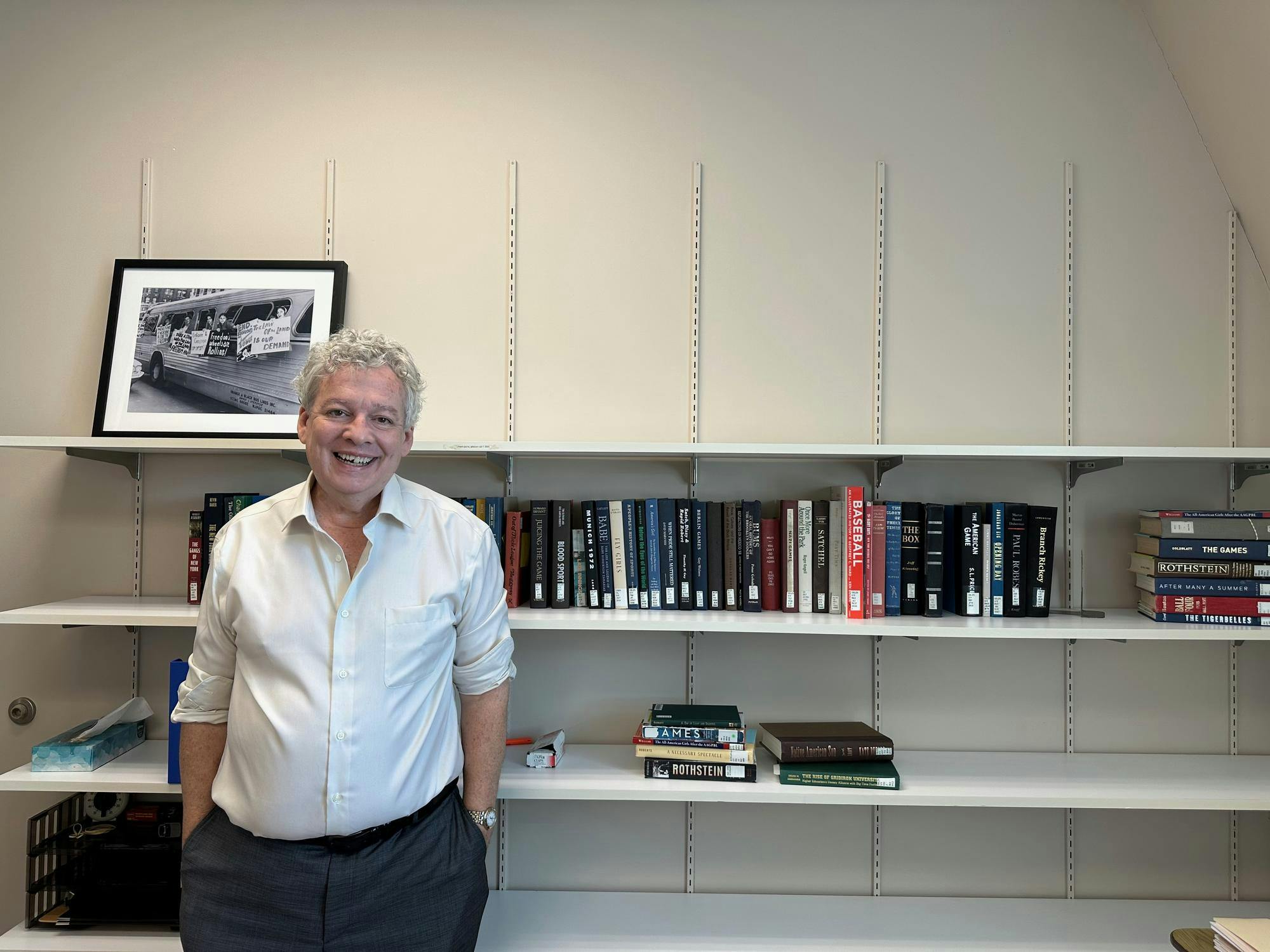
From a young age, Kevin Baker, visiting professor in American studies, had an innate interest in sports, history and writing — he described his bedroom floor as scattered with baseball cards, paperback history books that his mother would bring home from the grocery store and an ever-growing pile of novels and historical nonfiction.
“I’m a writer and I have been a writer pretty much my whole life,” Baker said. “I have always had a nerdy interest in statistics from my baseball card collection and of course a deep appreciation of history.”
Baker has transformed those childhood pastimes into a career as a historian, novelist and now visiting professor at Cornell. His writing explores how sports and politics reflect the identity of the United States.
From Newsrooms to Writing Novels
Baker was born in New Jersey and raised in Massachusetts. He was obsessed with history and sports when he was five years old and recalls memorizing baseball and historical statistics. At just 13 years old, he got his start to his writing career as a sports reporter for the Gloucester Daily Times, where he earned $10 per article and learned how to write “cohesive” stories using different writing techniques.
“The experience of being in a newsroom was fun and interesting,” Baker said. “My mother had to teach me to type on a Smith Corona portable typewriter in order for me to keep the job so that was my first real writing gig.”
When deciding where to pursue his college education, Baker explained that he had always wanted to study in New York City because of the "historical significance” and “culture” that the city had to offer. He started at Columbia in 1976 where he was a political science major and continued to be a sports reporter for the Columbia Spectator.
“While studying at Columbia, I set this goal for myself to write at least five pages a day,” Baker said. “Now while I didn’t get much out of that exercise I enjoyed being in the city and being immersed in the culture and sports was an experience that is paying off to this day.”
After college, Baker pursued an array of writing jobs including freelancing for newspapers and writing letters for the New York City mayoral office. In the background, Baker was exploring his true passion, novel writing.
“I told myself that if I had not sold any fiction by the time I was 30, I would give it up and go to law school,” Baker said. “And 30 came, and I didn't go to law school, but I finally published my first novel when I was 33.”
His debut novel, Sometimes You See It Coming, was published in 1993 and is loosely based on the life of Ty Cobb, a Major League Baseball player who spent 24 seasons as a center fielder. In the novel, the main character, John Barr, is a baseball star for the New York Mets as it explores the darker side of fame and competition in America’s pastime.
“The first novel I wrote was special to me but there was definitely a learning experience,” Baker said. “You learn more and more what good writing is, which makes it harder as you go on.”
Teaching and Writing Sports, Politics and History
Baker also wrote a trilogy of novels known as the City of Fire series, which includes Dreamland, Paradise Alley, and Strivers Row. Dreamland is set in Coney Island and New York City in 1910, exploring the lives and struggles of Jewish immigrants. Paradise Alley delves into the American Civil War and the Irish immigrant experience in New York, while Strivers Row takes place in Harlem during the 1930s and 1940s, capturing the spirit of the Great Migration and the Black American experience.
“So that trilogy of books is about three groups that were not really wanted in America, say, in the most silent and subservient positions, yet who, in the end, ended up giving us so much of our culture,” Baker said. “I could have written [about] the Chinese, Norwegian or Arabs, really any group of people but the message overall is that New York City is made up of so many different groups that contribute to the way the city is today in ways we didn’t and probably still don’t appreciate.”
On top of the fictional novels, Baker also writes historical nonfiction books. Most recently, he published The New York Game: Baseball and the Rise of a New City, a sweeping account of the city’s teams and the role baseball has played in its identity in March 2024. It was reviewed by The New York Times who hope for “a second volume … every bit as good as this one.” Baker told The Sun he plans to release the next volume in spring 2027.
His historical novel The Big Crowd tells the story of Bill O’Dwyer — the real-life New York district attorney who sent a mob boss to the electric chair before becoming the city’s mayor with the endorsement of President Franklin D. Roosevelt. O’Dwyer’s rise and fall, and his eventual appointment as U.S. ambassador to Mexico, mirror Baker’s fascination with the complex intersection of politics, power, and morality in American life.
Baker was also selected to deliver the 2025 Seymour Lecture in Sports History, “More and More is Less and Less: How Our Games Got Away from Us, and What We Can Do to Get Them Back” at 5 p.m. on Nov. 19 in Goldwin Smith Hall, Room 132.
Now, Baker is teaching a 30 person course at Cornell, HIST 1585: Sports and Politics in American History. He told The Sun that this is his first time teaching a class.
“It has been really interesting so far,” Baker said. “So it's an education for me, too, which I hope is the case in anything you do. This is my first time teaching a class as a professor, so far I have enjoyed interacting with the students and I try my best to engage them.”
The class, Baker says, dives into issues like gambling, college athletics and the economics of professional sports. Additionally, students study historical events and examine how sports have been politicalized.
“I'm just really trying to get the students to understand where sports came from, how they evolve, eventually, we get into what they are today and what they could be in the future," Baker said.
In 2017, he was awarded a Guggenheim Fellowship, a $30,000 to $45,000 grant given to “individuals in pursuit of scholarship in any field of knowledge and creation in any art form, under the freest possible conditions,” according to the Guggenheim Fellowship website.
Baker told The Sun he is using the grant to write a book about the United States between the world wars — an era he dubbed “the lost America.” Baker stated that there are many parallels between this period and the “great idyllic America” that President Donald Trump campaigned on.
“This time period and what was idolized [at the time] is at the heart of Trump fascism,” Baker said. “There are many parallels between then and what Trump is pushing for now.”
Baker described his collaborations with other authors and groups including his work with Ken Burns on The U.S. and the Holocaust documentary, which became an acclaimed PBS series. The documentary explores the actions of the United States during the Holocaust.
“It was an honor working with Burns, Lynn [Novick] and Sarah [Botstein],” Baker said.
“Part of any writing is to entertain,” Baker said. “I try and would like to do that in all my work. “I’ve really been very fortunate to get to work with terrific people and to be offered great opportunities.”
Now both a writer and educator, Baker sees his work as a lifelong conversation between history, storytelling, and sports.
“I have been honored to work with so many folks in this profession and being able to teach and try to engage students at Cornell has been an interesting experience,” Baker said. “I hope that they can take away the importance of learning and understanding history coupled with an appreciation of sports.”
Zeinab Faraj is a member of the Class of 2028 in the College of Arts and Sciences. She is a senior editor for the 144th Editorial Board. She was a features editor and an assistant sports editor on the 143rd Editorial Board and can be reached at zfaraj@cornellsun.com.


