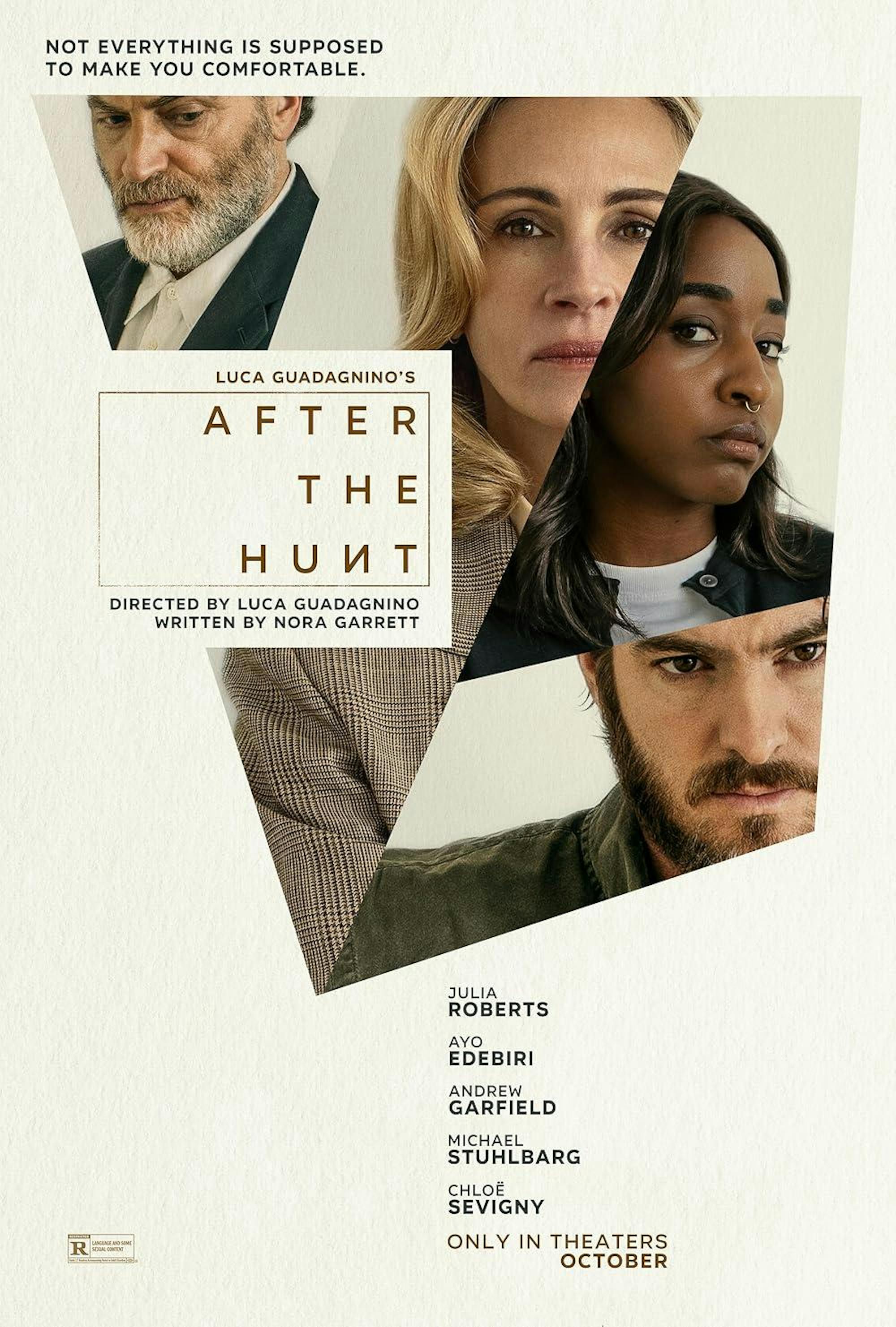
2025 has been no stranger to films attempting to capture our unique cultural moment. Luca Guadagnino’s After the Hunt is just as divisive as predecessors like this summer’s Eddington, but, while screenwriter Nora Garrett’s first screenplay is a little messy, Guadagnino’s directing elevates this film into something worth seeing.
After the Hunt follows Julia Roberts as Alma Imhoff, a sharp, calculating philosophy professor about to earn tenure. Her focus on her work and proving herself in a male-dominated field is absolute, sacrificing her relationship with her husband, Frederik (Michael Stuhlbarg), and her own health in the quest to publish her next paper. She is equally dedicated to the success of her mentee and PhD student Maggie (Ayo Edebiri), whose dedication to and obsession with Alma inflates the latter’s ego.
This comfortable dynamic goes awry when Maggie comes to Alma with an accusation against Alma’s closest colleague, Hank Gibson (Andrew Garfield). Alma is torn between her trust in Hank, with whom she shares a romantic connection, and her responsibility as Maggie’s mentor and advisor. What follows is a tense unraveling of Alma’s perfect world, thrusting her out of the pleasant life she’s built and into something incredibly knotted and messy.
Admittedly, I love the “dark academia” aesthetic. I was drawn in by Guadagnino’s shots of a Gothic campus, perfectly dusted with snow and Alma and Frederik’s sprawling New Haven apartment. Like Maggie, I was seduced by the perfect picture of an autumnal Ivy League campus — only for the illusion to drop, leaving me cold. Guadagnino’s opening sequence draws you into a comfortable, familiar world, backed by the sound of a ticking clock. As we witness one normal day in Alma’s life, the clock tells us that everything is about to blow, creating a thick tension that doesn’t let up until the credits roll.
What makes After the Hunt work is its ambiguity. Characters debate whether Maggie’s story is true or false, but the filmmakers leave this central question unanswered. I was reminded of 2023’s Anatomy of a Fall, which similarly left its protagonist’s guilt up to interpretation — to the extent that director Justine Triet refused to tell her lead actress what she thought. This means that the audience is never allowed to get comfortable. Even as they get to know the protagonist and sympathize with her, there’s always a sense of tension. Viewers are forced to wonder whether the character they’ve gotten to know would really murder her husband, and are left with this discomfort long after the film concludes.
Likewise, After the Hunt lends itself to multiple interpretations. Maggie’s character is just as complex and twisty as the rest of the film. The daughter of rich Yale alumni, her lack of passion for the field hints that her study of philosophy is somewhat arbitrary. She is hesitant to answer questions about her work and is accused, by Hank, of plagiarising her dissertation. What drives Maggie forward is not a love for her studies, but for Alma, an obsession that falls in a gray space between wanting to be with her professor and wanting to be her. It is not an intellectual admiration, but a deeply personal one. Did Maggie make up her story to bring Alma closer? To knock out Alma’s competition for tenure? To get ahead of Hank’s plagiarism allegations? Or did Hank, who Garfield plays as unaware, or perhaps unwilling to acknowledge, the power he holds, cross the line? You can read After the Hunt a hundred different ways, which is exactly what the film wants.
Multiple things can be true at once. By the end of the film, Alma realizes that whether Hank assaulted Maggie or not, his attitude has been coddled far too long. Here, After the Hunt unpacks something so incredibly timely that I have seen disappointingly little discussion of since the film’s release. Throughout the movie, Alma has clearly cemented herself as “one of the boys.” A self-proclaimed feminist, yes, but willing to let Hank’s sly, misogynistic comments go with a laugh. Hank is disheveled and perfectly aloof, creating the facade of an intelligent man who doesn’t really need to try to succeed. Once Maggie makes her accusation, it’s like a switch flips. Joking, charming Hank begins to use his physical stature to his advantage: in one scene, the camera stays at Alma’s eye level as Hank confronts her, his body completely taking over the frame. The effect is discomfiting, as Hank impedes both Alma’s, and the audience’s, personal space. As Hank becomes more and more unhinged, it dawns on Alma that the colleague she enjoyed playful, flirtatious banter with might really be capable of assault. Alma is forced to grapple with her complacency: she might have been able to brush the academy’s misogyny off, but her refusal to fight back directly harms the students she signed up to mentor and protect. After the Hunt is about “cancel culture,” yes, but it’s also digging deeper into our cultural climate and the discomfort older generations feel when younger generations advocate for a better world. Alma can’t understand why Maggie would risk a career in academia for the sake of telling her story and making sure Hank doesn’t get away with what he’s done. But Maggie doesn’t want a life as a career academic: she wants the personal support of her mentor, and can’t understand what is keeping Alma from offering the emotional reassurance she needs.
After the Hunt is a little messy in its commentary, but it’s also absolutely fascinating. I feel critics calling the film “shallow” are missing much of what Nora Garrett and Luca Guadagnino are trying to say. Guadagnino’s ability to look into a seemingly-perfect world and reveal all of its rough edges makes the film worth a watch, especially for students at a similarly competitive academic institution like Cornell. After the Hunt invites us to think about what we want, why we want it, and what we’re willing to sacrifice to get it.
Nicholas York is a junior in the School of Arts and Sciences. He can be reached at nay22@cornell.edu.
‘Projections’ is a column focused on reviewing recent film releases.
Nicholas York is a member of the Class of 2027 in the College of Arts and Sciences. He is a columnist for the Arts & Culture department and can be reached at nyork@cornellsun.com.